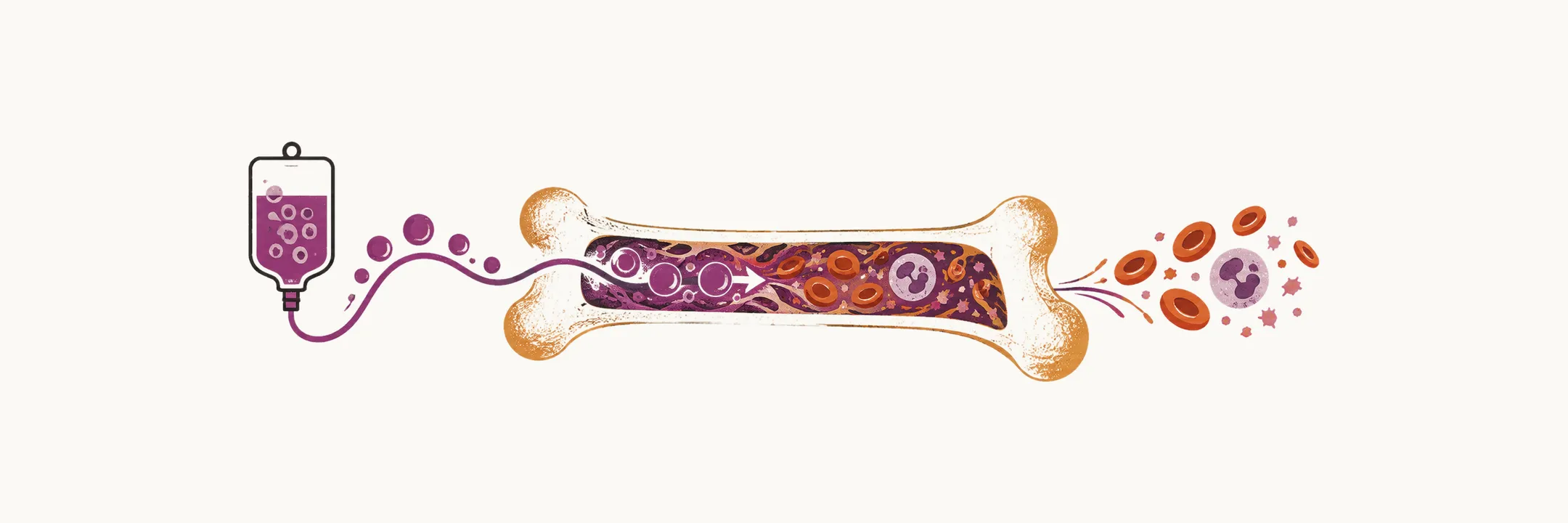
Hematopoietic stem cells (HSCs) are the multipotent stem cells that keep the blood cell population renewed.
What hematopoietic stem cell transplantation is
In several disorders, mainly hematological malignancies, hematopoietic stem cells themselves are the treatment. The patient’s bone marrow stem cells are replaced with a graft of HSCs given by infusion, after conditioning, a course of chemotherapy and sometimes radiotherapy, has prepared the body to accept it. This treatment is called hematopoietic stem cell transplantation, or HSCT. Whether the graft comes from the patient or from a donor changes how the cells are collected and which complications follow. A transplant therefore raises a sequence of questions: what the graft is, how the patient is prepared for it, how the cells are obtained from the patient or from a donor, and what can go wrong afterwards.
Where to start
Each of these questions has its own note. The graft itself, the hematopoietic stem cell, comes first, and the notes that follow take a transplant from preparation to its complications:
- Hematopoietic Stem Cells: Biology, Collection, Indications and Graft Types explains what hematopoietic stem cells are, where they are found and how they are collected, which disorders transplantation is used for, and the three types of graft defined by the donor.
- Conditioning Regimens Before HSCT: Myeloablative, Reduced-Intensity and Non-Myeloablative explains the chemotherapy and radiotherapy given before the graft, and why the intensity of the regimen is chosen to match the patient and the disease.
- Autologous HSCT: Steps, Determinants of Success, Mobilisation and Indications covers the transplant of the patient’s own cells: the two steps of the procedure, what determines its success, and the growth-factor mobilisation and apheresis used to collect the cells.
- Allogeneic HSCT: Donor Matching, Patient Selection and Graft Source covers the donor transplant: how donor and recipient are matched through the HLA genes, how the patient is selected, and the choice between peripheral blood, bone marrow and cord blood as the graft source.
- Immune Reactions After HSCT: Graft Rejection, Graft-Versus-Host Disease and Graft-Versus-Leukemia covers the conflict between host and graft: host-versus-graft rejection, acute and chronic graft-versus-host disease and its prevention, and the graft-versus-leukemia effect.
- Complications of HSCT: Timing, Infection and Endothelial Injury covers what follows the procedure: the three time-based categories of complications, the infections at each stage, and the endothelial damage behind the non-immune organ injury.