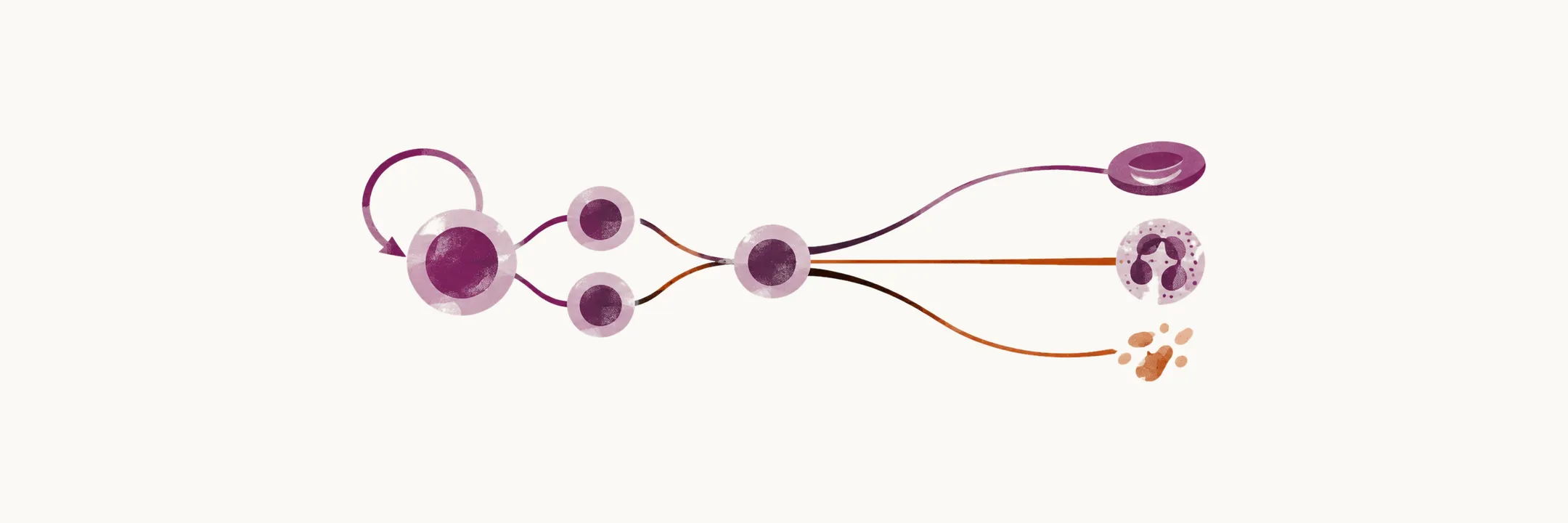
Hematopoietic stem cells are multipotent stem cells that keep the blood cell population renewed, and they are also the cells used as the graft in hematopoietic stem cell transplantation.
Why blood cells are produced continuously
Each type of blood cell has a finite lifespan, so the bone marrow has to replace them continuously. Red blood cells survive about 120 days, and platelets, the small cell fragments that help blood to clot, about 7-10 days; lymphoid cells are far more variable, with lifespans ranging from days to years depending on the subset. This turnover never stops: roughly 1.5 million new blood cells are produced every second.
What characterises a stem cell
Hematopoietic stem cells share the two defining properties of all stem cells. They proliferate and renew themselves, which keeps the pool from being used up, and they differentiate into highly specialised cells. Self-renewal is what lets a small number of cells sustain the marrow for a lifetime, and it is what allows a small graft to rebuild the whole blood system after transplantation.
How rare they are, and where they are found
About 0.01 to 0.1% of all the cells in the bone marrow are hematopoietic stem cells, or HSCs.
During fetal life, hematopoietic stem cells are found in the fetal cord blood, but during adult life they are found in the bone marrow. HSCs can be mobilised from the bone marrow to the peripheral blood so that they can be harvested.
Surface markers
Hematopoietic stem cells are identified by their surface markers: they express CD34 and lack CD38, written as CD34+ CD38-. These markers are what allow the harvested cells to be counted and selected, since a graft is collected and measured as a number of CD34+ cells.
Disorders treated with HSCT
The disorders for which HSCT is used fall into two broad groups. The largest is malignancy, and most of these are hematological: leukemia and the lymphoproliferative neoplasms, such as lymphoma. A few non-hematological malignancies are treated this way, chiefly neuroblastoma in children, and relapsed germ cell tumours are treated with high-dose therapy and autologous rescue, in which the patient’s own stored stem cells are given back after the high-dose treatment; breast cancer, once studied this way, is no longer a standard indication.
The second group is non-malignant disease of the blood and the immune system, both inherited and acquired, including aplastic anemia, thalassemia and sickle cell disease, and severe combined immunodeficiency (SCID).
The three types of graft
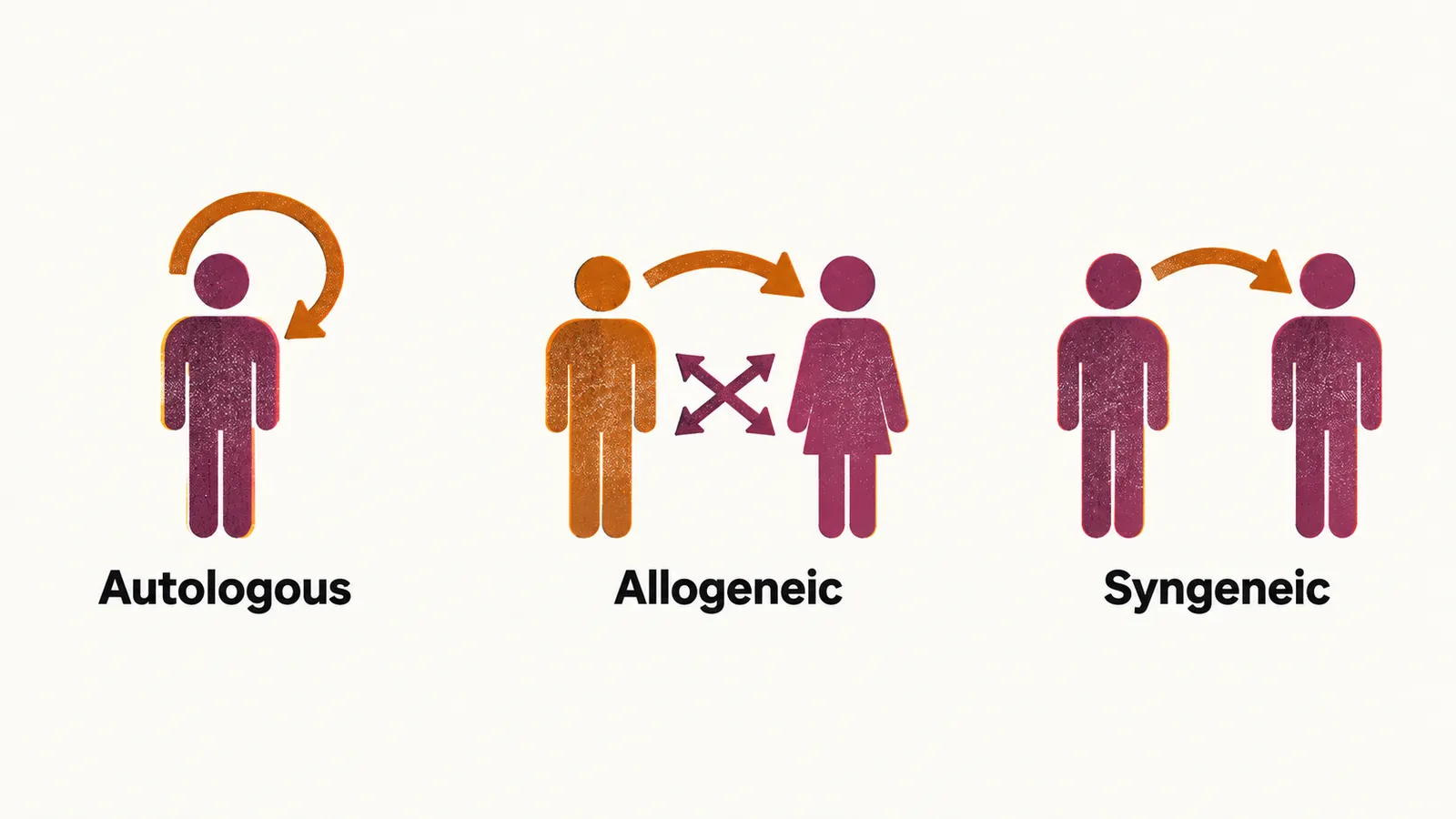
Once collected, the graft is classified by who the donor is, and that decides whether an immunological reaction occurs. There are three main types of HSCT:
- autologous HSCT, in which the recipient uses their own HSCs for the transplant, so there is no immunological reaction
- allogeneic HSCT, in which the recipient uses HSCs from a genetically different donor, so there is an immunological reaction
- syngeneic HSCT, in which the donor is a genetically identical monozygotic twin, and there are no immunological reactions
Whichever type is used, the patient must first be prepared to receive the graft, and that preparation is what conditioning provides.