
Chronic myeloid leukemia (CML) is the only Philadelphia, or BCR::ABL, positive myeloproliferative neoplasm. Its total incidence is 1-2 cases per 100,000 adults per year, which includes about 15% of newly diagnosed leukemia cases in adults.
The Philadelphia chromosome is the shortened chromosome 22 produced when part of chromosome 9 joins it, and the fusion it creates, BCR::ABL1, is a tyrosine kinase that is active without any external signal. That single molecular event explains both how the disease is diagnosed and why it responds to a drug that blocks the kinase.
How it presents
The disease usually declares itself through the blood count rather than through symptoms. CML typically presents with a marked leukocytosis and a left-shifted granulocytic maturation, meaning that immature granulocyte precursors appear in the peripheral blood; basophilia is a helpful clue, and an isolated marked thrombocytosis is very rare. About half of patients have no symptoms at diagnosis and are found when a routine blood count is abnormal. When symptoms do occur they are the constitutional ones of an expanded myeloid mass — fatigue, weight loss and night sweats — together with discomfort from an enlarged spleen.
How it is diagnosed
Because the diagnosis is molecular, it is confirmed by demonstrating the BCR::ABL1 fusion: routine cytogenetics shows the Philadelphia chromosome, fluorescence in situ hybridisation (FISH) shows the BCR-ABL1 abnormality, and molecular studies detect the fusion transcript itself. Once treatment has started, the same transcript is measured as a ratio to a control gene and expressed on an international scale, which is how the depth of response is followed over time.
The phases
CML is clinically divided into three phases, and the phase at diagnosis determines the outlook. Most patients are diagnosed in the chronic phase. If CML remains untreated it can evolve into an accelerated phase (AP), whose diagnostic criteria in CML patients are: the presence of blast cells (immature precursor cells) in the bone marrow or peripheral blood between 10-19%, more than 20% basophils in the peripheral blood, or additional chromosomal abnormalities other than the Philadelphia chromosome (Ph).
It can then evolve into the blastic phase (BP), also called blast crisis phase. BP is defined by blast cells in the bone marrow or peripheral blood of more than 20%; by the formation of a myeloid sarcoma, a mass-forming tumour of myeloid blasts outside the bone marrow and blood, which WHO-HAEM5 lists as a distinct entity and which here represents extramedullary blast proliferation; or by lymphoblast cells of more than 5%, the manifestation of lymphoblastic crisis.
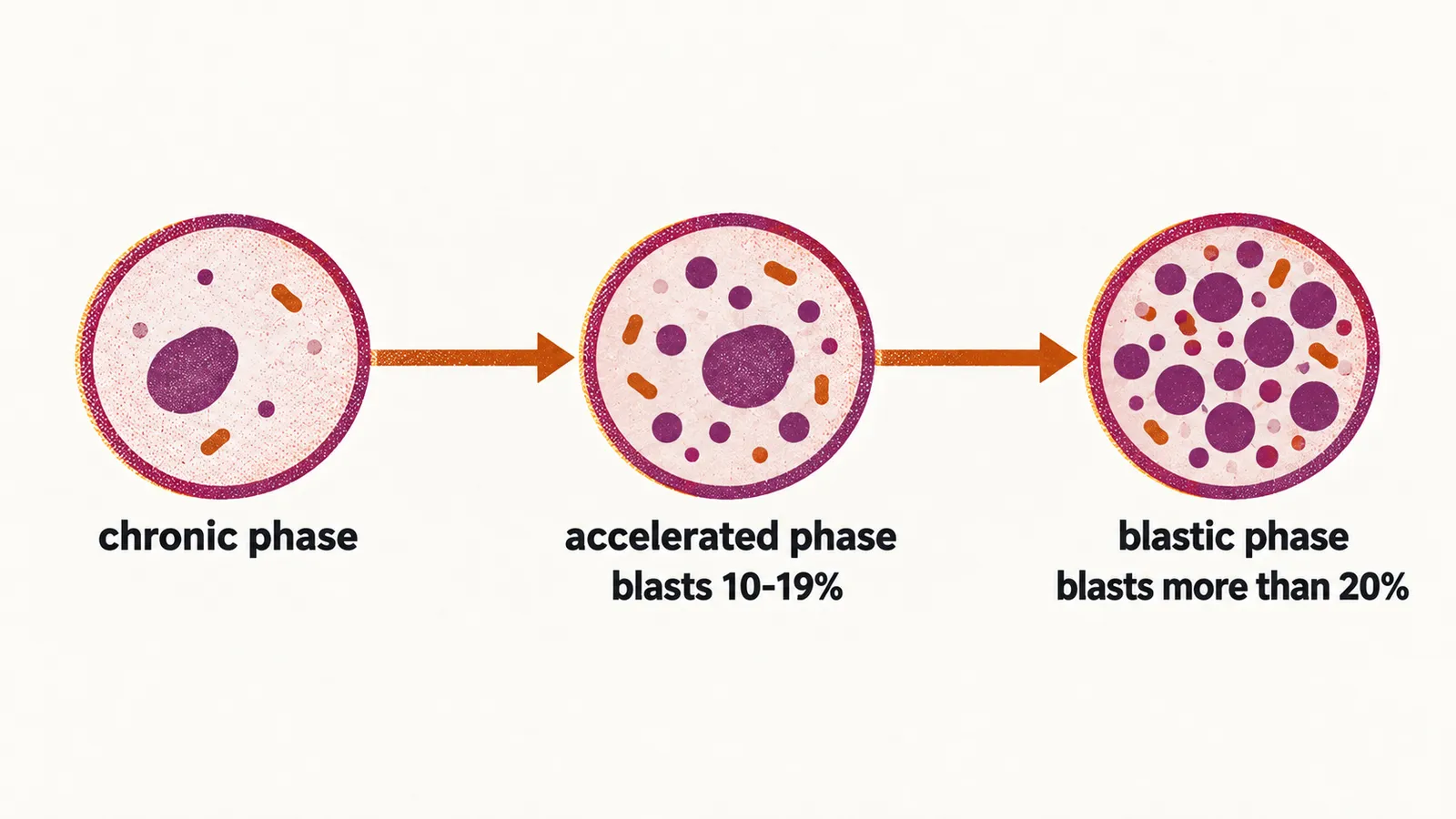
The chronic phase has a high chance of progression to the blastic phase over time, because the clone keeps acquiring additional mutations.
Treatment and prognosis
CML is treated with tyrosine kinase inhibitors (TKIs) such as imatinib and the second-generation agents dasatinib, nilotinib and bosutinib, which block the BCR::ABL1 kinase. Since the introduction of TKIs, the annual mortality has diminished from 10-20% to 1-2%; the 20-year survival rate has also increased to 80-90% from 20%.
Because the Philadelphia translocation defines CML, the other classical myeloproliferative neoplasms, which lack it and are mostly driven by JAK2-related mutations, form a separate group. The first of them, essential thrombocythemia, is mainly a proliferation of the platelet lineage.