
Primary myelofibrosis (PMF) is characterised by proliferation of abnormal megakaryocytes and granulocytes in the bone marrow, together with a polyclonal formation of fibroblasts. Those fibroblasts are not part of the clone: they are recruited by the abnormal megakaryocytes and granulocytes and then lay down the collagen that replaces the marrow space.
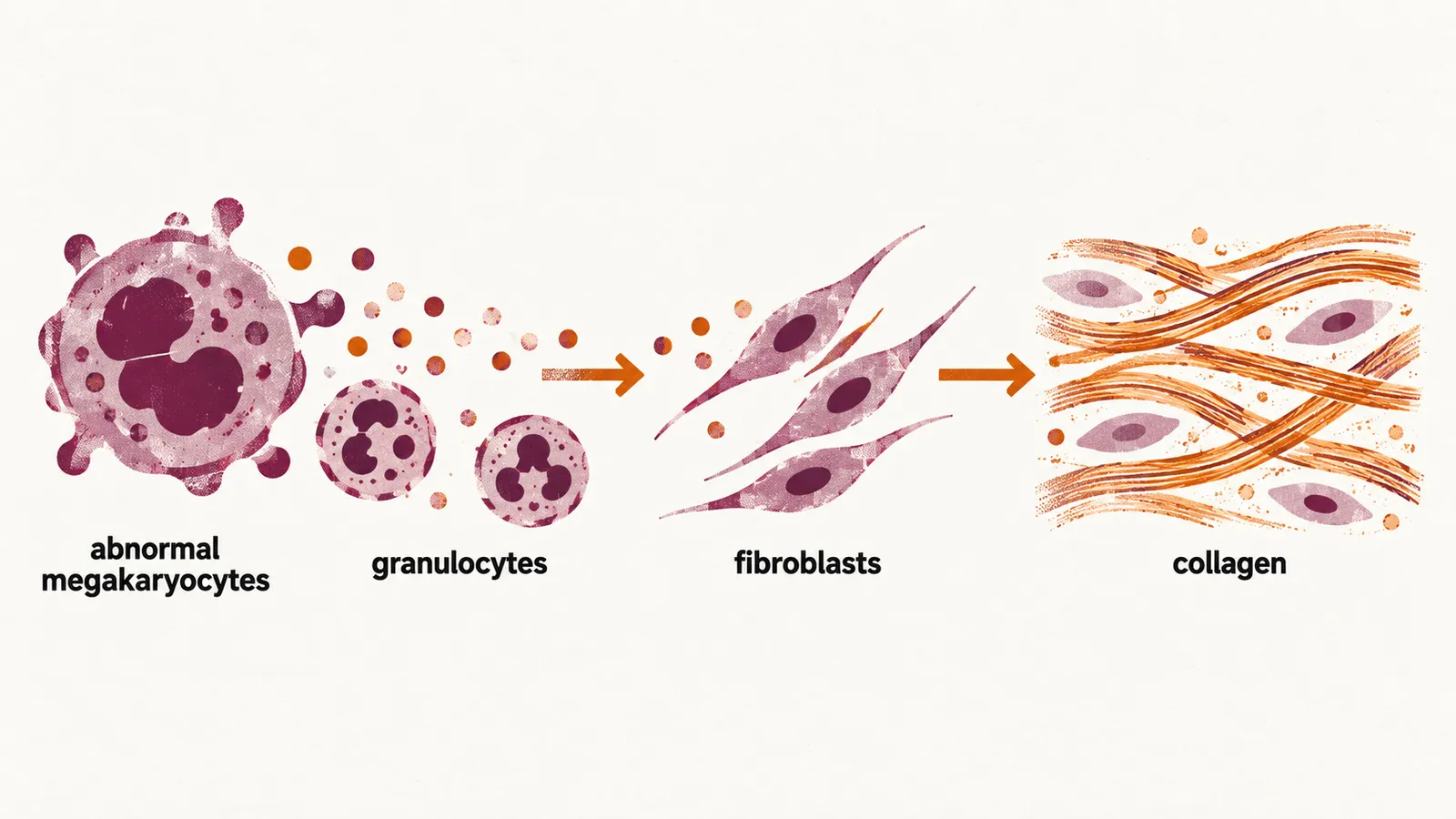
In the fibrotic stages the result is bone marrow fibrosis, osteosclerosis formation (abnormally dense bone) and extra-medullary hematopoiesis (blood cell production outside the marrow), which is why the marrow can fail even though the neoplastic cells are proliferating. The main clinical manifestations in PMF are anemia, thrombocytopenia, and leukocytosis or leukopenia.
Other than the main mutations found in Philadelphia-negative MPNs, PMF has other frequent mutations in genes that control the splicing of the genome, in epigenetic genes and in cellular signalling genes, and these additional mutations are related to poor prognosis.
Diagnosis
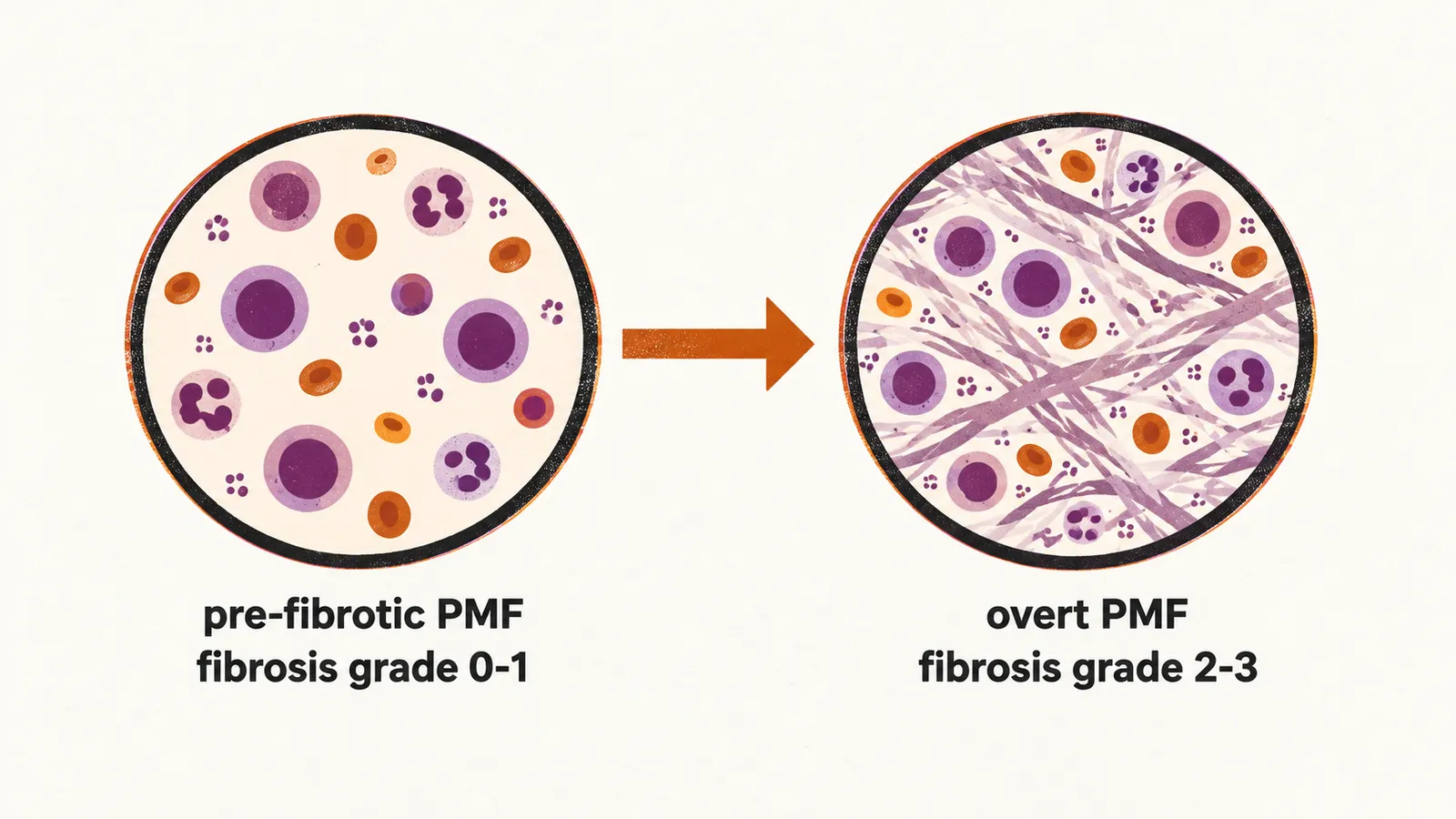
PMF is diagnosed on the bone marrow: proliferation and atypia of megakaryocytes together with granulocytic proliferation, in a marrow that does not meet the criteria for another myeloproliferative neoplasm. The amount of reticulin and collagen fibrosis separates the two stages — fibrosis grade 0-1 in the pre-fibrotic stage and grade 2-3 in overt PMF — and a driver mutation in JAK2, CALR or MPL, or the finding of another clonal marker, supports the diagnosis when morphology is not conclusive. Clinical features such as anemia, leukocytosis, a raised lactate dehydrogenase, leukoerythroblastosis (the appearance of immature white cells and nucleated red cells in the peripheral blood) and palpable splenomegaly are used as supporting criteria.
The latest studies and classifications from the International Consensus Classification (ICC) and the WHO also focus on the distinction between the pre-fibrotic and fibrotic stages of PMF and ET. Because a pre-fibrotic stage of PMF exists, there is a misdiagnosis rate of 14-18% of ET instead of pre-fibrotic PMF, which shows the importance of the definition of the pre-fibrotic stage for both ET and PMF.
Early/pre-fibrotic primary myelofibrosis
Pre-fibrotic PMF is the early stage, with fibrosis grade 0-1. About 30-40% of pre-fibrotic PMF cases are asymptomatic, while they have abnormal complete blood count (CBC) results that can be:
- slight anemia
- leukocytosis
- thrombocytosis, which mimics ET and is a clinical challenge
Compared with overt PMF, patients who are diagnosed with pre-fibrotic PMF are mostly younger and present with higher hemoglobin and platelet counts and minimal leukocytosis.
The main symptoms found in pre-fibrotic PMF are:
- fatigue
- night sweats
- weight loss
- dyspnea
- minimal splenomegaly, in about 90% of cases
- hepatomegaly, in about half of the cases
The risk factors for progression of pre-fibrotic to overt PMF are:
- slight fibrosis in the bone marrow
- anemia
The median survival of pre-fibrotic PMF is about 11 to 17 years.
Overt primary myelofibrosis
Overt PMF is the stage with fibrosis grade 2-3. Its incidence is about 0.5 to 1.5 cases per 100,000 per year.
The manifestations of overt primary myelofibrosis are mainly anemia, marked hepatosplenomegaly, fatigue, night sweats, fever, cachexia and thrombotic and hemorrhagic complications.
The cumulative incidence of overt PMF blastic phase is 11% in 5 years and 23% in 10 years.
20% of the mortality causes of overt PMF are due to leukemic progression; it can also be due to cardiovascular events and infections.
In ET and PV, a minority of cases evolve to the accelerated phase (AP) and the blastic phase (BP), while in PMF transformation to the leukemic phase is more frequent.
Treatment
Treatment is matched to the symptoms and to the estimated risk. Prognostic scores such as the DIPSS (Dynamic International Prognostic Scoring System) use age, blood counts, blasts and constitutional symptoms to place patients in a risk group, and that group guides who is offered more intensive treatment.
For symptomatic disease, the JAK inhibitor ruxolitinib reduces splenomegaly and the constitutional symptoms, but it does not remove the clone. Allogeneic haematopoietic stem-cell transplantation is the only treatment that can cure PMF, and because it carries substantial risk it is reserved mainly for younger and fitter patients with intermediate- or high-risk disease.
Myelofibrosis can also follow ET or PV, as post-ET and post-PV myelofibrosis, so a fibrotic marrow is not reached only through primary myelofibrosis.