
The clinical presentation of headache is the pattern of the attack: where it hurts, how it feels, how long it lasts, what comes with it, and how the patient behaves during it. Primary headaches (headache disorders that are the disease itself, such as migraine, tension-type, and cluster headache) are often diagnosed by pattern, sometimes with a normal scan, so the history is the instrument.
Migraine unfolds in phases
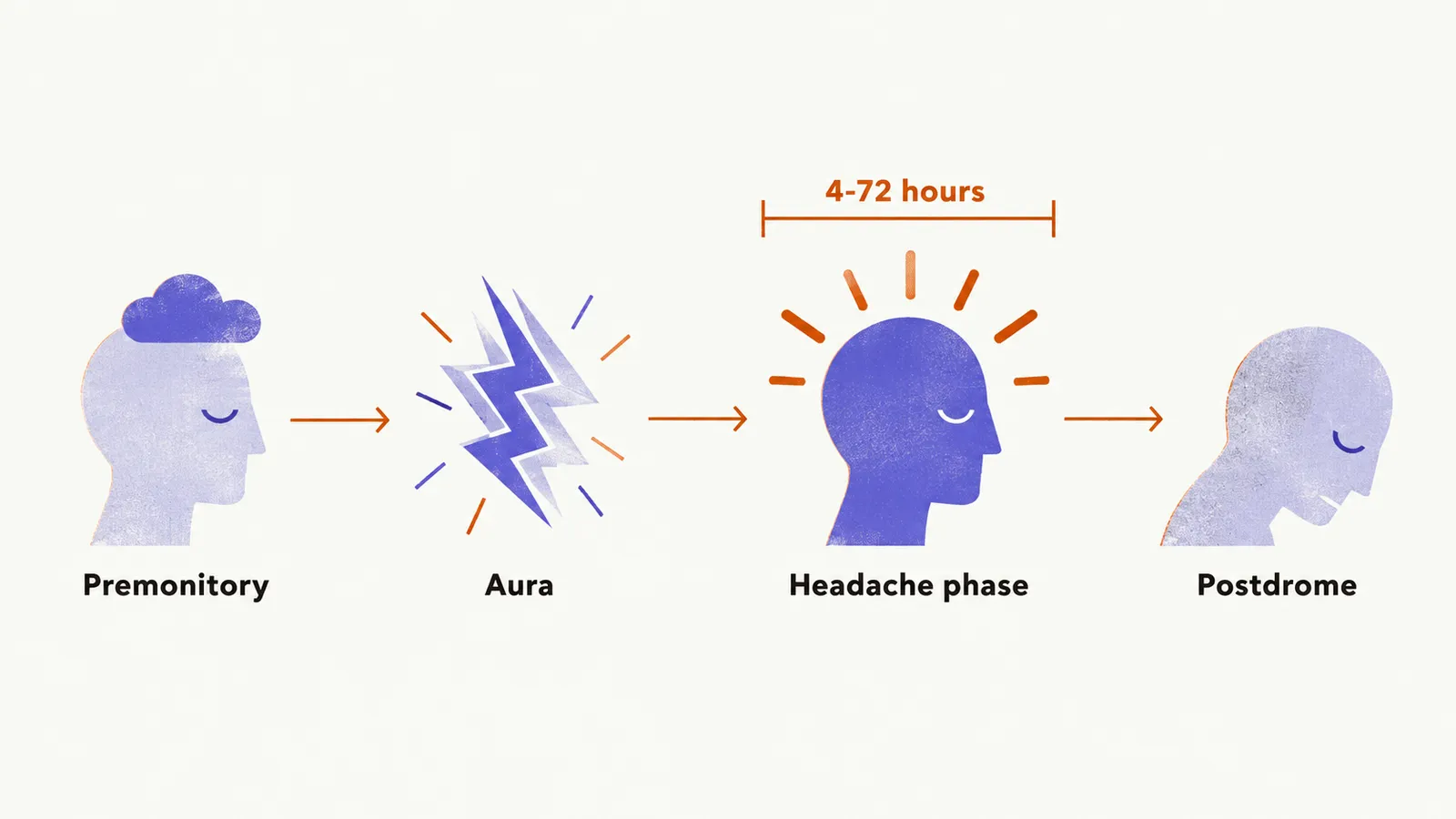
Migraine is not just a bad headache. It can move through phases.
The premonitory phase can arrive hours before pain, with tiredness, irritability, hunger, yawning, or cognitive fogginess, which shows migraine starting in the nervous system before pain begins. The aura phase, when present, is usually transient and reversible. Visual aura is classic: shimmering lights, zig-zag lines, or a growing blind spot. Sensory, speech, or brainstem symptoms can occur depending on the subtype.
The headache phase usually lasts 4–72 hours if untreated, often unilateral (one-sided), pulsating, moderate to severe, and worsened by routine activity, with nausea, vomiting, photophobia (light sensitivity), and phonophobia (sound sensitivity). The postdrome follows pain resolution, with patients feeling drained, foggy, stiff in the neck, or hungover.
Tension-type headache: bilateral pressure without migrainous features
Tension-type headache (TTH) is usually bilateral and feels pressing or tightening rather than pulsating. It is usually mild to moderate, and routine physical activity does not worsen it. The negative features carry the most diagnostic weight: TTH should not produce severe nausea or vomiting, nor the dramatic one-sided autonomic signs of cluster headache. Significant nausea and vomiting point toward migraine rather than TTH, even when the pain itself sounds like bilateral pressure. The name “tension” describes a clinical pattern that may involve pericranial muscle tenderness and central pain sensitization, especially in chronic cases; it does not mean the patient is simply stressed.
Cluster headache is short, severe, one-sided, and autonomic
Cluster headache is a trigeminal autonomic cephalalgia (TAC): trigeminal because the pain lies in trigeminal nerve territory, and autonomic because of the same-side signs that accompany it. Attacks are brutally severe, strictly unilateral, and centered around the orbit, supraorbital area, or temple. A typical attack lasts 15–180 minutes, with tearing, red eye, nasal blockage or runny nose, eyelid swelling, forehead sweating, small pupil, or drooping eyelid on the same side. Patients are often restless: they pace, rock, or cannot lie still. That behavior separates the two classic pictures. Migraine patients often want a dark room and stillness because movement worsens pain, while cluster patients move because the attack is so agitating.
Related syndromes share the face but differ in timing
Cluster headache is one of several TACs. Related TACs combine one-sided trigeminal pain with autonomic signs but differ in duration and treatment response, and duration is the quickest way to tell them apart.
| Disorder | Typical attack duration | Frequency clue | Treatment clue |
|---|---|---|---|
| Cluster headache | 15–180 minutes | One every other day to several per day | Oxygen and sumatriptan acutely; verapamil preventively |
| Paroxysmal hemicrania | 2–30 minutes | Often many attacks per day | Complete response to indomethacin |
| Short-lasting unilateral neuralgiform headache attacks with conjunctival injection and tearing (SUNCT) | 1–600 seconds | Very short, many attacks | Often difficult; specialist treatment |
| Hemicrania continua | Continuous baseline pain | Continuous one-sided headache with flares | Complete response to indomethacin |
When the pattern breaks: suspect a secondary headache
All of the patterns above are primary headaches. A secondary headache should be suspected when the story breaks the patient’s usual pattern: sudden onset, worst-ever pain, new neurological signs, fever, cancer, immunosuppression, trauma, pregnancy, or older age at onset. Subarachnoid hemorrhage classically causes sudden severe headache, often with nausea, vomiting, neck stiffness, loss of consciousness, or focal signs.
How these patterns convert into diagnostic criteria, and how red flags are weighed, is covered in Headache Diagnosis. The three classic patterns are set side by side in Migraine versus Tension-Type versus Cluster Headache. Why each pattern arises is the question of Headache Pathophysiology.