
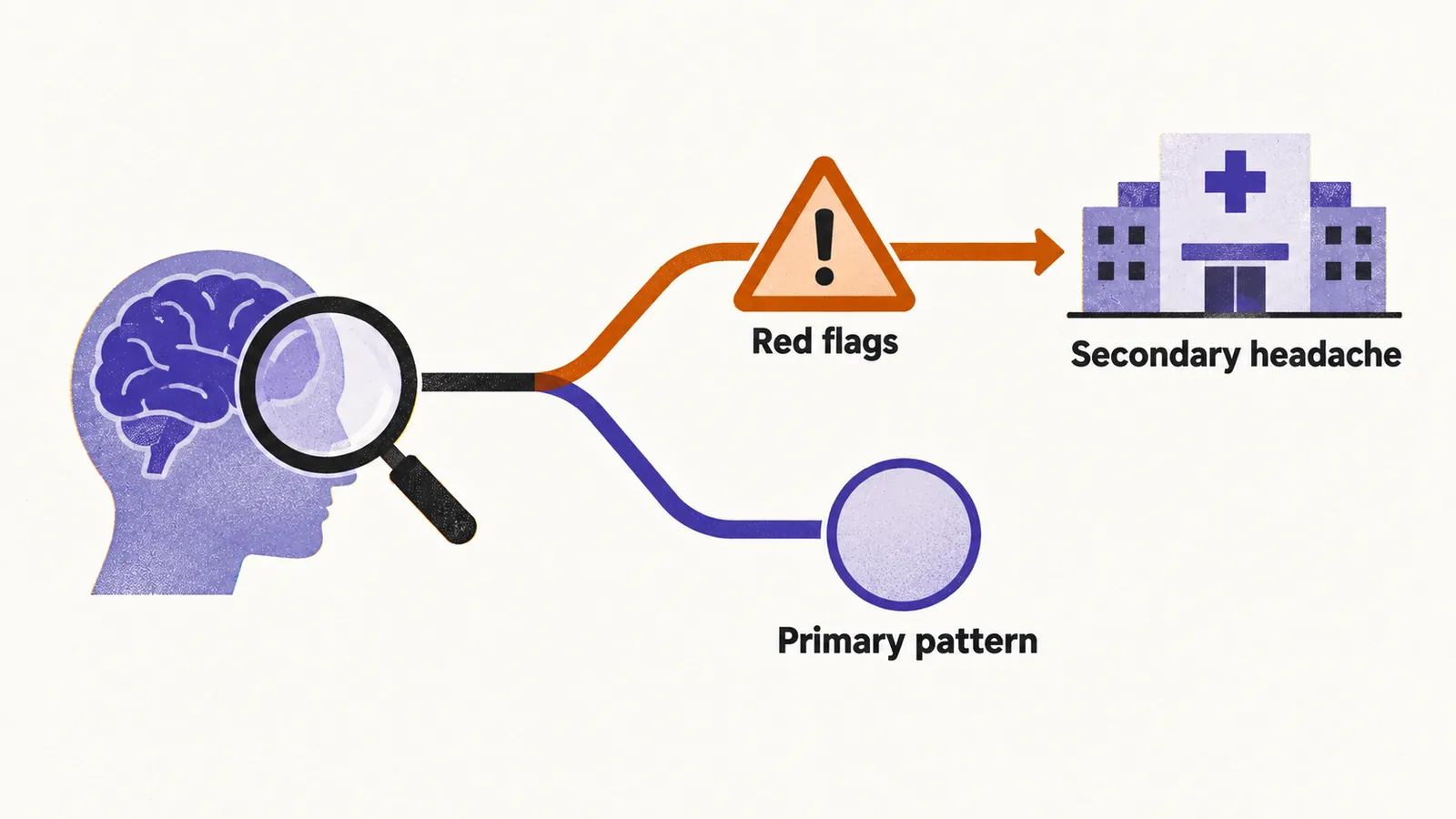
Headache diagnosis starts with one question: is this a recognizable primary headache pattern, or a secondary headache until proven otherwise? Criteria, such as those of the International Classification of Headache Disorders (ICHD), are useful, but they are not the first move. The first move is safety: rule out red flags.
Decide first whether the story is dangerous
Red flags are clues that the headache may be secondary. The common mnemonic is SNOOP.
- Systemic symptoms or disease. Fever, cancer, immunosuppression, pregnancy, or systemic inflammatory disease can point to infection, malignancy, thrombosis, or arteritis.
- Neurological signs. Weakness, aphasia (loss of language ability), seizure, altered consciousness, papilledema (swelling of the optic disc), or focal deficits suggest a structural or vascular cause.
- Onset sudden. Thunderclap headache, reaching maximal intensity within seconds to minutes, is subarachnoid hemorrhage until proven otherwise.
- Older age at onset. New headache after about age 50 raises concern for giant cell arteritis, tumor, vascular disease, or other secondary causes.
- Pattern change or progressive headache. A headache that is new, different, worsening, or triggered by posture, cough, exertion, or Valsalva maneuvers (straining against a closed airway) needs more caution.
SNOOP is a way of asking whether something about this headache sits outside what primary migraine or tension-type headache can comfortably explain. If nothing does, the next step is to see whether the story fits a primary pattern.
Migraine: recurrent stereotyped patterns
Migraine without aura requires recurrent attacks with a stereotyped pattern. The ICHD criteria emphasize at least 5 attacks lasting 4–72 hours if untreated or unsuccessfully treated, with at least two of four pain features (unilateral location, pulsating quality, moderate or severe intensity, worsening with routine activity) and at least one associated feature (nausea or vomiting, or both photophobia and phonophobia), with no better secondary explanation. The bedside shortcut is this: recurrent moderate-to-severe headache, worsened by movement, with nausea or light and sound sensitivity, is migraine until proven otherwise.
Migraine with aura adds transient neurological symptoms before or during the headache, most often visual, but sensory, language, motor, brainstem, or retinal symptoms may occur. The key is evolution: aura usually spreads gradually over minutes and then resolves. A sudden fixed neurological deficit is not just aura until stroke and other causes are considered.
Tension-type headache
Tension-type headache (TTH) is usually bilateral, pressing or tightening, mild to moderate, and not worsened by routine activity. It should not include vomiting, and many criteria allow only mild nausea and only one of photophobia or phonophobia. This is why nausea is such a useful discriminator: repeated vomiting moves the diagnosis away from clean TTH and back toward migraine.
Cluster headache and its relatives
Cluster headache and its relatives share one-sided trigeminal pain with autonomic signs and separate mainly by attack duration, from seconds through minutes and hours to continuous pain. The full timing table lives in Headache Clinical Presentation.
Medication-overuse headache and the chronic overlap
Frequent headache raises a further diagnostic question: is the treatment part of the problem? Medication-overuse headache happens when frequent acute medication use relieves individual attacks but maintains the chronic headache cycle. Suspect it when headache is frequent and the patient uses acute medication on many days each month; the exact threshold depends on the medication class, but the principle holds: the rescue drug becomes part of the disease loop. It can coexist with chronic migraine, so frequent triptan, NSAID, or combination analgesic use should prompt the question whether treatment has become fuel for the fire, not just a label of chronic migraine.
When to image or investigate
Imaging is not required for every stable, typical primary headache. It becomes important when the story is atypical, new, progressive, or focal, and in these situations:
- thunderclap onset
- altered consciousness
- trauma
- infection
- cancer
- immunosuppression
- pregnancy
- features of raised intracranial pressure
Subarachnoid hemorrhage needs urgent evaluation, usually starting with noncontrast computed tomography (CT) when presentation is acute. The secondary causes that imaging and investigation look for are explored in Headache Secondary Causes, and acute versus preventive treatment logic follows in Headache Treatment.