
Most primary headaches do not damage the brain. Three things change the outlook: chronification (the shift from episodic to chronic headache) through medication overuse, prolonged or infarcting migraine variants, and the complications of a missed secondary cause.
The chronification and medication-overuse loop
Medication-overuse headache means headache on at least 15 days per month after regular overuse of acute medication for more than 3 months. The day threshold is 10 or 15 days per month depending on the drug class. These thresholds are expert opinion, not trial-derived cut-points. Stopping the overuse usually improves the headache, but not invariably.
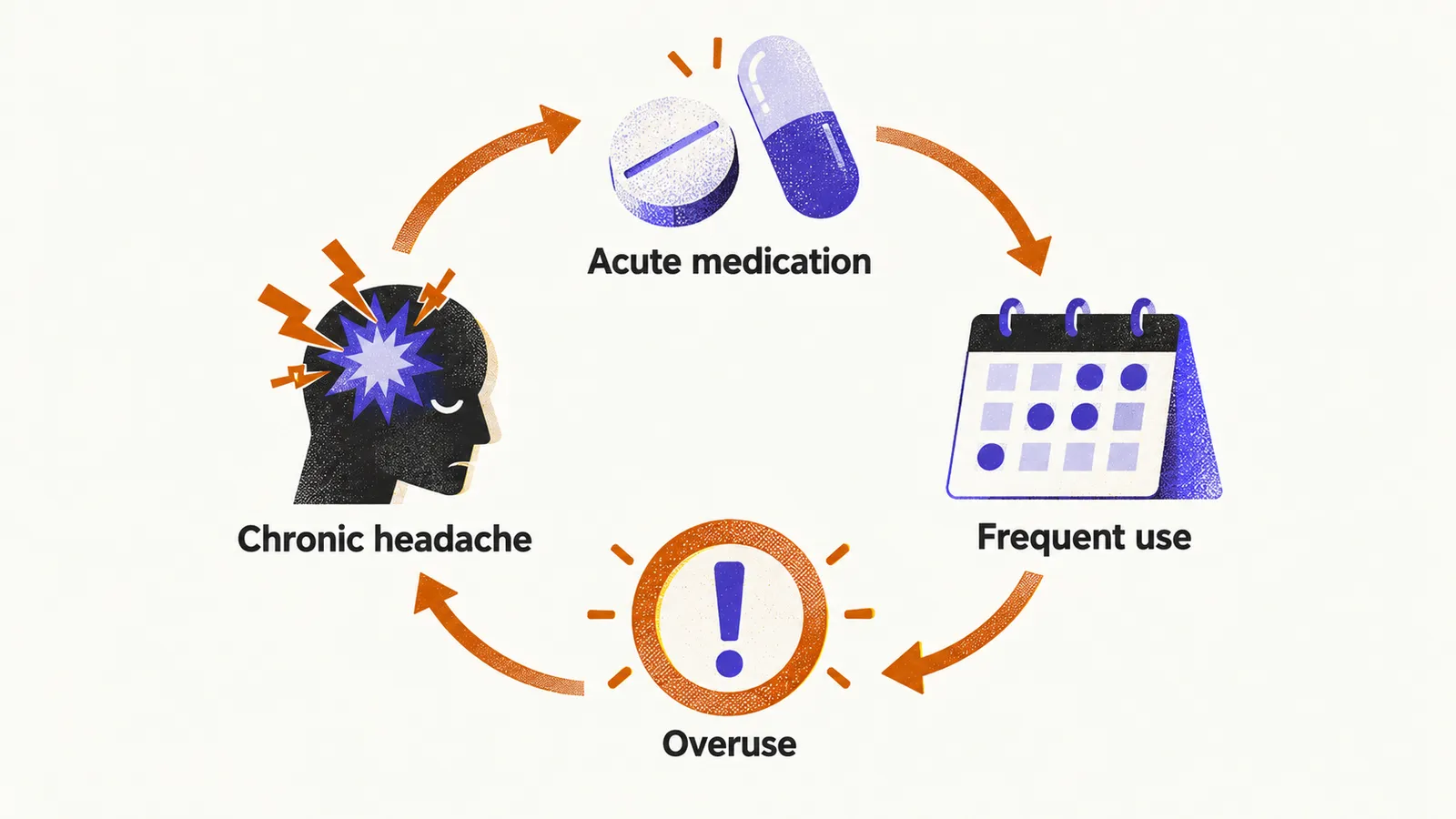
A patient can meet the criteria for chronic migraine and medication-overuse headache at the same time. That patient receives both diagnoses. About half of apparent chronic migraine reverts to episodic after withdrawal. Several factors shape the risk of migraine progression: opiates and barbiturates carry about twice the risk, and triptans raise risk mainly when baseline frequency is already high. Baseline frequency itself is the major predictor. Breaking the loop is covered in Headache Treatment.
Status migrainosus
Status migrainosus is a debilitating migraine attack lasting more than 72 hours. Brief remissions of up to 12 hours from sleep or medication still count. Milder prolonged attacks are coded as probable migraine. A prolonged attack driven by medication overuse is coded as medication-overuse headache plus the migraine type, not status migrainosus.
Migrainous infarction and stroke risk
Migrainous infarction means aura (the temporary neurological symptoms that can accompany migraine) persisting beyond 60 minutes with imaging proof of infarction in matching brain territory during a typical migraine-with-aura attack. It mostly affects posterior circulation in younger women. Separately, migraine with aura carries about twice the population risk of ischaemic stroke. Those strokes are not migrainous infarctions, and the mechanism behind the extra risk is unknown.
Course of post-dural puncture headache
Post-dural puncture headache is the low-pressure headache that follows a cerebrospinal fluid leak. It usually starts within 48–72 hours and within 5 days of the puncture. Over two-thirds of patients recover spontaneously within about 2 weeks. Epidural blood patch with 10–30 mL of autologous blood is definitive when conservative care fails. It succeeds in over 75–90%, especially when repeated. Rare severe sequelae include subdural haematoma, cerebral venous thrombosis, and seizures.
Complications of missed subarachnoid hemorrhage
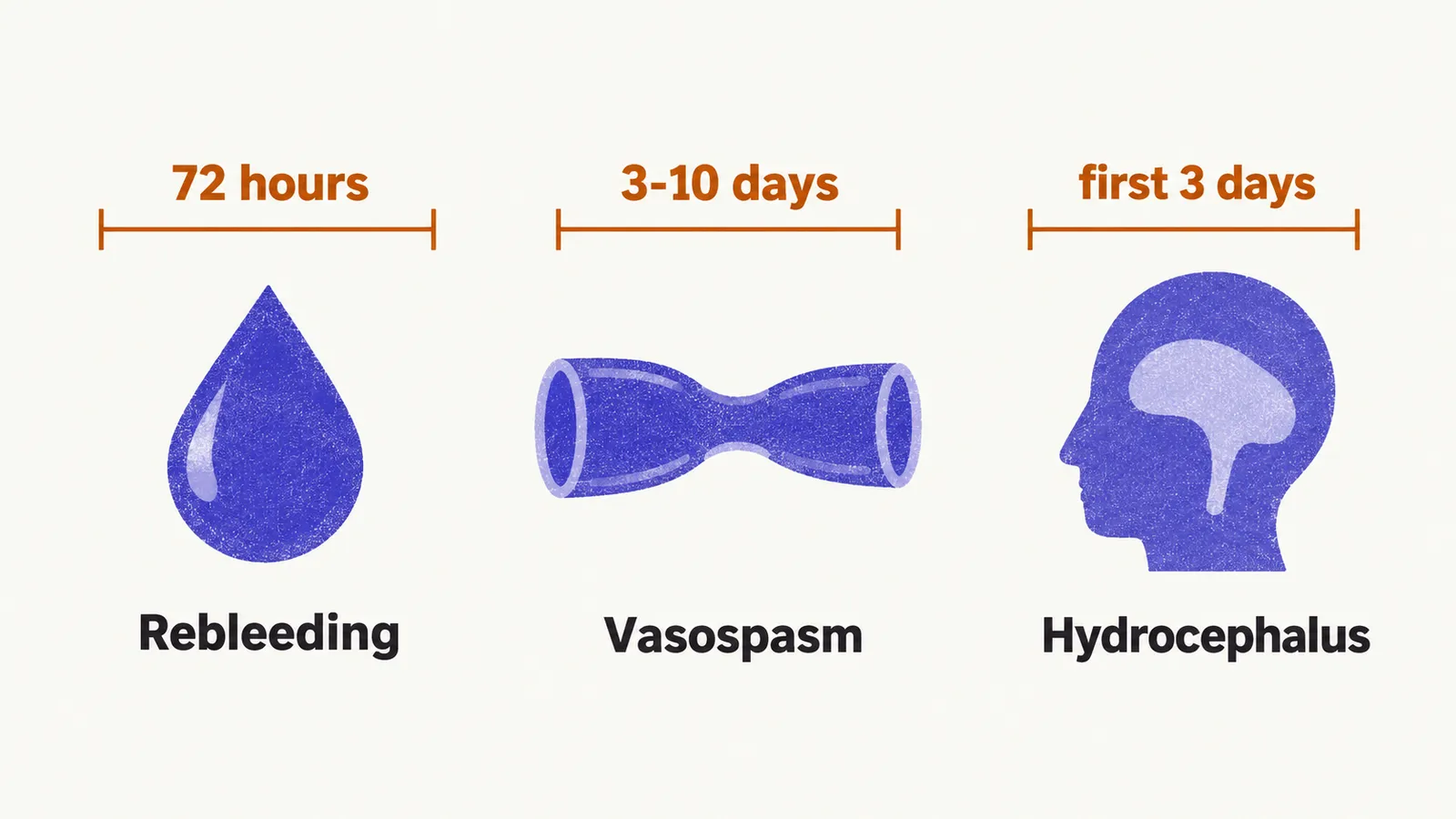
The most serious consequences come from a missed subarachnoid hemorrhage: rebleeding, vasospasm, and hydrocephalus.
Rebleeding affects 9–17% within the first 72 hours, with up to 50% mortality. Securing the aneurysm drops rebleed risk to about 1%, preferably within 24 hours.
About 60% of patients develop radiographic vasospasm (narrowing of cerebral arteries) and about 39% clinical vasospasm causing delayed cerebral ischaemia. Early enteral nimodipine prevents delayed ischaemia and improves functional outcome. A 21-day oral course is standard of care. Statins and intravenous magnesium are not recommended. Vasospasm surveillance concentrates approximately around days 3–10.
Hydrocephalus (accumulation of cerebrospinal fluid within the brain) affects up to 30%, often within the first 3 days.
The alarm pattern of subarachnoid hemorrhage itself is described in Headache Secondary Causes.