Respiratory assessment in neurological disease measures the pump rather than the lungs. The question is not only whether gas exchange looks acceptable now, but whether the drive, the muscles and the clearance of carbon dioxide will hold up overnight, during an infection, or as weakness progresses.
Why saturation can look reassuring during the day
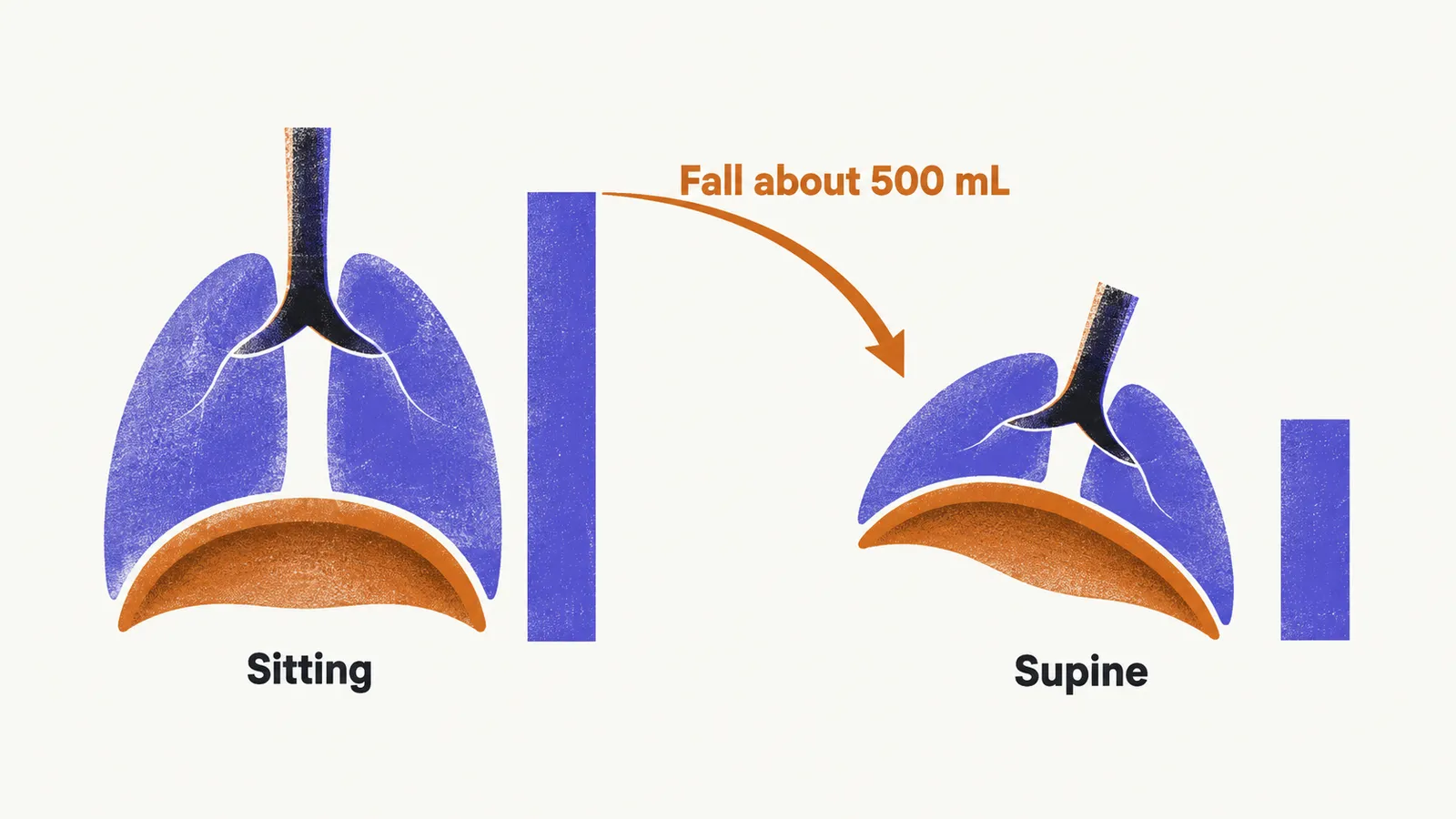
Daytime oxygen saturation can look acceptable while sleep testing shows hypoventilation, because diaphragm weakness often appears first at night or when lying down. In the supine position gravity pushes the abdominal contents upward against the diaphragm, so a diaphragm that is already weak has to work against that extra load. Hypoventilation — breathing that is too shallow or too slow to clear carbon dioxide — then develops during sleep before it is obvious when the patient is awake.
Tests of pump function
Because weakness can hide in the pump while daytime saturation looks acceptable, assessment targets pump function directly.
- Vital capacity, the largest volume of air that can be breathed out after a full breath in, measured sitting and supine (lying flat), so that the effect of posture on the diaphragm becomes visible.
- Maximal inspiratory pressure (MIP) and maximal expiratory pressure (MEP), the strongest pressures the patient can generate on effort.
- Sniff nasal pressure, measured during a sharp sniff through one nostril.
- Peak cough flow, the fastest expiratory flow a cough can produce.
Gas exchange and sleep are checked separately, with pulse oximetry, arterial blood gas, transcutaneous carbon dioxide monitoring, cardio-respiratory polygraphy, and sleep studies for hypoventilation.
This set of tests reflects the approach recommended for motor neuron disease, where respiratory function tests including vital capacity and sniff or inspiratory pressures guide the identification of respiratory impairment. Because function declines over time in progressive disease, the measurements are repeated at intervals, and the trend carries more information than any single value.
The sitting-to-supine vital capacity fall
Supine testing stresses the diaphragm, so lying down exposes weakness that a sitting measurement can miss. In amyotrophic lateral sclerosis (ALS), a fall in forced vital capacity of about 500 mL, or about 20%, between the sitting and supine positions is used as a marker of diaphragmatic weakness. Treat this as a marker rather than a universal cutoff: published literature describes postural vital capacity falls of about 20-30% as suggesting bilateral diaphragm dysfunction, with exact thresholds varying by study and population.
Nocturnal findings that need follow-up
The supine fall in vital capacity tests the diaphragm under postural load; sleep is where that load lasts for hours.
Nocturnal hypoventilation is suspected from the overnight record before it is confirmed. Nocturnal oximetry, which records oxygen saturation overnight, can show three patterns that raise the possibility of it:
- desaturation below 88% for more than 5 minutes;
- an oxygen desaturation index above 10 per hour (the number of desaturation episodes per hour of sleep);
- cumulative time below 90% saturation (T90) above 5%.
These are monitoring markers that should prompt evaluation for nocturnal hypoventilation, not standalone diagnostic criteria. Confirmed hypoventilation is established with sleep studies and carbon dioxide measurement, following local protocols.
Ventilation is only part of what the pump does. The cough that removes secretions from the airway is assessed in its own right.