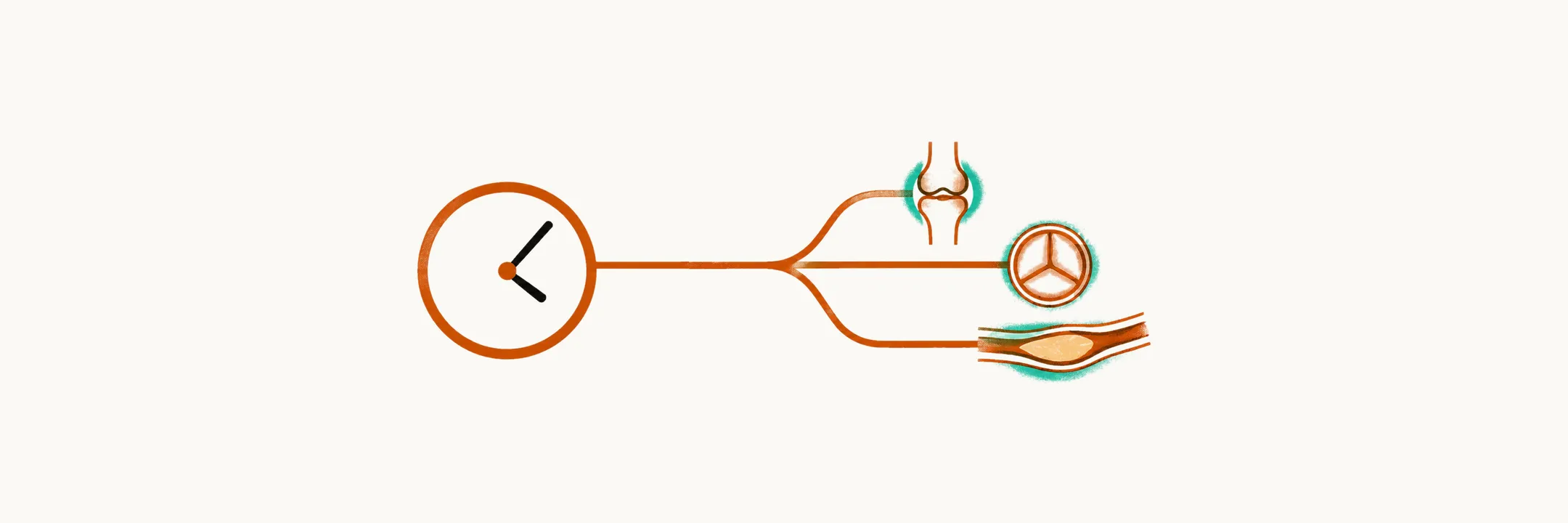
Rheumatological diseases are diseases in which the immune system inflames the body’s own joints, blood vessels, heart or other connective tissues. Each is individually uncommon in children, and they present in a small number of recurring shapes: fever that will not settle, a rash that comes and goes, a joint that will not straighten, an eye that looks normal but is not. Three diseases dominate the group, and they share enough surface features to be confused for one another:
- Kawasaki disease is a vasculitis — inflammation of the blood vessel wall — of medium-sized arteries in infants and young children, and the artery it damages is the coronary artery.
- Acute rheumatic fever is an immune cross-reaction that follows streptococcal pharyngitis (a sore throat caused by group A Streptococcus): the immune response raised against the bacterium also attacks the child’s own tissues, and the damage it leaves permanently is in the heart valves.
- Juvenile idiopathic arthritis is chronic inflammation of joints that begins in childhood and lasts years, and it threatens joints, growth and eyes.
They matter out of proportion to their frequency because each carries a decision with a deadline: Kawasaki disease must be treated inside 10 days of fever onset to protect the coronary arteries, streptococcal pharyngitis inside 9 days to prevent a first attack of rheumatic fever, and juvenile idiopathic arthritis early enough to prevent joint damage that cannot be undone later. Time, rather than severity, decides the outcome in all three. That shared asymmetry is why the family is worth learning together: the same child can present with any of them.
Choose a route through this family
If the topic is new, read the notes in the order below: the sequence follows the age at which each disease typically presents, and each disease’s diagnosis, complications, treatment and prevention notes follow the disease itself. If you are facing a specific child with fever and a rash, start with the comparison note at the end and then read the disease note it points to.
Kawasaki disease: protecting the coronary arteries
Everything in Kawasaki disease turns on recognising it in time to protect the coronary arteries.
- Kawasaki Disease: who the disease affects, the five principal features and the phases in which they appear, and the differential that has to be worked through.
- Diagnosing Kawasaki Disease: the rule for complete and incomplete disease, the algorithm for the febrile child with fewer features, the laboratory findings that support it, and how coronary involvement is graded on echocardiography.
- Treating Kawasaki Disease and Protecting the Coronary Arteries: and the 10-day window, aspirin at its two doses, the children treated with corticosteroids from the outset, and the follow-up the coronary findings dictate.
Acute rheumatic fever: protecting the heart valves
Rheumatic fever has a known bacterial trigger, which makes it the one disease of the three that can be prevented as well as treated.
- Acute Rheumatic Fever: the rheumatogenic strains and the genetic susceptibility behind it, molecular mimicry and immune complex deposition, the major manifestations as they appear over weeks, and what happens to the valves afterwards.
- Diagnosing Acute Rheumatic Fever: the 2015 Jones criteria — the clinical rule used to make the diagnosis — in low-risk and moderate- to high-risk populations, the evidence of a preceding streptococcal infection they require, and how to read an , the antibody test for that infection.
- Treating Acute Rheumatic Fever: clearing any residual streptococcus, anti-inflammatory treatment stratified by how much the heart is involved, and the management of chorea.
- Preventing Acute Rheumatic Fever and Its Recurrences: the 9-day antibiotic window and the regimens that meet it, long-term benzathine penicillin prophylaxis, and how long it is continued.
Juvenile idiopathic arthritis: protecting joints, eyes and growth
Juvenile idiopathic arthritis is a group of diseases rather than one, and the category a child has decides which threat — to the joints, the eyes or the whole body — matters most.
- Juvenile Idiopathic Arthritis: the six-week definition, the seven categories of the (ILAR), and the articular subtypes with the prognosis attached to each.
- Uveitis and Eye Screening in Juvenile Idiopathic Arthritis: the inflammation at the front of the eye (anterior uveitis) that produces no symptoms, the risk factors that set how often a child is screened, and the stepped treatment once it is found.
- Systemic Juvenile Idiopathic Arthritis and Macrophage Activation Syndrome: the systemic category with its daily fever spikes and evanescent rash, the malignancies that mimic it, and macrophage activation syndrome, the complication that turns it into an emergency.
- Treating Juvenile Idiopathic Arthritis: the treat-to-target strategy (treatment escalated until a defined target of inactive disease is reached), the drugs from intra-articular corticosteroid to biologic agents, and the sequence most guidelines follow.
When the diagnosis is not yet clear
- Telling Kawasaki Disease, Acute Rheumatic Fever and Juvenile Idiopathic Arthritis Apart: the comparison by fever pattern, rash, joint pattern, cardiac finding and laboratory result, with the wider differentials and the order in which to work.
Where this family stops
Several conditions that belong to paediatric rheumatology in the broader sense sit outside these notes, and a child who fits none of the three may have one of them:
- IgA vasculitis (Henoch-Schönlein purpura) is the most common childhood vasculitis, with palpable purpura, arthritis, abdominal pain and nephritis, and it has a different mechanism and a different follow-up.
- Systemic lupus erythematosus appears here only as a differential diagnosis, for joint disease and for subcutaneous nodules.
- The hereditary autoinflammatory syndromes — familial Mediterranean fever, (tumour necrosis factor receptor-associated periodic syndrome), (cryopyrin-associated periodic syndromes) and related periodic fever syndromes — are a distinct group defined by dysregulation of innate immunity, the body’s first-line, non-specific defence, and the recurrent fever they cause belongs with them.
- PFAPA syndrome — periodic fever with aphthous stomatitis, pharyngitis and cervical adenitis — is a non-hereditary periodic fever and a diagnosis of exclusion in young children.
- Neonatal lupus, other neonatal rheumatological presentations, and reactive arthritis as a cause of joint inflammation in children are named only as differentials.
Macrophage activation syndrome, the uncontrolled immune activation that complicates systemic juvenile idiopathic arthritis, can also complicate lupus and other rheumatic diseases.