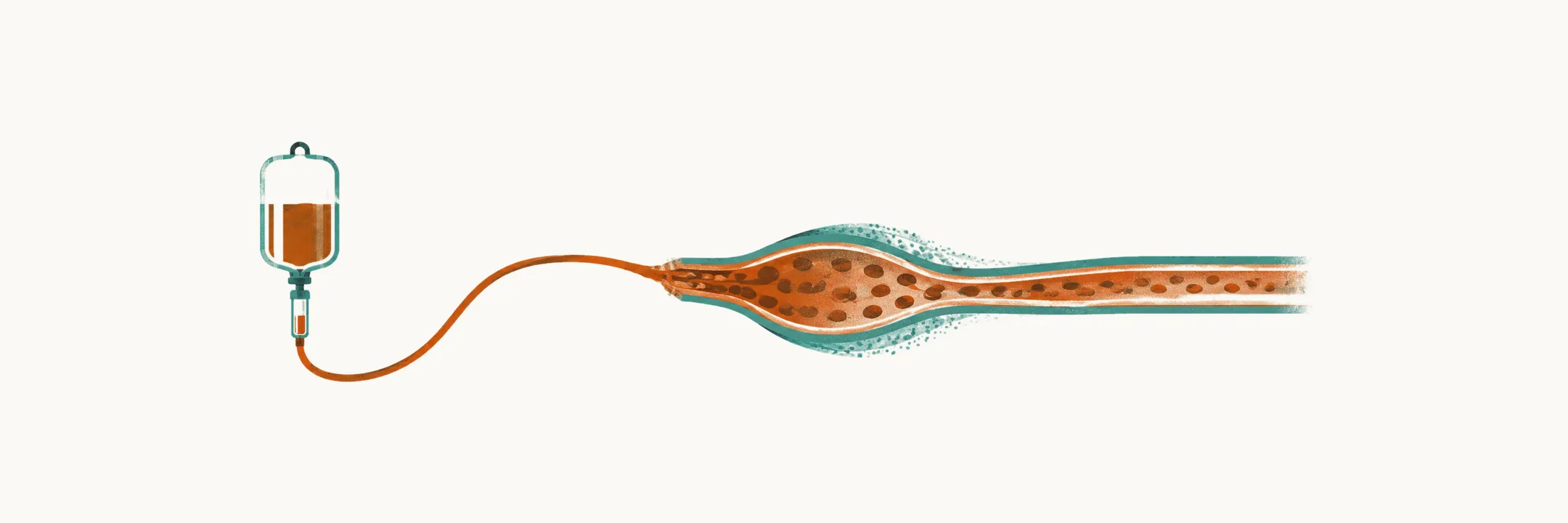
Kawasaki disease is an acute vasculitis — inflammation of the vessel wall — of medium-sized arteries that occurs almost entirely in young children, and its importance comes from one target: the coronary arteries. Untreated, roughly a quarter of children develop coronary artery dilation or aneurysm (a localised ballooning of the artery), and those aneurysms can thrombose years later. Treated with inside the correct time window, the great majority recover with normal coronary arteries. Treatment is therefore built around a single time-limited decision, and the long-term plan afterwards follows the coronary arteries rather than the fever.
Intravenous immunoglobulin, and the timing problem
The cornerstone of treatment is intravenous immunoglobulin (IVIG), and its timing matters more than any other single decision in the illness.
- The dose is 2 g/kg as a single infusion, usually given over 10-12 hours, and more slowly if there is cardiac dysfunction.
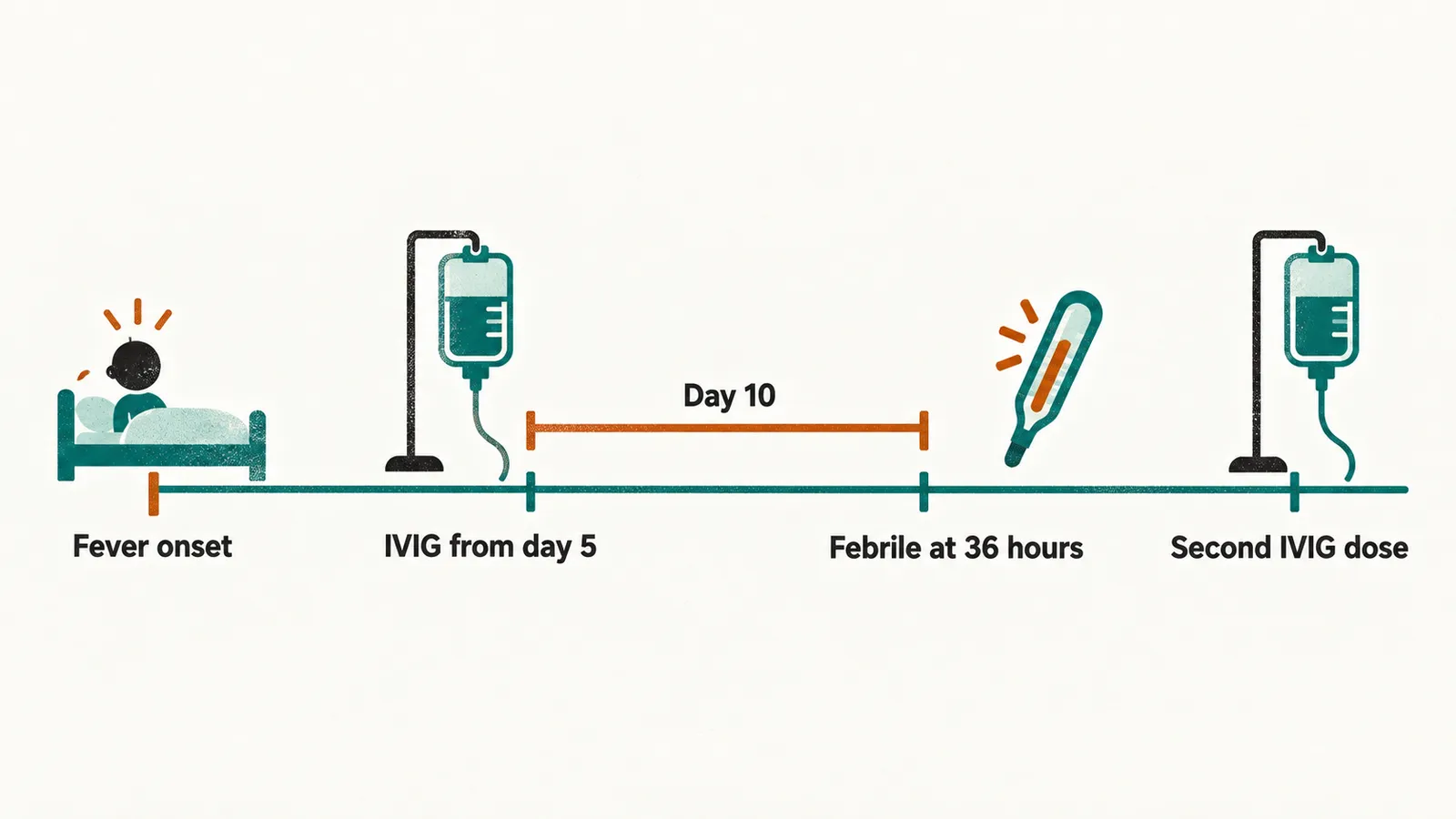
- Treatment should be given within 10 days of the onset of fever, and as soon as the diagnosis is secure — which may be day 4 in a child with 4 or more features.
- When the diagnosis can safely wait, treatment is usually started from day 5 onwards. A meta-analysis of more than 70,000 patients found that IVIG given before day 5 of fever was associated with a higher rate of treatment failure and the need for retreatment (odds ratio about 2.2, roughly twice the odds).
- Treatment after day 10 is indicated when the child is still febrile or has active coronary involvement. If the fever has resolved and the coronary arteries are normal, late IVIG has no demonstrated benefit.
Not every child responds to the first infusion. Approximately 10-20% of children remain febrile 36 hours or more after it, and this is what is meant by IVIG resistance; in pooled series its prevalence is around 14%. The usual next step is a second dose of IVIG at the same dose (2 g/kg), given at least 36-48 hours after the first. The alternative is infliximab, an antibody that blocks tumour necrosis factor (TNF), an inflammatory signalling molecule. In a randomised trial infliximab ended fever more often than a second IVIG dose (77% vs 51% of children afebrile at 24 hours without recurrence within 7 days), with a shorter hospital stay and fewer serious adverse events, while inflammatory markers and coronary artery outcomes were similar at study completion.
Alongside these decisions, fever control, fluid and electrolyte management, and treatment of any cardiac failure or arrhythmia are handled as they arise.
Aspirin
Aspirin is given alongside IVIG, at two very different doses, for two different reasons.
| Phase | Dose | Purpose |
|---|---|---|
| Acute, until the child has been afebrile for 48-72 hours | 80-100 mg/kg/day in divided doses | Anti-inflammatory |
| After that, for about 6-8 weeks | 3-5 mg/kg/day once daily | Antiplatelet, to reduce thrombotic risk while the coronary arteries are abnormal or healing |
The high dose has an anti-inflammatory action that the low dose does not; the low dose has an antiplatelet action that the high dose is not used for. Aspirin is avoided in children in most other circumstances because of the association with Reye syndrome, an acute illness of the brain and liver, and Kawasaki disease is one of the few remaining indications for high-dose aspirin in paediatrics.
Children at higher risk
IVIG and aspirin are the standard initial treatment, but some children are treated more intensively from the outset. Features that identify them include:
- Age under 1 year, and especially under 6 months.
- Markedly raised inflammatory markers, particularly C-reactive protein (CRP).
- Anaemia or low albumin at presentation, or raised liver enzymes.
- Shock, or — uncontrolled activation of T lymphocytes and macrophages.
For these children, corticosteroids are added to the initial IVIG and aspirin, either as a single intravenous dose of methylprednisolone before the infusion or as a short course afterwards; methylprednisolone pulse therapy for three days is used in severe disease and in non-responders. The evidence base for routine corticosteroid use in all children with Kawasaki disease, rather than only in those at high risk, continues to evolve.
Follow-up and prognosis
The fever and the mucocutaneous features resolve over days to weeks, and most children recover completely. The long-term outcome is decided almost entirely by the coronary arteries, and the plan is set by what echocardiography has shown.
| Coronary status | Long-term plan |
|---|---|
| No coronary involvement in the first 6-8 weeks | Aspirin can be stopped; no routine restriction |
| Transient dilation that resolves | Aspirin until it has resolved |
| Small or medium persistent aneurysm | Continued aspirin, with cardiology follow-up and imaging |
| Giant aneurysm | Long-term aspirin plus anticoagulation, and restriction of vigorous physical activity |
Anticoagulation appears in the plan because coronary thrombosis is the mechanism of the late deaths, so children with large or giant aneurysms may need anticoagulation in addition to aspirin. Physical activity restriction is likewise tied to the severity of coronary involvement; it is difficult to maintain because children feel entirely well once the inflammation has settled.
Features reported to predict a worse outcome include male sex, diagnosis after day 10 of fever, fever lasting more than 10 days, and neutrophil predominance.
Coronary aneurysms caused by Kawasaki disease are the leading cause of acquired heart disease in children in developed countries, which is why a febrile child who does not fit the usual patterns deserves echocardiography rather than another antibiotic.
Kawasaki disease is not the only illness of childhood in which the heart is the target of an immune response, and not every such illness attacks arteries. When the valves are the target instead, and the bacterium that triggered it has long since been dealt with, the disease appears weeks after the sore throat that started it.