Juvenile idiopathic arthritis (JIA) is chronic arthritis of unknown cause that begins in childhood. Systemic JIA is the category of JIA in which the disease is truly systemic rather than primarily articular, and it is the one that most often resembles an infection.
It is increasingly regarded as an autoinflammatory rather than a classic autoimmune disease: it is driven by the innate immune system — the body’s first-line, non-specific defence — and its cytokines, including interleukin-1 (IL-1) and interleukin-6 (IL-6). That is why IL-1 and IL-6 blockade works particularly well in this subtype. It is also the category whose complication, macrophage activation syndrome, can become fatal within days.
Diagnosing the fever subtype
The diagnosis requires arthritis plus fever for at least 2 weeks, plus at least one of:
- an evanescent rash — pale pink, non-fixed, appearing with the fever spike and fading as the temperature falls;
- hepatomegaly or splenomegaly;
- generalised lymphadenopathy;
- serositis — inflammation of the lining of the heart, lungs or abdomen — most often pericarditis.
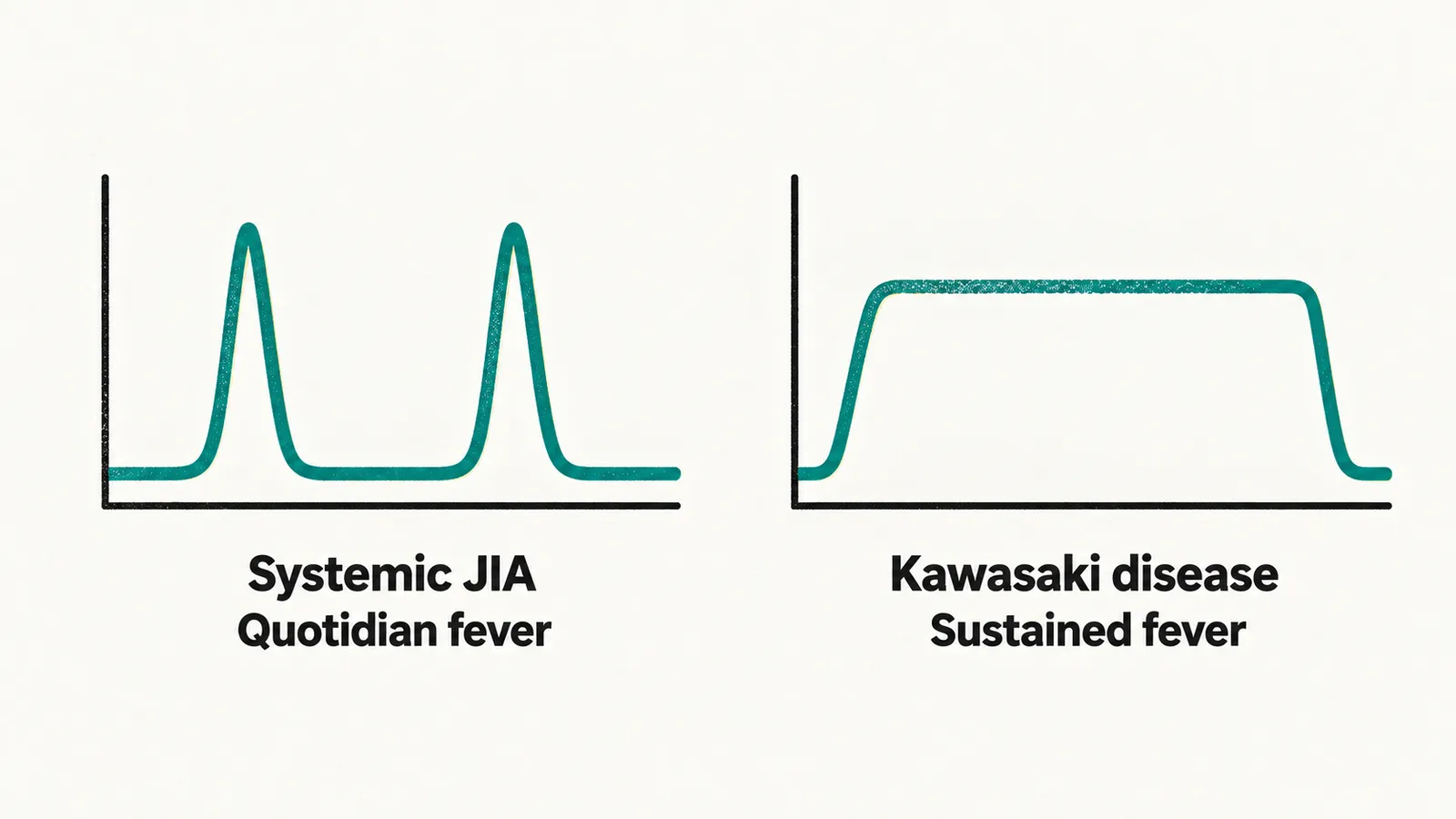
The fever is the key discriminator: it is typically , spiking once or twice daily to high values and returning towards normal in between, and it often precedes the arthritis by weeks. A child with recurring daily spikes, a rash that appears with each spike, and joint pain is a different diagnostic problem from a child with sustained fever, and the shape of the fever chart is often the first clue that the illness is not an ordinary infection.
The differential, and the trap in it
Like every category of JIA, systemic JIA is diagnosed by recognising a pattern and excluding the alternatives, and because the fever often comes before the arthritis, the alternatives are many. Persistent fever with rash and joint complaints in a child has a wide and serious differential, and the trap within it is malignancy: leukaemia and lymphoma can produce the same picture, especially where there is bone pain, night pain, or cytopenia (a low count of one or more blood cell lines). Acute lymphoblastic leukaemia is the classic mimic, and bone marrow examination is part of the workup of a child whose systemic JIA does not behave typically.
The other alternatives to work through are:
- Infection — sepsis, endocarditis, Epstein-Barr virus, cytomegalovirus, osteomyelitis.
- Kawasaki disease — fever, rash and lymphadenopathy, but the fever is sustained rather than spiking, and the echocardiogram shows coronary involvement.
- Other rheumatic disease — systemic lupus erythematosus and other vasculitides.
- Inflammatory bowel disease with associated arthritis.
Macrophage activation syndrome
Macrophage activation syndrome (MAS) is the most dangerous complication of systemic JIA. It is a state of uncontrolled activation of T lymphocytes and macrophages, with features that overlap with , a related syndrome in which activated macrophages engulf blood cells. It can develop at the onset of the disease or during a flare — often triggered by an infection or by a change in treatment.
The picture is of a child who suddenly becomes much worse:
- Unremitting, sustained fever, losing the quotidian pattern,
- pancytopenia (a fall in red cells, white cells and platelets together),
- hepatosplenomegaly, sometimes with liver failure,
- coagulopathy with bleeding,
- neurological symptoms — drowsiness, irritability, seizures.
Typical laboratory findings are a very high ferritin, raised triglycerides, low fibrinogen, raised liver enzymes and lactate dehydrogenase, hyponatraemia, and haemophagocytosis (macrophages that have engulfed blood cells) on bone marrow examination. Falling ESR (erythrocyte sedimentation rate) in the face of a rising CRP (C-reactive protein) is a useful clue, because the ESR falls as fibrinogen is consumed.
MAS is a medical emergency with high mortality if it is not recognised, and it is treated with high-dose intravenous corticosteroids together with cyclosporine, with anakinra (an IL-1 inhibitor) added in refractory cases. The trigger to remember is the child with known systemic JIA whose fever suddenly becomes continuous and whose blood counts fall.
Between those emergencies, the systemic disease and the other categories of JIA are managed by a long-term strategy that is measured against a target rather than by the severity of the moment.