
Osteoporosis weakens the skeleton through low bone mineral density and disrupted bone architecture, so treatment has a single aim: to reduce the risk of fracture. Bone mineral density is the measure used to follow the response, but the target is not a normal scan. Somebody who has already fractured, or who has a very low density, remains at high risk even if treatment raises the density into the normal range, because the deterioration in bone architecture persists. Treatment is continued and risk reassessed rather than stopped when the numbers improve.
Non-drug measures
Everyone at risk, whether or not they take medication, is advised on the measures that support bone health and reduce the chance of falling:
- Calcium: a total intake of 1000 mg/day for men aged 50–70 years, and 1200 mg/day for women aged 51 and over and men aged 71 and over, from diet where possible and supplements where not.
- Vitamin D: 800–1000 units/day, aiming for a serum 25-hydroxyvitamin D of at least 30 ng/mL.
- Smoking cessation and moderation of alcohol intake.
- Weight-bearing and muscle-strengthening exercise, with balance training.
- Removal or reduction of the things that cause falls: sedating medications, postural hypotension, poor vision, and hazards in the home.
These measures are not a substitute for drugs in a patient who has already fractured or who has osteoporosis by densitometry.
Who should be treated
Pharmacological treatment is considered in postmenopausal women and men aged 50 years or older who have any of the following:
- a hip or vertebral fracture, regardless of T-score;
- a fracture of the pelvis, proximal humerus or distal forearm together with low bone mass;
- a T-score of ≤ -2.5 at the femoral neck, total hip, lumbar spine or 33% radius;
- low bone mass with a FRAX 10-year probability of major osteoporotic fracture of 20% or more, or of hip fracture of 3% or more.
The same thresholds are used to diagnose osteoporosis in the Diagnosis and risk assessment of osteoporosis note; here they mark the point at which treatment is worth starting. A T-score is the number of standard deviations below the young-adult mean bone mineral density, and FRAX is the tool that estimates the 10-year fracture probability from clinical risk factors.
Drugs
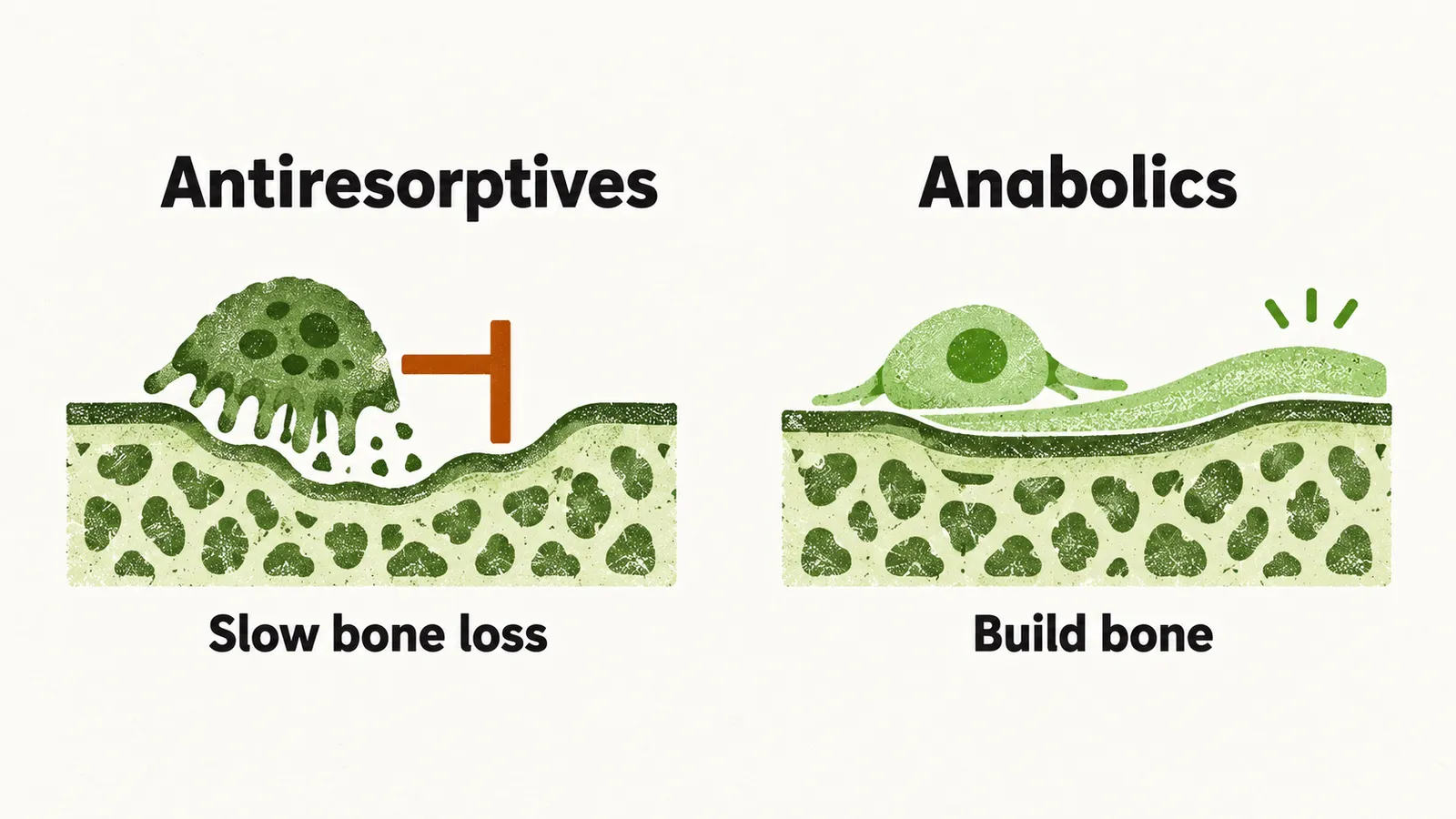
The drugs fall into two families. Antiresorptives slow bone loss by suppressing osteoclast activity. Anabolics build bone by stimulating the osteoblast.
| Drug | Class | Dose and route | Notes |
|---|---|---|---|
| Alendronate, risedronate | Bisphosphonate (antiresorptive) | Oral, weekly (also daily or monthly) | Take on an empty stomach with plain water and stay upright for 30 minutes; contraindicated if the estimated glomerular filtration rate (eGFR) is below 30–35 mL/min |
| Zoledronic acid | Bisphosphonate (antiresorptive) | 5 mg intravenous once a year | Same renal contraindication; a flu-like reaction is common after the first dose |
| Ibandronate | Bisphosphonate (antiresorptive) | Oral monthly or intravenous every 3 months | Reduces vertebral fractures but not non-vertebral fractures |
| Denosumab | RANKL inhibitor (antiresorptive) | 60 mg subcutaneous every 6 months | Blocks RANKL, the signal that drives osteoclast formation; must not be paused; when it is stopped, another antiresorptive is started |
| Teriparatide | Parathyroid hormone (PTH) analog (anabolic) | 20 µg subcutaneous daily | Follow with an antiresorptive; avoid with skeletal malignancy, Paget’s disease, or previous skeletal radiotherapy, and in raised alkaline phosphatase of unknown cause |
| Abaloparatide | Parathyroid hormone-related protein (PTHrP) analog (anabolic) | 80 µg subcutaneous daily | As for teriparatide |
| Romosozumab | Sclerostin inhibitor (anabolic) | 210 mg subcutaneous monthly for 12 months | Avoid within a year of a myocardial infarction or stroke |
| Raloxifene | Selective estrogen receptor modulator | 60 mg oral daily | Reduces vertebral fractures but not non-vertebral fractures; increases venous thromboembolism |
| Calcitonin | Antiresorptive | 200 units intranasal daily | Second line; reduces vertebral fractures only |
| Estrogen or estrogen–progestin therapy | Antiresorptive | Various | Mainly for younger postmenopausal women with vasomotor symptoms who cannot take a bisphosphonate or denosumab; a progestin is required if the uterus is intact |
For most patients at high risk, treatment begins with an oral bisphosphonate — alendronate or risedronate — or with intravenous zoledronic acid where the oral route is unsuitable. Denosumab is an alternative antiresorptive and is preferred when oral bisphosphonates cannot be used, for example with uncontrolled esophageal disease or an eGFR below 30–35 mL/min.
Raloxifene and calcitonin are weaker options that reduce vertebral but not non-vertebral fractures, so they are reserved for patients who cannot take the first-line drugs or who have an additional reason to prefer them, such as a high risk of breast cancer in the case of raloxifene.
For patients at very high risk — multiple vertebral fractures, a recent fracture, or a very low T-score — an antiresorptive alone may not lower risk enough, and treatment starts instead with an anabolic agent for 1 to 2 years, followed by an antiresorptive to hold the gain.
Sequence, duration and stopping
The order in which drugs are given matters. An anabolic agent works less well after a potent antiresorptive, so when the two are combined in sequence, the anabolic is given first and the antiresorptive afterwards.
Bisphosphonates are retained in bone, which is why they are the only osteoporosis drugs that can be temporarily paused. After 5 years of oral treatment or 3 years of intravenous treatment, a patient who is no longer at high risk — a T-score above -2.5 and no new fracture — can stop, in what is called a drug holiday. A patient who remains at high risk continues, up to 10 years on an oral bisphosphonate or 6 years on annual intravenous zoledronic acid.
Denosumab is the opposite case. Its effect disappears within months of the next missed dose, and stopping it can cause rapid bone loss and multiple vertebral fractures. It is therefore either continued long term or followed immediately by another antiresorptive.
Monitoring and adverse effects
Bone mineral density is re-measured 1 to 2 years after treatment is started or changed, and the patient is reassessed periodically. Adherence is checked at every encounter, because a large proportion of patients stop treatment within the first year, and non-adherence is itself associated with more fractures.
Adverse effects are uncommon, but two matter because they shape how long treatment is continued. Osteonecrosis of the jaw and atypical femoral fracture both occur rarely with antiresorptives and become more likely with longer treatment; the risk of either is far smaller than the fracture risk of leaving osteoporosis untreated. Hypocalcemia must be corrected before a bisphosphonate or denosumab is given. Romosozumab carries a cardiovascular warning and is avoided in patients who have had a myocardial infarction or stroke in the previous year.