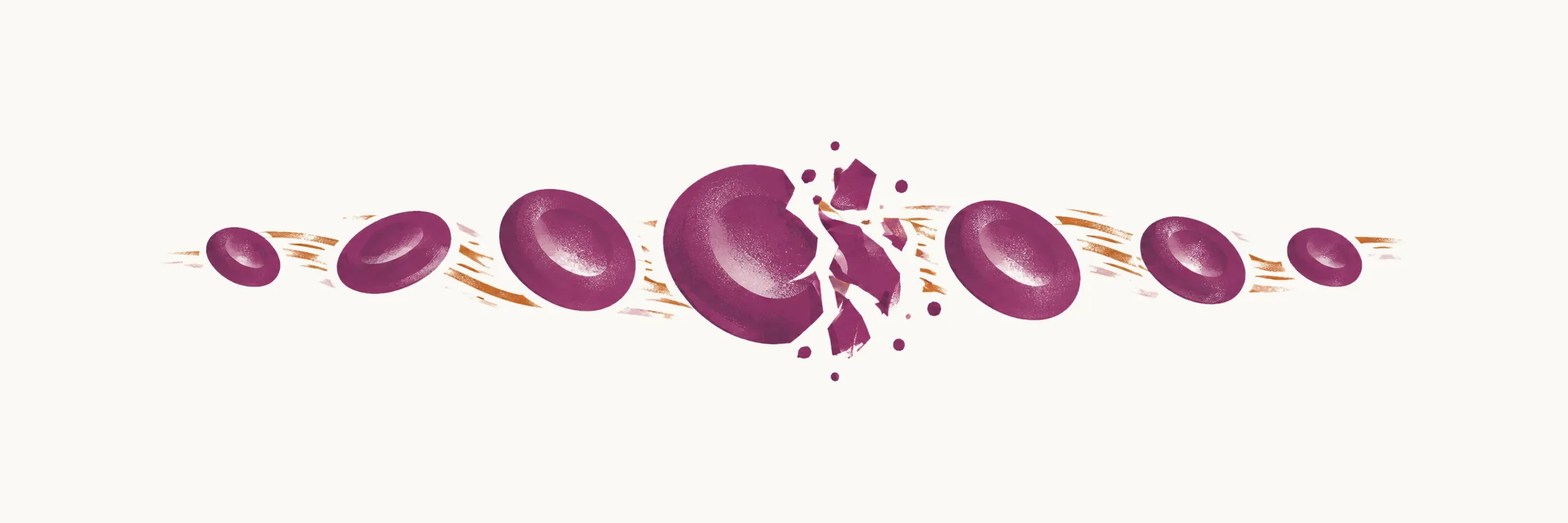
Hemolytic anemia arises when red blood cells are destroyed faster than the bone marrow can replace them. Anemia is classified into three groups by the mechanism that produces it:
- anemia due to decreased production of red blood cells;
- anemia due to acute blood loss;
- anemia due to increased destruction of red blood cells.
The last two remove red cells from the circulation while the marrow’s ability to replace them stays normal, or rises only within its physiological range. Hemolytic anemia belongs to the third group, and it presents in very different ways: inherited or acquired, acute or chronic, mild or severe, with the destruction taking place inside the vessels or in the spleen and liver.
Inherited and acquired causes
The question that organises the topic is whether the fault lies in the red cell or acts on it from outside. Inherited hemolytic anemias come from a defect built into the red cell itself, and four kinds are recognised: the hemoglobinopathies (thalassemia and sickle cell disease), which follow the hemoglobin molecule; defects of the membrane and of the cytoskeleton, the protein scaffold that supports it; defects of the ion channels that control red cell volume; and defects of the enzymes that supply the cell with energy and protect it from oxidation.
Acquired hemolytic anemias destroy red cells that are themselves normal, and they arise from antibodies against the red cell, physical trauma in the circulation, infection, or drugs and chemicals. Paroxysmal nocturnal hemoglobinuria completes the group: an acquired defect of the anchor that holds protective proteins to the cell surface leaves the red cell unprotected from complement, the set of plasma proteins the immune system uses to destroy cells.
Choose a route through the topic
Two notes give the framework that applies to every cause, and the remaining six take the causes one at a time. Start with Pathophysiology of Hemolytic Anemia: why a mature red cell cannot repair damage, how a shortened red cell lifespan becomes anemia only when destruction outpaces production, and why a patient can have hemolysis without anemia.
Then Clinical and Laboratory Features of Hemolytic Anemia: the signs that point to hemolysis rather than to another anemia, the laboratory markers that separate intravascular from extravascular hemolysis, and the iron problems each pattern can produce.
The inherited causes come next:
- Hemolytic Anemia from Membrane and Cytoskeleton Defects: how the red cell membrane and its cytoskeleton are built, and the inherited disorders that follow when their proteins fail — hereditary spherocytosis and hereditary elliptocytosis, with southeast Asian ovalocytosis and hereditary pyropoikilocytosis.
- Channelopathies and Hereditary Stomatocytosis: the rare ion-channel defects that change red cell volume and cause hemolysis, mainly dehydrated and over-hydrated hereditary stomatocytosis, and why splenectomy is contraindicated in them.
- Hemolytic Anemia from Enzyme Abnormalities: the enzyme systems a red cell depends on and the anemias that follow their failure — pyruvate kinase deficiency in the glycolytic pathway and G6PD deficiency in the red-ox balance.
The acquired causes follow:
- Acquired Hemolysis: Mechanical, Infectious and Toxic Causes: hemolysis caused by physical trauma to red cells, by infection, including malaria and shiga-toxin producing E. coli, and by drugs and chemicals that damage red cells directly or provoke antibodies against them.
- Autoimmune Hemolytic Anemia: antibody-mediated destruction of red cells — the warm type with its abrupt onset, Coombs testing and treatment, and the cold type, which includes cold agglutinin disease and paroxysmal cold hemoglobinuria.
- Paroxysmal Nocturnal Hemoglobinuria: the acquired hemolytic anemia caused by loss of the complement-regulating proteins CD55 and CD59, with its triad of hemolysis, pancytopenia and venous thrombosis, and treatment that blocks C5.