The acquired hemolytic anemias include the forms caused by physical trauma to the red cells, by infection, and by drugs and chemicals. What they share is that the red cell itself is normal and the damage comes from outside it.
Mechanical destruction
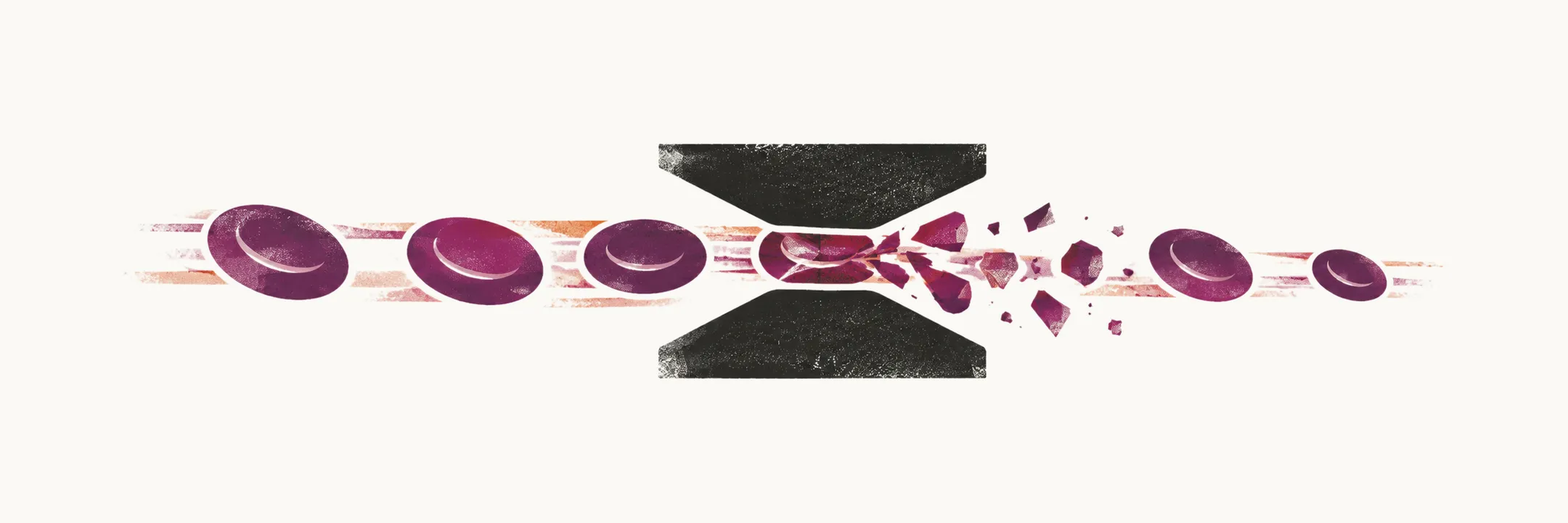
Red cells deform easily to pass through the microvasculature, even through vessels narrower than themselves, but in two settings the mechanical forces are strong enough to fragment them. Both produce intravascular hemolysis with hemoglobinuria:
- march hemoglobinuria, an acute and self-limiting condition that occurs in situations such as marathon running, whose mechanism is not fully understood;
- microangiopathic hemolytic anemia, in which red cells are cut apart as they pass through vessels narrowed or blocked by fibrin and platelet plugs, as in thrombotic thrombocytopenic purpura, hemolytic uremic syndrome and disseminated intravascular coagulation, or across an abnormal mechanical surface such as a prosthetic heart valve, especially one that regurgitates. The fragments (schistocytes) are visible on the blood film.
Microangiopathic hemolysis is not managed as an isolated anemia: the microangiopathy is the emergency, and its cause has to be identified at once. Thrombotic thrombocytopenic purpura, one of its causes, is treated with plasma exchange.
Infection
Infection causes hemolysis in different ways, and the leading cause depends on where the patient lives. In endemic areas the most common infectious cause of hemolysis is malaria; in non-endemic areas it is Shiga-toxin-producing E. coli O157:H7.
Shiga-toxin-producing E. coli and hemolytic uremic syndrome
The E. coli form is more common in children than in adults, and it causes hemolytic uremic syndrome (HUS), the combination of microangiopathic hemolysis, a low platelet count and acute kidney injury. HUS is therefore one of the microangiopathic causes described above. Most HUS follows infection; a smaller group, atypical HUS, is caused not by infection but by a dysregulation of the alternative complement pathway, and it tends to relapse.
Clostridium perfringens sepsis
In life-threatening Clostridium perfringens sepsis, the lecithinase toxin causes intravascular hemolysis.
Drugs and chemicals
Many chemicals generate oxidative stress (damage from reactive oxygen species) and cause hemolysis even in patients who do not have glucose-6-phosphate dehydrogenase (G6PD) deficiency, the enzyme defect that leaves red cells unprotected against oxidation. Examples include hyperbaric oxygenation, nitrate, chlorate, dapsone, cisplatin and aromatic compounds.
A second group damages the red cell without oxidation. These include lead, arsine, copper and stibine.
In both groups the chemical acts directly on the cell. It can also act indirectly, by turning the immune system against the red cell. A drug can behave as a hapten, a small molecule that provokes an antibody response once it binds to a larger carrier, so that antibodies form against it and the red cell caught in the antibody–drug complex is destroyed, as with penicillin. Alternatively, antibodies made against a drug can cross-react with the red cell itself, as with methyldopa. Among the drugs that matter most for hemolysis are diclofenac, piperacillin, ceftriaxone and oxaliplatin.