Myelodysplastic syndrome (MDS) is a group of clonal marrow disorders in which blood cells are produced abnormally (dysplasia) and blood counts fall (cytopenia). It has been reclassified several times, and each revision has redrawn the boundary between MDS and acute myeloid leukemia (AML). The categories matter because they name the disease, set the prognostic score, and decide whether a patient is treated as MDS or as leukemia, so it helps to know what each system was trying to fix. Most of the systems count blasts, the immature myeloid cells (myeloblasts) of the marrow and blood, because the blast percentage separates lower-grade disease from leukemia.
The FAB classification of 1982
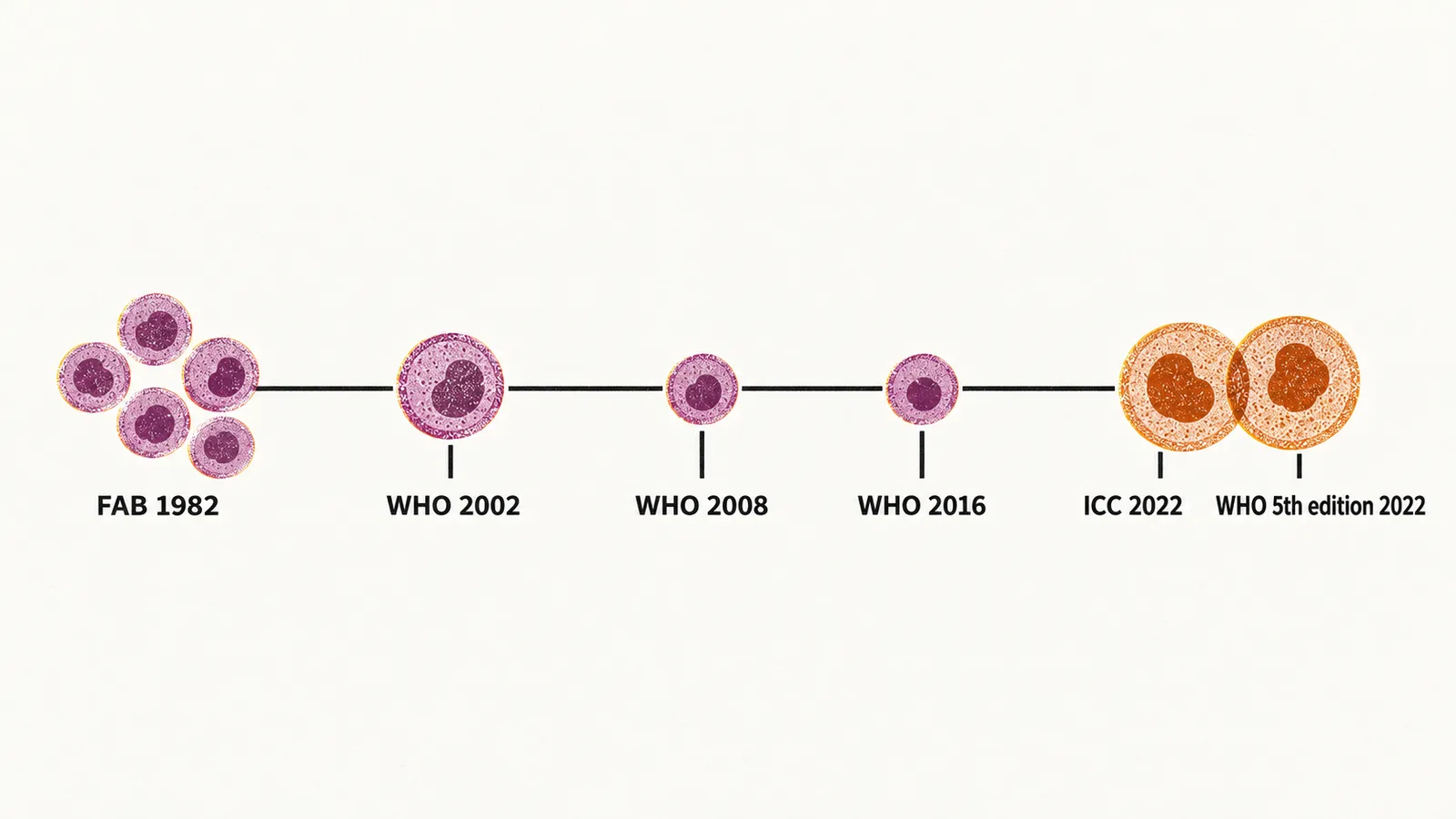
MDS covers a broad spectrum of pathology and clinical behaviour, and the first widely used scheme was produced in 1982 by the French-American-British (FAB) group. It rested on morphology alone, meaning the appearance of the cells under the microscope: the percentage of myeloblasts in the bone marrow and peripheral blood, together with the number of monocytes and the share of ring sideroblasts (red-cell precursors with iron deposits ringing the nucleus). It defined five subtypes:
- refractory anemia or RA
- refractory anemia with ringed sideroblasts or RARS
- refractory anemia with excess blasts or RAEB
- refractory anemia with excess blasts in transformation or RAEB-t
- chronic myelomonocytic leukemia or CMML
The WHO classification of 2002
The WHO classification of 2002 is more complicated than the FAB scheme, because it adds clinical and genetic information to morphology. Classification is mainly based on the blast percentage, and the blast percentage at which AML is diagnosed was reduced from 30% to 20%. As a consequence, RAEB-t, which has more than 20% myeloblasts, is considered AML, and RAEB-t is eliminated from the classification. Erythroid-predominant leukemias are now generally considered MDS.
Within MDS, RAEB is split into RAEB-I (5-10% blasts, median survival 2-3 years) and RAEB-II (10-20% blasts, median survival about 1 year). CMML is no longer a subtype of MDS but part of the myeloproliferative disorders.
Genetic and morphological markers also enter the scheme: the presence of Auer bodies (rod-shaped inclusions in blasts) is related to a poor prognosis, and a single mutation in SF3B1 is characteristic of sideroblastic anemia.
The 2008 and 2016 revisions
A WHO revision in 2008 made small changes to the 2002 version: the term refractory anemia was replaced by refractory cytopenia with unilineage dysplasia, and RCMD and RCMD-RS were merged into RCMD. In 2016 the WHO released another revision with further changes of terminology.
The groups that replaced the FAB subtypes
Taking the changes of 2002 and 2016 together, MDS was sub-classified into new groups instead of the FAB ones:
- RA and RARS
- refractory cytopenia with multilineage dysplasia or RCMD
- RCMD with ringed sideroblasts or RCMD-RS
- refractory anemia with excess blasts-1 or RAEB-1, and RAEB-2
- MDS, unclassified or MDS-U
- MDS associated with isolated del(5q)
In this scheme CMML sits as a bridge between MDS and the myeloproliferative disorders.
Why MDS is hard to diagnose morphologically
MDS is difficult to diagnose even for experts, and there is no firm agreement on the morphological changes. The findings that carry most weight are a change in the appearance of the megakaryocytes (more reliable than the next two), loss of granules in neutrophil precursors, and dyserythropoiesis. Because the morphology and the genetics are both hard to agree on, the 2022 WHO classification focused on cytogenetic and morphological defects together. The two 2022 systems that follow, the ICC and the WHO 5th edition, both build on that combination.
The International Consensus Classification (ICC)
The International Consensus Classification (ICC) classifies MDS on the basis of specific cytogenetic abnormalities (chromosome changes in the cells), dysplasia, or excess blasts. It allows a diagnosis of MDS in some genetically defined subtypes even when dysplasia is not visible. The table lists its entities.
| ICC entity | Defining criteria |
|---|---|
| MDS with SF3B1 mutation | SF3B1 mutation in at least 10% of the cells, without a TP53 or RUNX1 mutation; sideroblasts are not mandatory; bone marrow blasts < 5% and peripheral blood blasts < 2%; cytopenia ≥ 1; dysplasia ≥ 1 |
| MDS with del(5q) | del(5q) with up to one other cytogenetic abnormality, except del(7q); bone marrow blasts < 5% and peripheral blood blasts < 2%; dysplasia ≥ 1; cytopenia ≥ 1 |
| MDS with mutated TP53 | a multi-hit TP53 abnormality (two TP53 mutations, or one mutation with deletion or loss of heterozygosity of the other allele) with bone marrow or peripheral blood blasts < 10% |
| MDS-NOS, without dysplasia | no dysplasia; cytopenia ≥ 1; peripheral blood blasts ≤ 2% and bone marrow blasts ≤ 5%; deletion of 7q, monosomy 7 or a complex karyotype |
| MDS-NOS, single lineage dysplasia | one dysplastic lineage; cytopenia ≥ 1; peripheral blood blasts ≤ 2% and bone marrow blasts ≤ 5%; any cytogenetic abnormalities except a 5q deletion |
| MDS-NOS, multilineage dysplasia | dysplasia in ≥ 2 lineages; cytopenia ≥ 1; peripheral blood blasts ≤ 2% and bone marrow blasts ≤ 5%; any cytogenetic abnormalities except a 5q deletion |
| MDS with excess blasts | dysplasia ≥ 1; cytopenia ≥ 1; peripheral blood blasts 2-9% and bone marrow blasts 5-9%; any cytogenetic abnormalities |
| MDS/AML | peripheral blood or bone marrow blasts 10-19%; any cytogenetic abnormalities except the ones that define AML |
The separation of MDS/AML at 10% blasts exists so that these patients can enter either MDS or AML trials depending on the clinical situation.
The WHO 5th edition classification
The latest WHO classification, the WHO 5th edition, also classifies MDS on the basis of either cytogenetic abnormalities or morphological changes. It also recognises clonal cytopenia of undetermined significance (CCUS), a clonal cytopenia that falls short of MDS because dysplasia is below the diagnostic threshold and blasts are not increased.
| WHO 5th edition entity | Defining criteria |
|---|---|
| MDS with low blasts and del(5q) | del(5q) or monosomy of chromosome 5, with up to one other cytogenetic abnormality except del(7q); bone marrow blasts < 5% and peripheral blood blasts < 2%; a mutated TP53 or SF3B1 is permitted if the other criteria are met |
| MDS with low blasts and SF3B1 mutation | SF3B1 mutation, or ≥ 15% ring sideroblasts in the bone marrow without the mutation; bone marrow blasts < 5% and peripheral blood blasts < 2%; absence of a 5q deletion and of monosomy 7 |
| MDS with biallelic inactivation of TP53 | two TP53 mutations, or one mutation with evidence of TP53 deletion or loss of heterozygosity; bone marrow or peripheral blood blasts < 20% |
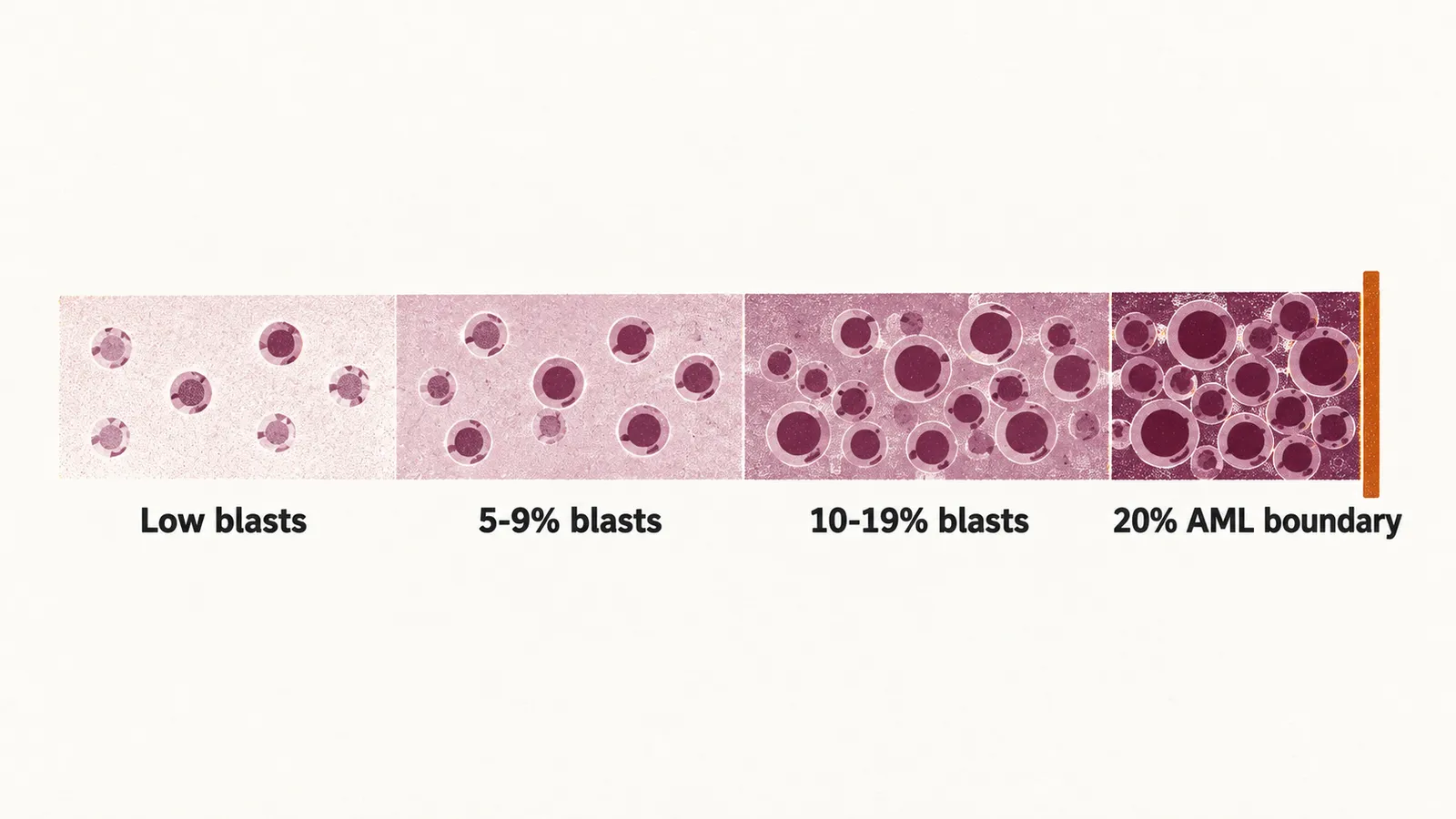
| MDS with low blasts | bone marrow blasts < 5% and peripheral blood blasts < 2% |
| MDS with hypoplastic bone marrow | bone marrow cellularity less than 25%, adjusted by age |
| MDS with increased blasts, MDS-IB1 | bone marrow blasts 5-9%, or peripheral blood blasts 2-4% |
| MDS with increased blasts, MDS-IB2 | bone marrow blasts 10-19%, or peripheral blood blasts 5-19%, or Auer rods with any blast percentage up to 19% |
The 20% blast count remains the boundary between MDS and AML in both systems, but the ICC and the WHO 5th edition draw the internal lines differently, and a patient can change category depending on which one is applied. These categories describe what the disease looks like; who develops it, and what happens in the marrow to produce these findings, is a separate question.