
Myelodysplastic syndrome (MDS) is most often fatal through the complications of pancytopenia or through progression to acute myeloid leukemia (AML), and the factors behind that outcome also drive the scores used to estimate survival. The same features that name the disease — blast count, karyotype and the number of cytopenias — are the ones that predict its course, which is why prognosis can be read from the diagnostic work-up.
Causes of death
The fatality of MDS is most often due to complications of the pancytopenia, such as bleeding or infection, or to the complications of progression to AML. Infection is a major contributor: about 40% of the deaths from infection complications in patients with MDS are related to pneumonia.
Prognosis by classification
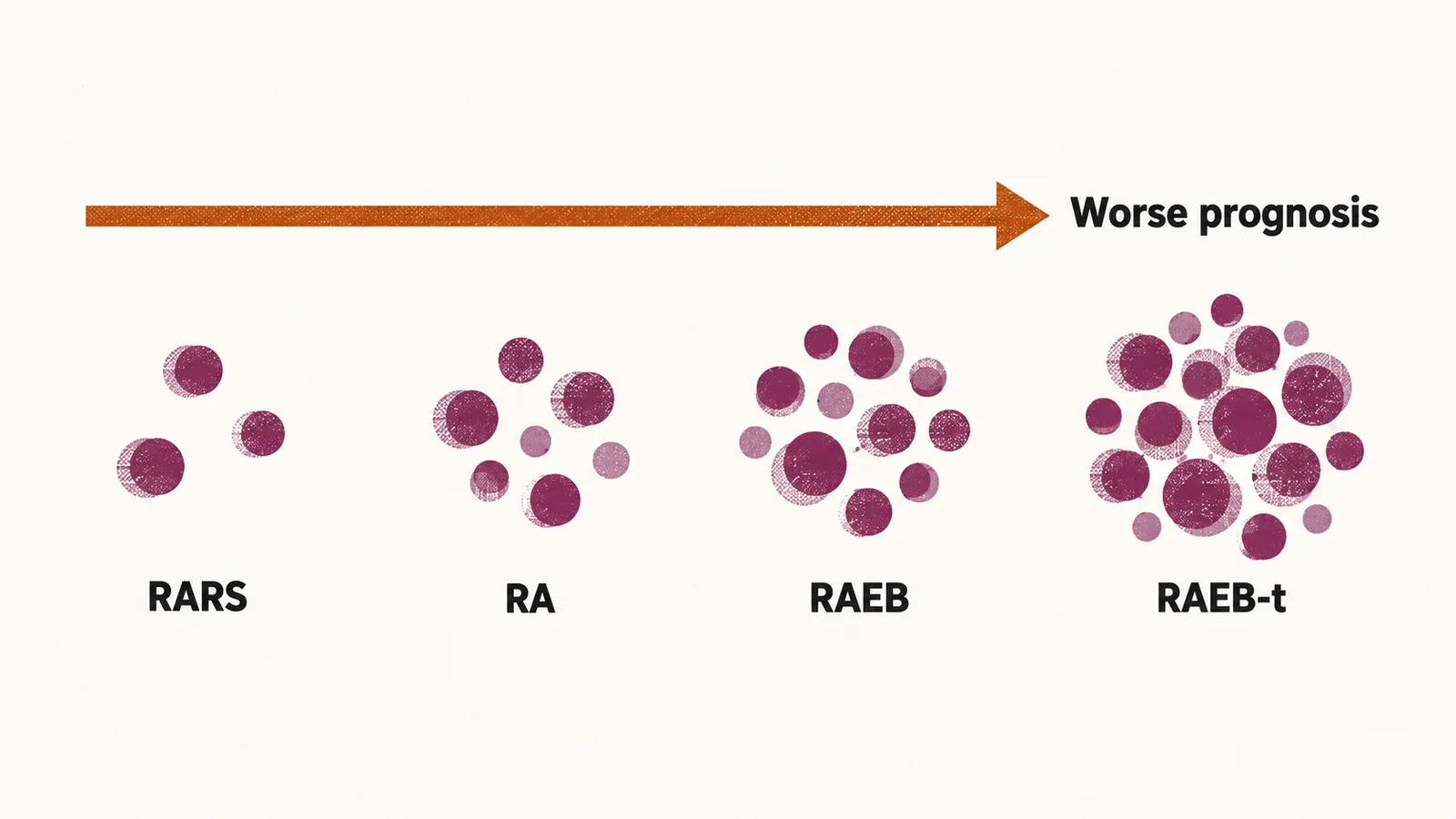
Within the FAB (French-American-British) classification, RARS (refractory anemia with ring sideroblasts) has the best prognosis and RAEB-t (refractory anemia with excess blasts in transformation) has the worst, for both survival and freedom from progression to AML. The reason is the blast count: the lowest myeloblast counts (the percentage of immature myeloid cells in the marrow) are found in refractory anemia (RA) and RARS, and the highest in RAEB-t, so prognosis is directly correlated with the number of myeloblasts in the bone marrow.
Survival is also correlated with the number of cytopenias the patient has at the first presentation: the higher the number of cytopenia forms at the first presentation, the worse the prognosis. The two effects combine, so median survival (the time by which half of the patients have died) varies extremely, from years in del(5q) to months in RAEB and in monosomy of 7. Within the recent WHO classification, studies show that the worst prognosis is for RAEB-2 and the best prognosis is still for RA/RARS.
The International Prognostic Scoring System and its revisions
The International Prognostic Scoring System (IPSS) turns those features into four prognostic groups — low, intermediate-1, intermediate-2 and high risk — based on three main factors (karyotype being the set of chromosome abnormalities in the marrow cells):
- bone marrow blast count
- karyotype and cytogenetic abnormalities
- the number of cytopenias present in the patient
The IPSS scores the cytogenetic abnormalities, and a new cytogenetic scoring system was introduced later, with a revised scoring table for the IPSS. This revised format is the IPSS-R.
The IPSS-M is a different form, a molecular-based scoring system: because more than 90% of the cases of MDS carry a somatic mutation (a gene change acquired during life rather than inherited), this new method of scoring was made in 2022.
The IPSS-M uses different factors, such as:
- clinical data: marrow blast percentage, hemoglobin, and platelet count
- cytogenetics: the presence of different cytogenetic abnormalities
- molecular data: the presence of different mutations in different genes, such as TP53, RUNX1 and others
One distinguishing feature of the IPSS-M is that it also predicts survival after hematopoietic stem cell transplantation (HSCT).