
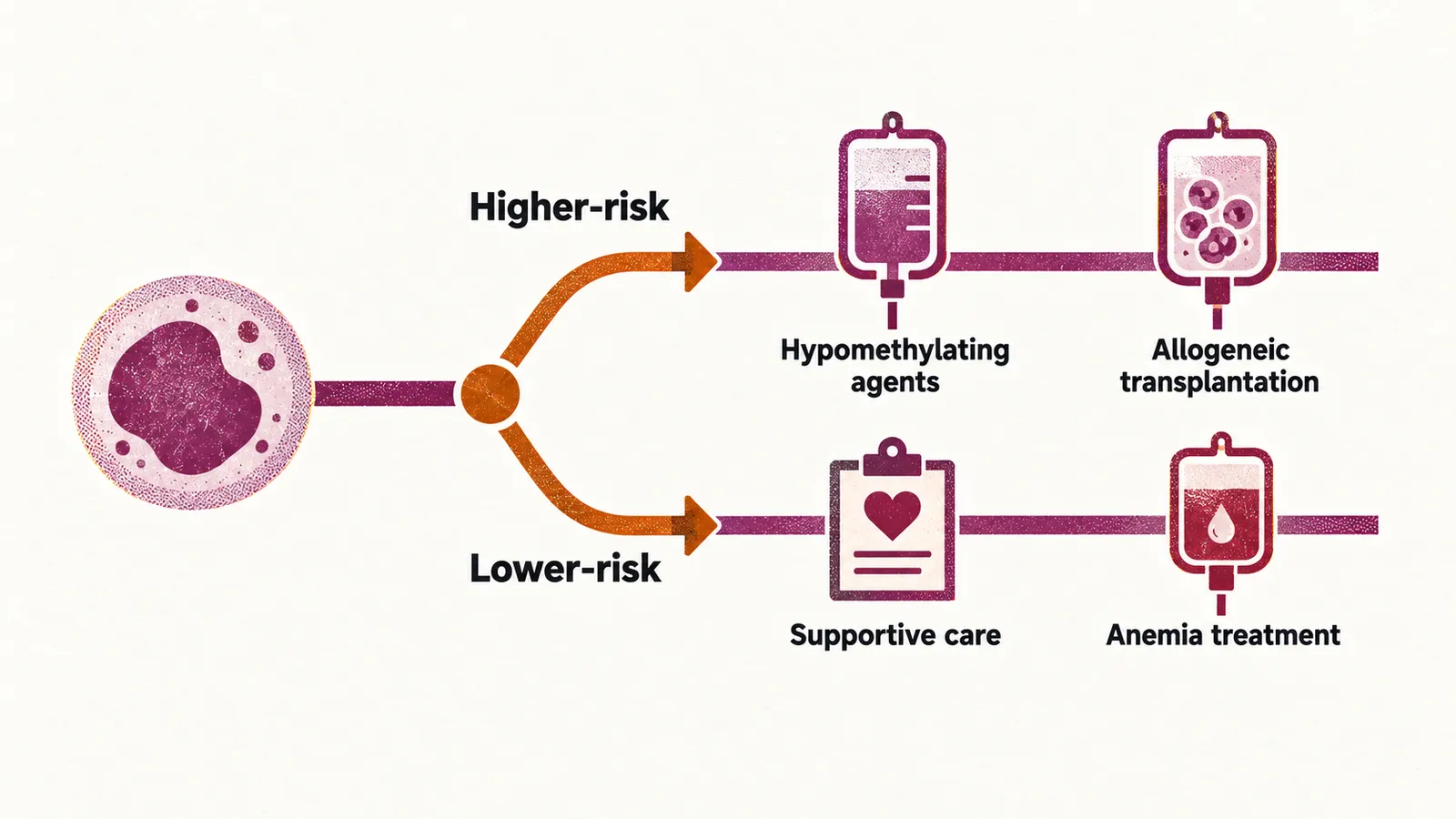
Treatment in myelodysplastic syndrome (MDS) is decided less by the subtype name than by where the patient sits on the risk spectrum. Risk is assigned by a prognostic score such as the IPSS-R or the molecular IPSS-M; lower-risk covers the low and intermediate categories, where the disease usually behaves indolently, and higher-risk covers the rest, where survival is limited by the disease itself. The same drugs therefore appear in very different roles depending on that position.
The two goals of treatment
In lower-risk MDS the disease is usually not immediately life-threatening, so the goals are to reduce the cytopenias and their symptoms, to decrease transfusion requirements, and to delay progression to higher-risk disease or acute myeloid leukemia (AML). Many patients, especially those without symptomatic cytopenia, are simply monitored with regular blood counts rather than treated.
In higher-risk MDS the disease itself threatens survival, so the goals change to prolonging survival and, where the patient is eligible, cure. This difference in aim, rather than any difference in the drugs available, is what makes risk stratification the first step of management.
Supportive care
Supportive care addresses the consequences of each cytopenia, and it runs through both ends of the spectrum; in lower-risk disease it is often the mainstay. It rests on a few principles:
- red-cell transfusion for symptomatic or severe anemia, which relieves symptoms but does not treat the clone
- iron chelation when repeated transfusions cause iron overload, because the excess iron damages organs over time
- platelet transfusion, and in selected patients a thrombopoietin receptor agonist, when thrombocytopenia causes bleeding
- treating and preventing infection when neutropenia is present
- attention to bone health, since patients with MDS are at higher risk of bone loss
Treating anemia in lower-risk MDS
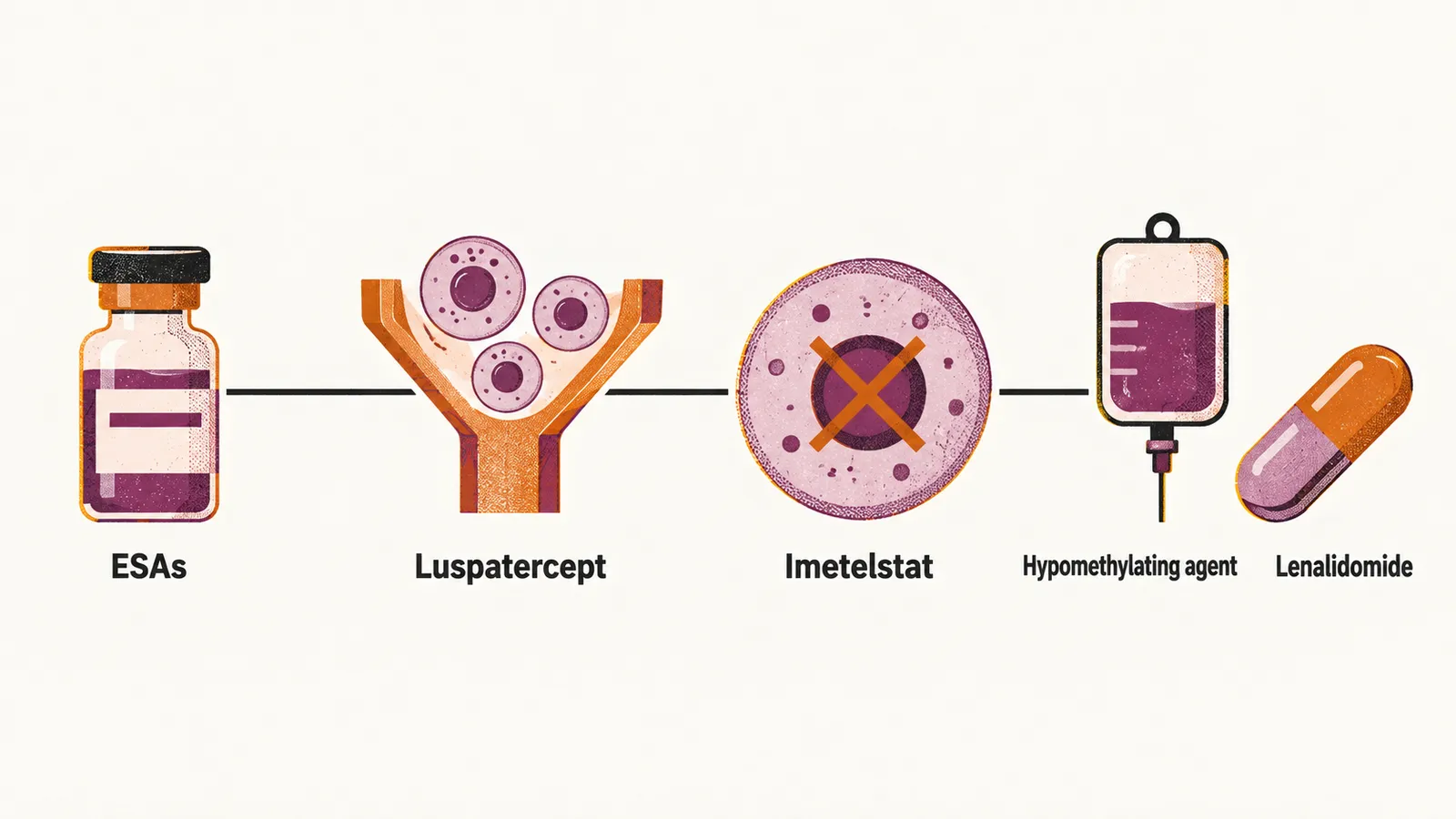
Anemia is the cytopenia that most often drives treatment, and the options are chosen in a sequence that depends on transfusion dependence (a regular need for red-cell transfusions) and on the serum erythropoietin level, erythropoietin being the hormone that stimulates red-cell production.
Erythropoiesis-stimulating agents (ESAs), which act like erythropoietin, remain the standard first-line treatment for symptomatic anemia in non-transfusion-dependent patients. They work best when serum erythropoietin is low, and they are less likely to help once it is high (above about 200 U/L), which is why that level is checked before they are started.
Luspatercept is a ligand trap for transforming growth factor-β superfamily members, and it improves red-cell production in patients whose ineffective erythropoiesis is driven by that pathway. It is particularly effective in patients with ring sideroblasts and an SF3B1 mutation, and it can be used first-line in transfusion-dependent lower-risk MDS, including before an ESA has been tried.
Imetelstat is a telomerase inhibitor; telomerase is preferentially active in the malignant clone, so inhibiting it pushes the abnormal progenitor cells toward apoptosis while relatively sparing normal cells. It is used in transfusion-dependent lower-risk MDS that has not responded to, or cannot receive, an ESA.
For lower-risk patients in whom these options are exhausted, a hypomethylating agent or lenalidomide may be used, and such patients should also be considered for clinical trials.
MDS with deletion of 5q
MDS carrying a del(5q) behaves differently. Lenalidomide is the first-line treatment for the symptomatic anemia of this subtype, whether or not the patient is transfusion-dependent, and it can reduce transfusion needs and suppress the abnormal clone. If it fails, the patient is managed as a non-del(5q) patient.
Thrombocytopenia and hypoplastic MDS
Isolated thrombocytopenia can be treated with a thrombopoietin receptor agonist, although this is not an approved indication everywhere.
A distinct group is hypoplastic MDS, in which the marrow is hypocellular rather than packed with the clone. Here, immune suppression with anti-thymocyte globulin and cyclosporine can restore hematopoiesis, because part of the cytopenia is immune-mediated. This is the same subtype that the WHO 5th edition separates out by its low marrow cellularity.
Higher-risk MDS
In higher-risk disease the hypomethylating agents azacitidine and decitabine are the standard first-line treatment for patients who are not candidates for transplantation. They act on the abnormal epigenetic regulation of the clone and prolong survival compared with supportive care or conventional chemotherapy. An oral form, decitabine combined with cedazuridine, delivers the same exposure without daily injections.
Response is judged over several cycles, and a patient with stable disease may reasonably continue treatment beyond the first 4 to 6 cycles; once the disease progresses on a hypomethylating agent, the outcome is poor.
Combinations and targeted agents are used in specific situations:
- venetoclax added to azacitidine is an option, though it has not consistently improved survival over azacitidine alone
- TP53-mutated disease responds poorly to hypomethylating agents and to their combinations, and transplantation offers the best, though still limited, chance
- IDH1 inhibitors such as ivosidenib and olutasidenib are used when an IDH1 mutation is present
For patients whose disease has progressed to an AML-like picture, intensive chemotherapy is used when fitness allows, in the same way as for AML.
Allogeneic hematopoietic stem cell transplantation
Allogeneic hematopoietic stem cell transplantation is the only curative treatment for MDS. It is offered to eligible patients with higher-risk disease, and to some lower-risk patients whose cytopenias persist despite other treatment. Eligibility depends on age, performance status, major comorbid conditions, psychosocial status, patient preference and the availability of a caregiver.
Patients with a high blast count, above about 10%, or with an MDS/AML picture are usually treated first with a remission-inducing agent before transplantation, because reducing the disease burden improves the outcome. In older or frail patients, a hypomethylating agent is often chosen for this step instead of intensive chemotherapy, because it is less toxic.