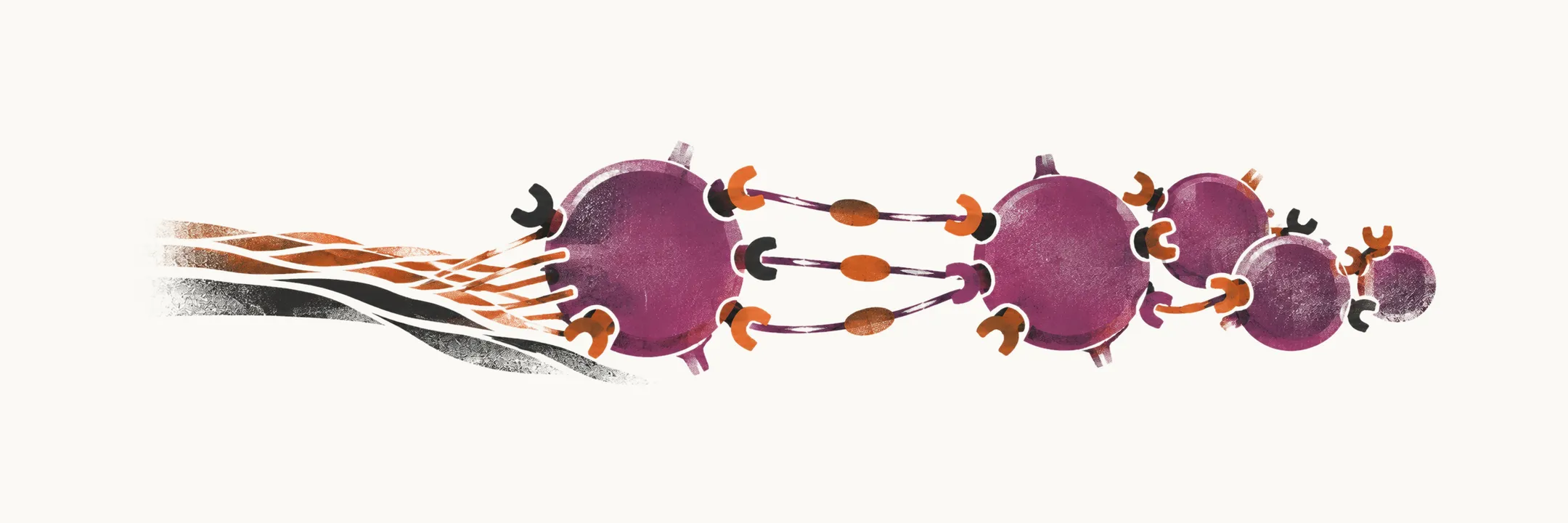
Platelets are small cell fragments that circulate in blood and assemble the plug that seals a damaged vessel wall. Their activation is not a zero-or-one event: different adhesion molecules and agonists (soluble activating signals such as thrombin and ADP) activate platelets to different degrees, in quantity and in quality. This graded response lets the same platelet behave differently depending on the stimulus.
Platelet granules
Platelets carry two types of granule, and the contents of each point to its role. The α-granules are the larger and more abundant type, and they hold the mediators of the platelet’s inflammatory activity: soluble coagulation proteins, cytokines, growth factors, adhesive molecules, integrins and inflammatory mediators. The dense granules are smaller and less abundant, and they hold adenosine diphosphate (ADP) and serotonin, which act mainly on platelet aggregation and on vasomotor activity.
Adhesion to the damaged vessel wall
When the endothelium, the cell layer lining the vessel, is damaged, it exposes molecules that activate the platelets: von Willebrand factor (VWF), collagen, fibronectin, vitronectin and thrombospondin. Collagen-induced activation under high flow depends on molecules on the platelet surface, including glycoproteins such as glycoprotein VI (GPVI) and the integrin (a type of adhesion receptor) α2β1.
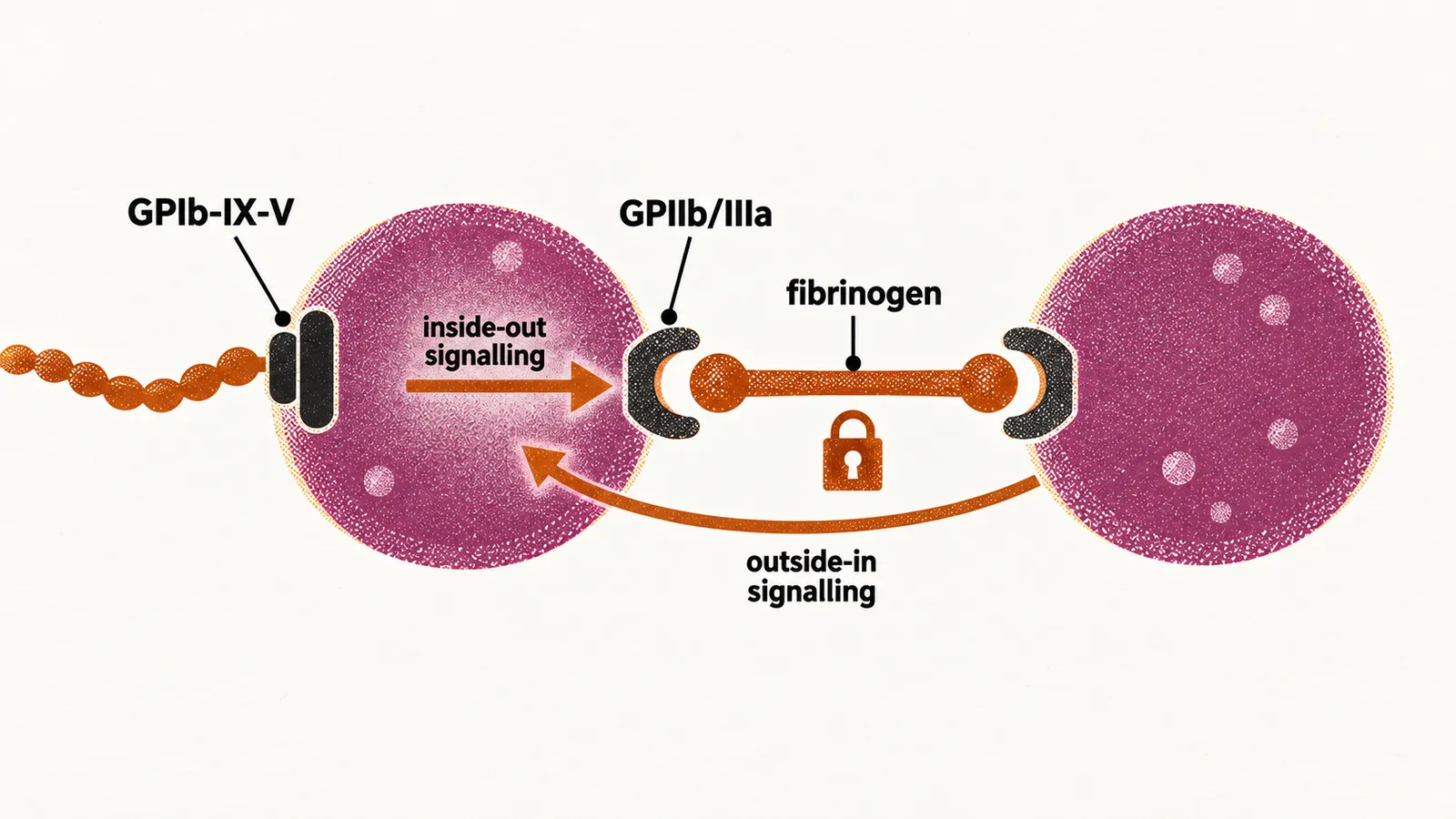
The central surface glycoprotein for platelet adhesion and for the initiation of platelet activation is the GPIb-IX-V complex. It binds the exposed VWF, which both anchors the platelet to the wall and activates intracellular pathways inside the platelet. That binding also changes the conformation of the platelet fibrinogen receptor GPIIb/IIIa from a low-affinity to a high-affinity state for fibrinogen.
Activation and irreversible aggregation
Adhesion is not the only source of activating signals. Soluble agonists act through one of the most important receptor families on the platelet, the seven-transmembrane family, which includes the thrombin receptors (the protease-activated receptors PAR1 and PAR4), the ADP receptors (P2Y1 and P2Y12), and prostaglandin, lipid and chemokine receptors. Both P2Y1 and P2Y12 must be activated for ADP-induced platelet aggregation, which is why the antiplatelet drugs clopidogrel and prasugrel work by inhibiting P2Y12. Platelets also carry the purinergic receptor P2X1, but it is an ATP-gated non-selective cation channel rather than an ADP receptor, and it is not a seven-transmembrane receptor.
After a platelet receives several initial activatory signals, GPIIb/IIIa is changed from its low-affinity to its high-affinity state for fibrinogen. Because signals from inside the platelet alter a receptor on its surface, this change is called inside-out signalling. Once GPIIb/IIIa binds fibrinogen, the binding sends further signals back into the platelet — outside-in signalling — which stabilises the activated state and makes aggregation irreversible rather than reversible.
Inflammation, infection and platelet reactivity
The receptors on the platelet surface fall into two broad groups. Thrombotic receptors carry out adhesion and activation during thrombus formation, and non-thrombotic receptors mediate adhesion of the platelet to endothelial cells, neutrophils and mononuclear cells. Through this second group, platelets interact with white blood cells, and that interaction matters when inflammation is present.
Inflammatory conditions increase platelet reactivity. During an inflammatory illness such as an upper respiratory infection, the risk of myocardial infarction rises, and patients with acute coronary syndromes show not only a greater tendency for platelets to aggregate but also more interaction between platelets and leukocytes (white blood cells).
The link between the two cell types is direct. Activated platelets expose P-selectin, which binds P-selectin glycoprotein ligand-1 (PSGL-1) on leukocytes. This interaction increases the formation of tissue factor (TF), the protein that triggers coagulation, by monocytes, and the production of CD11b/CD18, which amplifies immunity.
A second immune effect comes from CD40 ligand: on activation it is translocated to the platelet surface, then cleaved from the cell to become the soluble CD40 ligand, an important immune modulator.
Platelets also carry Toll-like receptors (TLR), which recognise molecules from microbes, so bacterial and viral infections can in some cases produce infection-induced thrombosis. Infection is also a risk factor for venous thrombosis, where the thrombus forms with less dependence on platelets.