
A thrombophilia is an increased tendency to thrombosis. Five inherited thrombophilias are tested for: antithrombin deficiency, protein C deficiency and protein S deficiency, which weaken the natural anticoagulants, and factor V Leiden and the prothrombin G20210A variant, which are gain-of-function changes that favour clotting.
Thrombophilia testing asks whether a patient carries one of these inherited tendencies to clot, but the result rarely changes how that patient is managed, so the decision is less about the test than about who is worth testing. In an adult, the answer depends on whether the patient has already had a venous thromboembolism (VTE) and on the family history.
When to screen for thrombophilia
In an asymptomatic adult there is no clinical benefit from screening for thrombophilia. Screening is reserved for a very high familial history of VTE or for a very high-risk setting such as major surgery.
In an adult with proven VTE, testing is guided by the family history. If a family member had VTE before 45 years of age, all five inherited thrombophilias are tested. Without such a family history, screening is run if the patient has one of the conditions below:
- a young patient with age less than 45
- recurrent thrombosis
- thrombosis in multiple venous regions
- a history of warfarin-induced skin necrosis
- a history of arterial thrombosis
Treatment of venous thromboembolism
Whatever the screening decision, the VTE itself is treated with anticoagulation, and the drugs fall into two groups by route and by how quickly they act.
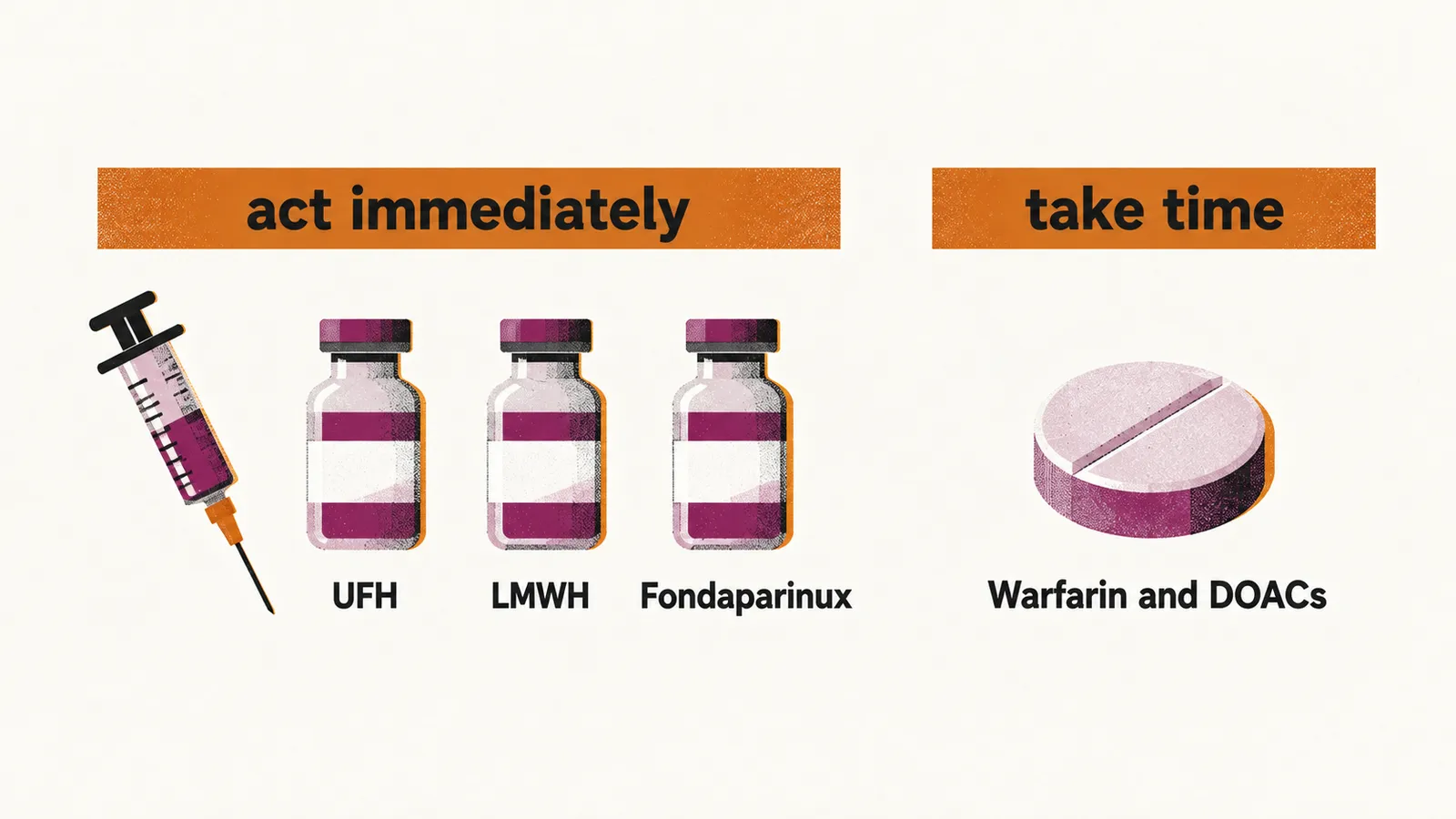
The heparin-type drugs act immediately by enhancing antithrombin, the natural inhibitor of thrombin and factor Xa, and they are given parenterally (by injection). They are the usual starting therapy for an acute event:
- unfractionated heparin (UFH)
- low-molecular-weight heparin (LMWH)
- fondaparinux
The oral drugs take time to reach full effect. Warfarin inhibits the vitamin K-dependent clotting factors, so it is monitored with the INR (international normalized ratio, a standardised clotting-time measure) and is normally overlapped with a heparin at the start. The direct oral anticoagulants (DOACs) act directly on factor Xa or on thrombin, and they do not need this bridging or routine monitoring.
The heparin-type drugs appear again in prevention, where LMWH, low-dose unfractionated heparin and fondaparinux are used to stop VTE from developing in patients at risk.