
Congenital myotonic dystrophy (CDM) is the congenital form of myotonic dystrophy type 1 (DM1): an autosomal dominant expansion disorder of the DMPK gene on chromosome 19 that presents in the newborn as a floppy infant. It is uncommon, with an estimated incidence around 1 in 47,000 live births, but it matters beyond the infant, because the diagnosis often reveals an undiagnosed mother and changes counseling for the whole family.
From CTG expansion to spliceopathy
DM1 comes from an expanded CTG trinucleotide repeat, the three-base sequence CTG repeated many times in a row, in the noncoding region of DMPK. Normal alleles carry 5–34 repeats, premutation alleles 35–49, and full disease alleles 50 or more, with congenital cases usually above 1,000. The expanded repeat is transcribed into RNA that folds into structures trapping muscleblind splicing proteins, so splicing goes wrong in many genes at once. That shared mechanism, called spliceopathy, explains why one mutation affects muscle, heart, eye, endocrine, and brain together.
Longer expansions broadly correlate with earlier and more severe disease, but somatic mosaicism means different tissues carry different repeat sizes, so repeat length alone cannot predict an individual’s course. Repeats tend to grow between generations (anticipation), and congenital disease follows maternal transmission in about 90% of cases. DM2, from a different gene, has no congenital form, so a floppy infant with myotonic dystrophy means DM1.
The neonatal presentation
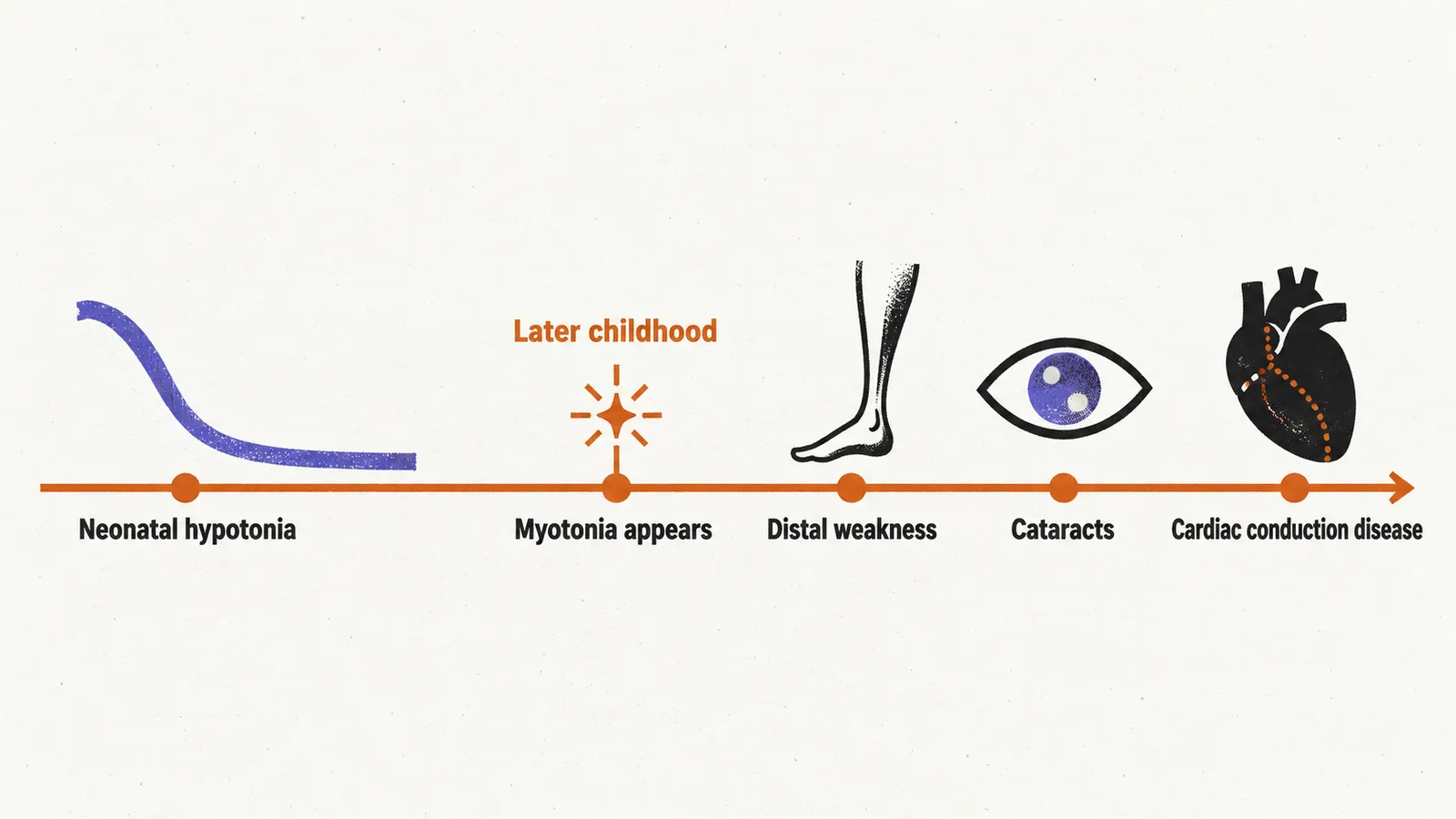
Myotonia is classically absent in infancy and appears only in later childhood, so the newborn is simply floppy. Characteristic features include severe facial and jaw weakness (the mouth hangs open, sometimes with a tented upper lip), poor suck with secretion handling difficulty, generalized hypotonia and weakness, and clubfoot. Respiratory insufficiency is the main early danger, and neonatal mortality is up to 40% in published series.
CDM is a mixed hypotonia: the motor unit is diseased and the brain is involved too, with intellectual disability and speech delay common in survivors. The course is biphasic: tone and strength often improve through infancy and childhood, then the classic adult DM1 picture of distal weakness, myotonia, cataracts, and cardiac conduction disease emerges later.
Recognizing the adult disease in the mother
The adult form helps find the congenital one. Because congenital disease follows maternal transmission in most cases, and because hypotonic newborns warrant examination of the parents, the mother’s examination is part of the infant’s. Distal wasting, grip myotonia, early cataracts, frontal balding, and cardiac conduction defects in a parent, particularly the mother, should prompt suspicion.
The diagnosis can also run the other way. A mother with unrecognized myotonia can be diagnosed through her floppy infant, and confirming the DMPK expansion in the child obliges testing the mother.
Management
Management of CDM itself is supportive: neonatal respiratory and feeding support, orthopedic correction, developmental and speech support, plus lifelong cardiac, respiratory, endocrine, and eye surveillance. No disease-modifying therapy exists yet.
CDM sits between the two branches of the floppy differential, with a diseased motor unit and an affected brain in the same infant. The purely central end of that spectrum is the infant whose motor unit is healthy and whose floppiness comes from the brain alone.