Chronic diarrhea in children is defined by duration first and explained by mechanism second. Duration separates it from the acute illness that usually precedes it; mechanism decides which part of the work-up to follow, and therefore which diagnosis is even possible.
Duration thresholds
The thresholds used in pediatric practice sit on a continuum that begins with acute gastroenteritis:
- Acute diarrhea — less than 7 days, and in practice not longer than 14 days. In Europe it is viral in the great majority of children and is managed by replacing fluid (see Acute Diarrhea and Dehydration).
- Prolonged diarrhea — 7 to 14 days. Often an acute illness that is resolving slowly, but already the point at which a non-infectious cause may be declaring itself.
- Chronic diarrhea — 14 days or more. Some pediatric texts reserve the word chronic for four weeks or more, and the two thresholds are used interchangeably in different sources. The clinical consequence is the same: the differential has changed completely.
- Intractable diarrhea — a historical term for severe diarrhea of infancy that does not respond to enteral feeding and requires parenteral nutrition. It describes a group of congenital enteropathies rather than a duration.
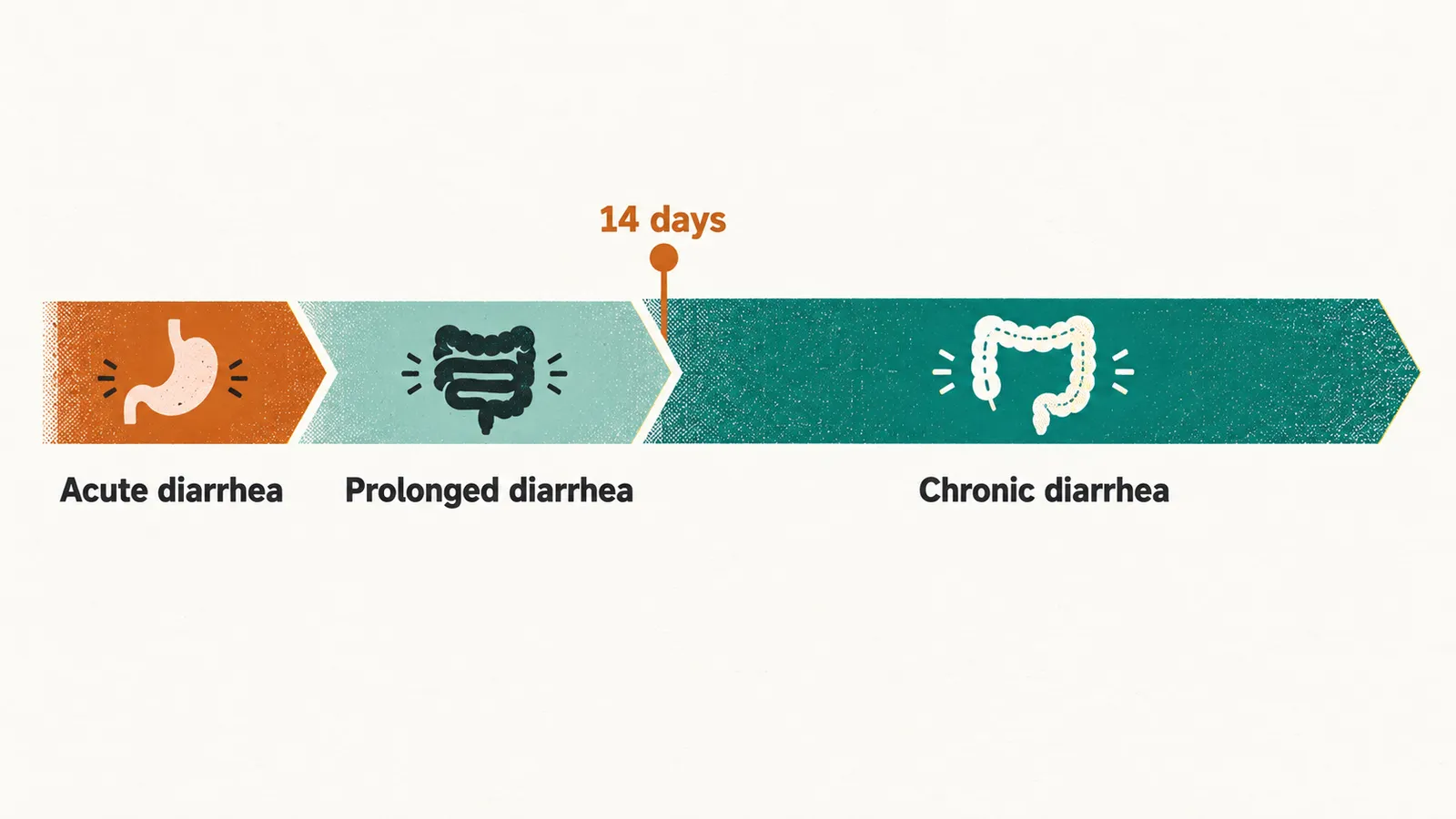
The exact thresholds matter less than the shift they mark. Acute diarrhea in children is overwhelmingly infectious, and its causes are covered in Etiology and Risk Factors of Acute Diarrhea. Chronic diarrhea is functional in many children, but it is also where malabsorption, immune-mediated mucosal disease and congenital defects live, and none of those is settled by rehydrating the child.
Four mechanisms, and why most cases are mixed
Water movement across the intestinal mucosa normally follows solute: water goes where dissolved particles go. Anything that adds an unabsorbed solute to the lumen (the inside of the bowel), drives secretion, damages the mucosa or blocks fat digestion will produce loose stools, but each does it differently — and the difference is visible at the bedside and in the stool.
One of the stool discriminators is a calculation. The stool osmotic gap is calculated as 290 − 2 × (stool sodium + stool potassium) in mmol/L; a high gap points to an unabsorbed solute, a low gap to active secretion. A gap between 50 and 100 mOsm/kg is intermediate and does not settle the question on its own.
| Mechanism | Behavior | Bedside and stool discriminators | Typical pediatric examples |
|---|---|---|---|
| Osmotic | An unabsorbed solute holds water in the lumen | Stools stop when the child fasts; stool osmotic gap greater than 100 mOsm/kg; acidic stool (pH below about 5.5) with positive reducing substances (unabsorbed sugars detected in the stool) when the solute is a carbohydrate | Lactose or other disaccharide intolerance, excessive fruit juice or fructose, some malabsorptive states |
| Secretory | The mucosa actively secretes chloride and water | Stools continue during fasting; stool osmotic gap below 50 mOsm/kg; large volumes | Enterotoxin-driven diarrhea, congenital chloride diarrhea, laxative or osmotic-drug ingestion; rare as an isolated mechanism in children |
| Fat malabsorption (steatorrhea) | Fat is not digested or not absorbed, and the unabsorbed load carries water with it | Pale, bulky, greasy, foul-smelling stools, sometimes with visible oil; high osmotic gap | Pancreatic exocrine insufficiency — cystic fibrosis is the most important cause — plus chronic pancreatitis, bile-salt deficiency and mucosal disease such as celiac disease |
| Inflammatory | Inflamed mucosa leaks blood, mucus, protein and water | Blood and mucus in the stool, urgency and tenesmus (a painful, persistent urge to pass stool), raised blood inflammatory markers (CRP or ESR) and raised fecal calprotectin, a stool protein released by neutrophils | Inflammatory bowel disease, cow’s milk protein allergy, eosinophilic gastroenteritis, infections |
Pure mechanisms are the exception: most children with chronic diarrhea have a mixed picture, an osmotic load from malabsorbed carbohydrate layered on mucosal inflammation, or fat malabsorption with an osmotic component. Fasting response is also a bedside observation, not a laboratory test; withholding food from an already faltering child to prove a mechanism costs more than it gives.
Fat malabsorption deserves its own pointer, because its investigation differs from the rest. When stools are pale, greasy and offensive and the child is not growing, the next tests are fecal elastase-1 for pancreatic exocrine insufficiency and a sweat chloride test for cystic fibrosis; a sweat chloride of 60 mmol/L or more is diagnostic of cystic fibrosis, and below 30 mmol/L the diagnosis is unlikely. Both tests are described with the rest of the first-line work-up in Clinical Approach and Work-up of Chronic Diarrhea in Children.
The differential changes with age
Mechanism explains how the stools are being produced; age says which diseases are likely to be producing them. Age narrows the list faster than any single symptom, and this is the reason a chronic diarrhea work-up always starts with how old the child is.
| Age band | Causes that dominate |
|---|---|
| First month | Congenital and monogenic (single-gene) enteropathies, which are inherited defects of the intestinal lining such as microvillus inclusion disease and tufting enteropathy; congenital disaccharidase defects and glucose-galactose malabsorption; congenital chloride diarrhea; primary immunodeficiency; intestinal lymphangiectasia (dilated lymph vessels in the bowel wall); very early onset IBD |
| 1–6 months | Cow’s milk protein allergy is the leading cause; congenital enteropathies become less common than in the neonatal period |
| 1–5 years | Functional (toddler) diarrhea is the single most common cause; celiac disease appears after gluten is introduced; cystic fibrosis–related pancreatic insufficiency and cow’s milk protein allergy persist |
| Older child and adolescent | IBD becomes a major consideration, irritable bowel syndrome is common, and celiac disease often presents without diarrhea at all — with short stature, anemia or dermatitis herpetiformis, its itchy blistering skin rash |
The bands are tendencies rather than rules. A congenital enteropathy can present late and IBD can present in the first year of life, so the table narrows the questions to ask rather than answering them. The benign patterns that dominate the young end of the table are described in Functional Diarrhea of Toddlerhood and Overflow Around Constipation.