
Inflammatory bowel disease (IBD) is chronic, relapsing inflammation of the gastrointestinal tract of unknown cause. Its two main forms are Crohn’s disease, which is patchy, can involve any part of the gut from mouth to anus and extends through the full thickness of the bowel wall, and ulcerative colitis, which inflames the colonic mucosa continuously from the rectum upwards.
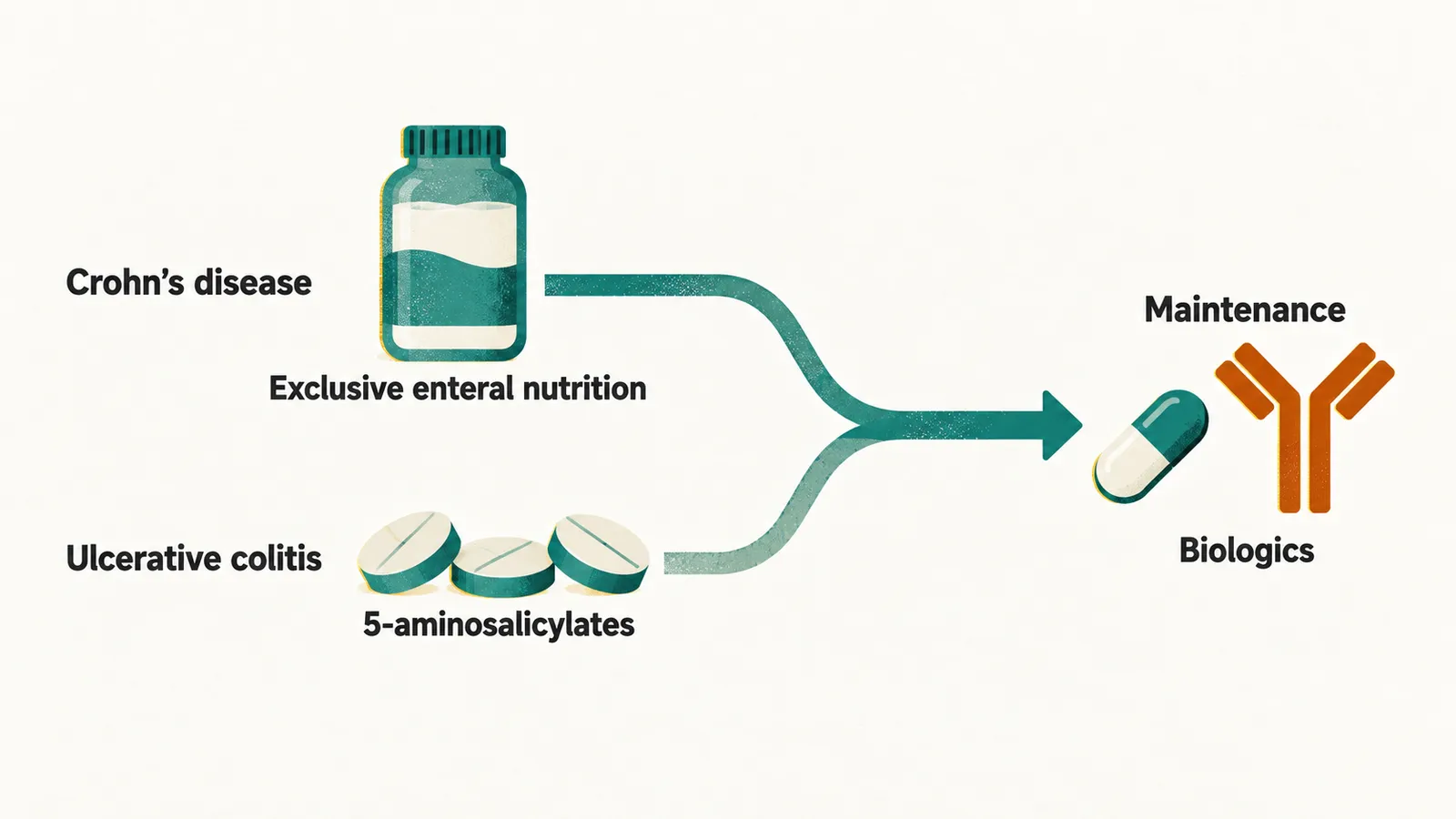
Treatment of IBD in a child runs in two phases: inducing remission, which means bringing the active inflammation under control, then keeping it. Which induction is used depends on the disease and on how severe it is at presentation rather than on the child — Crohn’s disease is induced nutritionally, ulcerative colitis by severity-based drug treatment — while maintenance looks much the same across the two. Two features of childhood shape both phases. Growth and nutrition are treatment targets rather than late-arriving side issues, and the disease will last for decades, so the treatment chosen now has to be one the child can stay on.
Induction of remission in Crohn’s disease
Exclusive enteral nutrition (EEN) is the first-choice induction therapy for pediatric Crohn’s disease, because it is as effective as corticosteroids in this setting without their toxicity, and it does not depend on a decision to use drugs. It means a complete liquid formula as the only source of calories for about 6 to 8 weeks, with regular monitoring of weight and intake. Its disadvantages are practical rather than medical: it is hard to sustain, and food-based social life disappears during the course.
The Crohn’s disease exclusion diet (CDED) with partial enteral nutrition, in which formula provides only part of the intake alongside a restricted set of foods, was developed as a less restrictive alternative. In the randomized trial that compared the two in children with mild to moderate Crohn’s disease, CDED plus partial enteral nutrition and EEN induced remission in a similar proportion at 6 weeks, and the CDED group had significantly better sustained remission at 12 weeks with better tolerance.
EEN works in Crohn’s disease, not in ulcerative colitis, so it is not the induction tool for a child with colon-only ulcerative colitis. Corticosteroids remain the alternative for children who cannot or will not complete nutritional induction.
Induction in ulcerative colitis
Ulcerative colitis follows a severity-based step-up rather than a nutritional approach. Mild to moderate disease is induced and maintained with 5-aminosalicylates (anti-inflammatory drugs that act on the colonic mucosa), with corticosteroids or immunomodulators (drugs that damp down the immune response, such as the thiopurines below) added if the response is inadequate.
Acute severe colitis, defined by a Pediatric Ulcerative Colitis Activity Index (a clinical score of disease activity) of 65 or more, is a medical emergency treated with intravenous methylprednisolone, a corticosteroid. If there is no response, second-line therapy should start by the fifth day of intravenous steroids, with infliximab as the preferred medical option and calcineurin inhibitors, another class of immunosuppressant, as an alternative in experienced centers.
Maintenance
Once remission has been induced, maintenance looks much the same in the two diseases, and it rests on two drug groups, thiopurines and biologics; mild to moderate ulcerative colitis can also be maintained with 5-aminosalicylates, as above.
Thiopurines (azathioprine, 6-mercaptopurine) remain the conventional maintenance immunosuppressant in pediatric IBD, and early introduction is associated with higher steroid-free remission rates than late introduction. Testing for thiopurine methyltransferase activity (the enzyme that breaks the drugs down) or NUDT15 variants before starting, and metabolite monitoring afterwards, is used to reduce the risk of myelosuppression, a fall in blood-cell production by the bone marrow.
Biologics are antibody-based drugs that block a specific inflammatory signal. Anti-TNF therapy, directed against tumour necrosis factor, is the best-established biologic class in children. In the European Union, infliximab is licensed for severe active Crohn’s disease and severely active ulcerative colitis in children aged 6 to 17 years who have not responded to conventional therapy, and adalimumab is licensed for moderately to severely active Crohn’s disease and moderately to severely active ulcerative colitis from 6 years of age, in each case after an inadequate response to conventional therapy.
In ulcerative colitis, infliximab — usually combined with an immunomodulator — is the first-line biologic in chronically active or corticosteroid-dependent disease, and adalimumab is used in selected cases or after loss of response to infliximab. Proactive therapeutic drug monitoring, which measures drug levels and adjusts the dose rather than waiting for symptoms to return, is recommended for both, particularly at the end of induction.
Newer agents with different inflammatory targets have been added as options after anti-TNF failure: vedolizumab is recommended as a second-line biologic in ulcerative colitis, and ustekinumab received a European license for moderately to severely active Crohn’s disease in children weighing at least 40 kg in 2025. Their use in children remains an area where evidence is still building, and the sequencing of advanced therapies is specialist territory.
Monitoring, and what is specific to children
The two features of childhood that shape treatment also shape follow-up. Growth and nutrition are treatment targets, not side effects to note later: height velocity, weight and pubertal progress are followed at every visit, and malnutrition is treated alongside the inflammation. Bone health and drug safety monitoring follow the chosen therapy.
Adherence, staying on treatment through decades of disease, is a clinical problem in its own right. Reported non-adherence among adolescents with IBD is high, and it is linked to anxiety, depression and poor quality of life, so psychosocial support is part of management rather than an adjunct.
Two further measures apply in particular situations:
- Thromboprophylaxis, preventive treatment against blood clots, should be considered in children admitted with acute severe colitis: venous thromboembolic risk is increased compared with other hospitalized children, although it is lower than in adults.
- Colorectal cancer surveillance is recommended for children with ulcerative colitis from age 12 when disease duration exceeds 8 years, and from age 12 regardless of duration when primary sclerosing cholangitis, a chronic inflammatory disease of the bile ducts associated with IBD, is present.