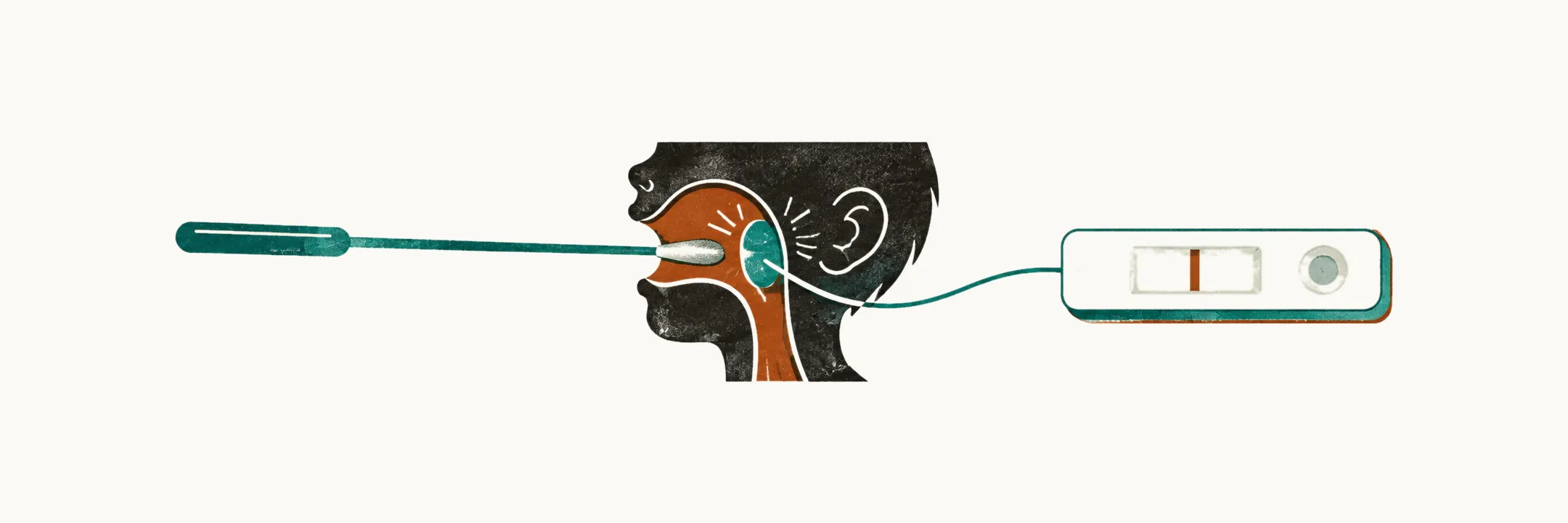
The diagnosis of group A Streptococcus (GAS) pharyngitis is made with a swab. Clinical scores can end the reasoning at the bottom of their range, but they cannot establish the diagnosis at the top, because the signs of GAS overlap with adenovirus and Epstein–Barr virus to the point of being indistinguishable. The rest of the diagnostic reasoning follows from that asymmetry: the score decides whether to test, and the test decides whether to treat.
Taking the swab: the step most often done badly
The swab is a procedure with a measurable failure rate, and almost all of the failure comes from two errors — the wrong site and the wrong pressure.
- Immobilise the child. The child who is not held will close the mouth as the swab approaches, and a swab against a moving child hurts.
- Use a tongue depressor, always. Without one, the mouth closes before the posterior pharynx is reached.
- Rub firmly over both tonsils and the posterior pharyngeal wall. A gentle, careful swab that touches only the soft palate is the classic false negative. Firm contact with the two areas where GAS sits is what makes the test work.
- Avoid saliva, the tongue base, the sublingual area and the buccal mucosa. In children with culture-proven GAS, swabs taken from those sites are frequently negative in the same child whose tonsillar swab grew the organism. The site, not the test, decides the result.
The rapid antigen detection test
The rapid antigen detection test (RADT) is the point-of-care test that made GAS diagnosis practical in primary care. An extraction reagent breaks down the bacterial cell wall and exposes the group A–specific carbohydrate antigen, which binds a labelled antibody on a strip and produces a visible line in 5 to 10 minutes. The format is the same idea as a rapid test for SARS-CoV-2, and it carries the same lesson about sampling: the test is only as good as the specimen.
Performance. Pooled estimates in children put sensitivity at about 86% and specificity at about 95%, with substantial variation between test types and between studies. That combination has two direct consequences.
- A positive RADT needs no confirmation. Specificity is high enough that a positive result in a child with a compatible illness justifies treatment, and culture adds nothing but delay.
- A negative RADT is not a rule-out in children. Because pooled sensitivity is around 86%, roughly one child in seven with true GAS will test negative. For that reason the Centers for Disease Control and Prevention and the 2012 Infectious Diseases Society of America guideline advise a back-up throat culture when the RADT is negative in a child or adolescent, with a mechanism in place for contacting the family and starting antibiotics if the culture grows GAS. Practice varies. Some national guidelines, including the United Kingdom NICE guideline on acute sore throat, do not rely on microbiological testing at all in most patients and use clinical scoring alone to choose between immediate antibiotics, back-up antibiotics and no antibiotic. Others, particularly in North America, treat the back-up culture as standard in children. The local protocol governs. What is not defensible is treating a negative rapid test in a child with a classic picture as proof that the illness is viral.
Throat culture
Throat culture remains the reference standard. Its disadvantages are timing and process:
- Results take 18 to 24 hours, and a negative plate should be re-incubated overnight: some GAS strains grow slowly, and 48-hour cultures detect a further proportion of true positives that the 24-hour reading misses.
- Susceptibility testing is unnecessary. GAS has never developed resistance to penicillin, so the result will not change the antibiotic choice.
The delay is easier to accept because antibiotics started within about nine days of symptom onset still prevent acute rheumatic fever, so a culture that returns on day 2 changes neither the rheumatic outcome nor the safety of the child. What it does change is how the child feels over those two days, which is why the rapid test matters when it is available.
Clinical scores: what the low end and the high end are worth
The McIsaac score, a modification of the Centor score, is the scoring system taught in primary care. It carries five items, one point each except for the age item:
| Item | Points |
|---|---|
| Fever (or history of fever) | +1 |
| Tonsillar exudate | +1 |
| Tender anterior cervical lymphadenopathy | +1 |
| Absence of cough | +1 |
| Age 3–14 years | +1 |
| Age 15–44 years | 0 |
| Age 45 years or older | −1 |
Maximum score 5. The two ends of the scale are not mirror images, and this asymmetry is the whole reason a score and a swab can be taught together.
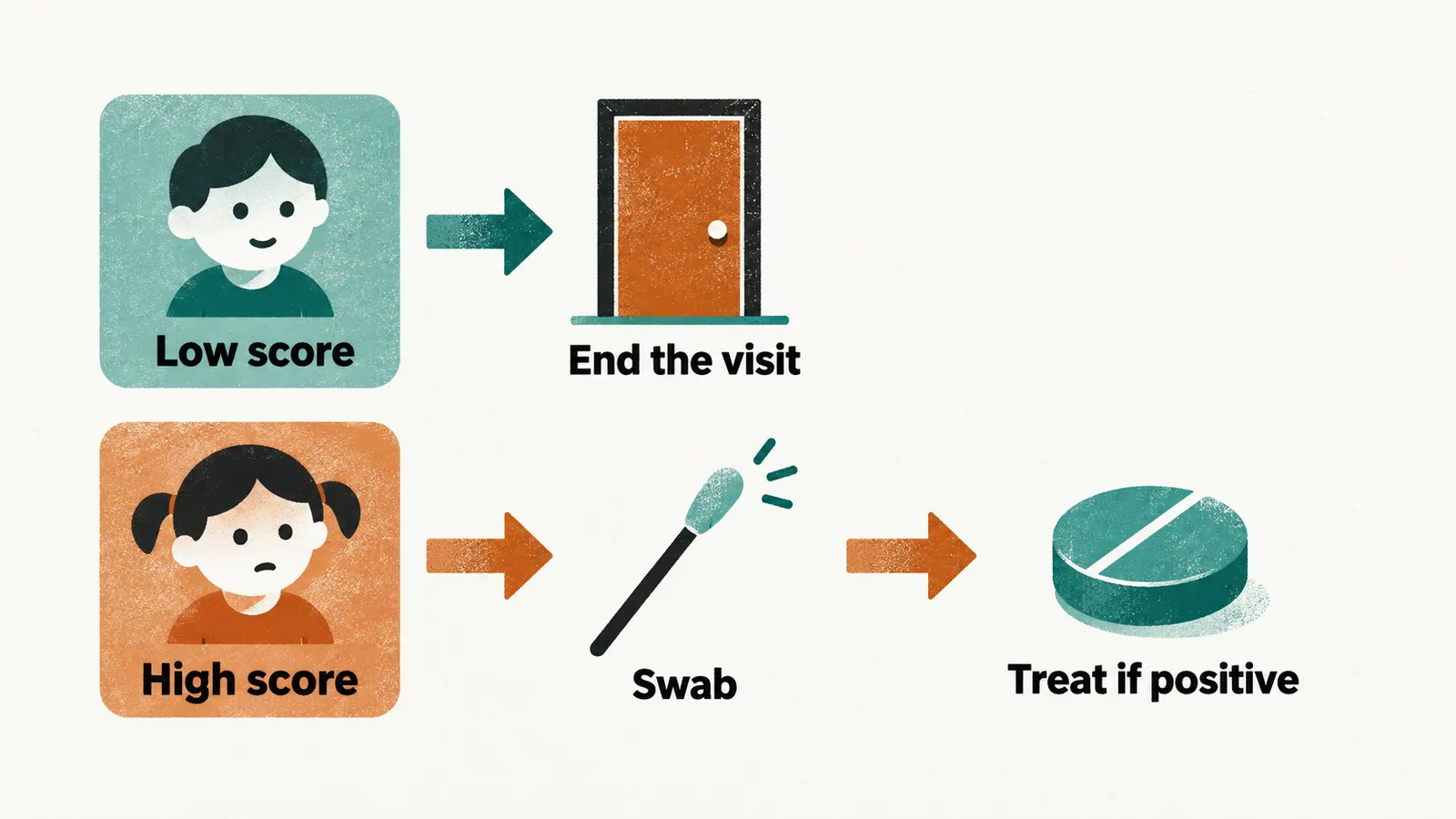
At the low end (0 or 1) the score is allowed to end the reasoning. A child with none or one of the independent predictors has a low probability of GAS, and guideline wording accepts that this band is valid to rule the diagnosis out — with two caveats: there should be no ongoing GAS epidemic, and the setting should have a low prevalence of rheumatic heart disease, as in Italy. This band can close a visit without a swab.
At the high end (4 or 5) the score has not earned the same authority. Fever, exudate, tender nodes and absent cough raise the probability of GAS, but they raise it in a way that cannot distinguish GAS from adenovirus or EBV, which produce the same exudative tonsillitis with the same nodes. The score measures the shape and severity of pharyngitis, not the presence of Streptococcus pyogenes. A high score therefore justifies a swab, and in some guidelines justifies starting antibiotics in the same encounter while awaiting it, but it never justifies believing that GAS has been established. The Infectious Diseases Society of America published a focused update in 2025 revisiting the use of clinical scoring systems for risk assessment in children and adults; the practical position remains that scoring is a triage step.
Stated as a rule: a low score can end the visit; a high score cannot. A high score only moves the decision.
Who not to test
A low score is one way of deciding not to swab; the other is the kind of child in front of you. What matters in both is the pre-test probability, meaning how likely GAS is before any test is done. Most acute pharyngitis is not GAS pharyngitis, and guideline differences exist about how much testing is worthwhile, but two situations are reasonably consistent:
- Infants under 12 months. Pharyngitis in this age group is viral in the great majority of cases and GAS is uncommon, so the pre-test probability is low and a swab rarely changes management. This is the only age band in which the old logic survives; the previous rule that children under 3 years are viral by default has been abandoned.
- A child whose illness is clearly viral — prominent cough, coryza, hoarseness or oral ulcers with no fever — has a low probability of GAS even if exudate is present.
The streptococcal carrier
Between 10% and 21% of children with microbiological evidence of GAS are chronic carriers: the organism sits in the pharynx without causing the illness that brought the child to the clinic. A carrier who contracts a viral pharyngitis will test positive, and a second positive test after treatment most often means carriage rather than failed treatment, especially if the child is asymptomatic or the illness does not behave like GAS pharyngitis.
Two practical consequences follow. First, a positive test is evidence of the organism, not proof that it is the cause, which is why the clinical picture still matters at the margin. Second, recurrent positive tests in a well child who is being treated again and again should prompt a different question — is this carriage, non-adherence, or reinfection from a household contact? — rather than another antibiotic.
Eradication of carriage is possible (combined intramuscular penicillin plus four days of oral rifampicin, or a ten-day clindamycin course, have been studied) but the evidence base is small and old, and routine treatment of carriers is not recommended. Household and classroom contacts of a case of invasive GAS disease are a separate situation: their management follows public-health guidance and includes chemoprophylaxis only in defined situations.
For the child whose positive test does reflect acute infection, the remaining questions are which antibiotic, at what dose and for how long.