Vaccination is the deliberate presentation of an antigen so that the immune system builds memory without the disease. Stanley Plotkin’s framing is the one usually quoted: apart from safe water, no other modality, not even antibiotics, has had such an effect on mortality reduction. The clinician’s part in that is partly biological — knowing which vaccine suits which pathogen — and partly operational, which means knowing the schedule well enough to notice when a child has fallen out of it.
Vaccine, vaccination, immunization
Three words are often used interchangeably, but they name different things: a product, an act and a result.
- Vaccine — a product that produces immunity to a disease and can be given by injection, by mouth or by aerosol.
- Vaccination — the act of administering a killed or weakened organism, or part of one, to produce immunity.
- Immunization — the process by which a person becomes protected. Both vaccines and natural infection can immunize.
The six vaccine types
The taxonomy matters because the choice of platform follows from the biology of the pathogen, not from convenience. The first question about any platform is whether the organism replicates: a live vaccine produces a strong, durable response with few doses, while in a non-replicating vaccine the immune system sees only the antigen it contains, and purified protein antigens usually need an adjuvant.
| Type | How it works | Examples |
|---|---|---|
| Live-attenuated | The organism is alive and replicates, but has been weakened so that it does not cause disease. Replication produces a strong, durable response, usually with one or two doses | Measles, mumps, rubella (MMR), varicella, rotavirus (oral), yellow fever, BCG, oral polio vaccine |
| Inactivated (“killed”) | The organism cannot replicate; the immune system sees a fixed dose of antigen | Injected influenza vaccine, inactivated polio vaccine (IPV), hepatitis A |
| Subunit (toxoid, protein fragment) | Purified protein antigens or chemically inactivated toxins, which are less immunogenic than a replicating organism and usually need an adjuvant | Diphtheria and tetanus toxoids, acellular pertussis (in DTaP), recombinant hepatitis B |
| Conjugate | A polysaccharide antigen chemically joined to a protein carrier, so that the response becomes T-cell dependent | Hib conjugate, pneumococcal conjugate, meningococcal conjugate (MenACWY) |
| Polysaccharide | Long chains of surface sugar without a carrier protein | Pneumococcal polysaccharide vaccine (PPSV23) — does not work reliably in children under 2 years |
| Recombinant | The antigen is produced by another organism engineered to make it | Recombinant hepatitis B (the first genetically engineered vaccine), recombinant meningococcal B, HPV virus-like particles |
The conjugate principle
The conjugate vaccines are the clearest example of a platform chosen to match a pathogen’s biology.
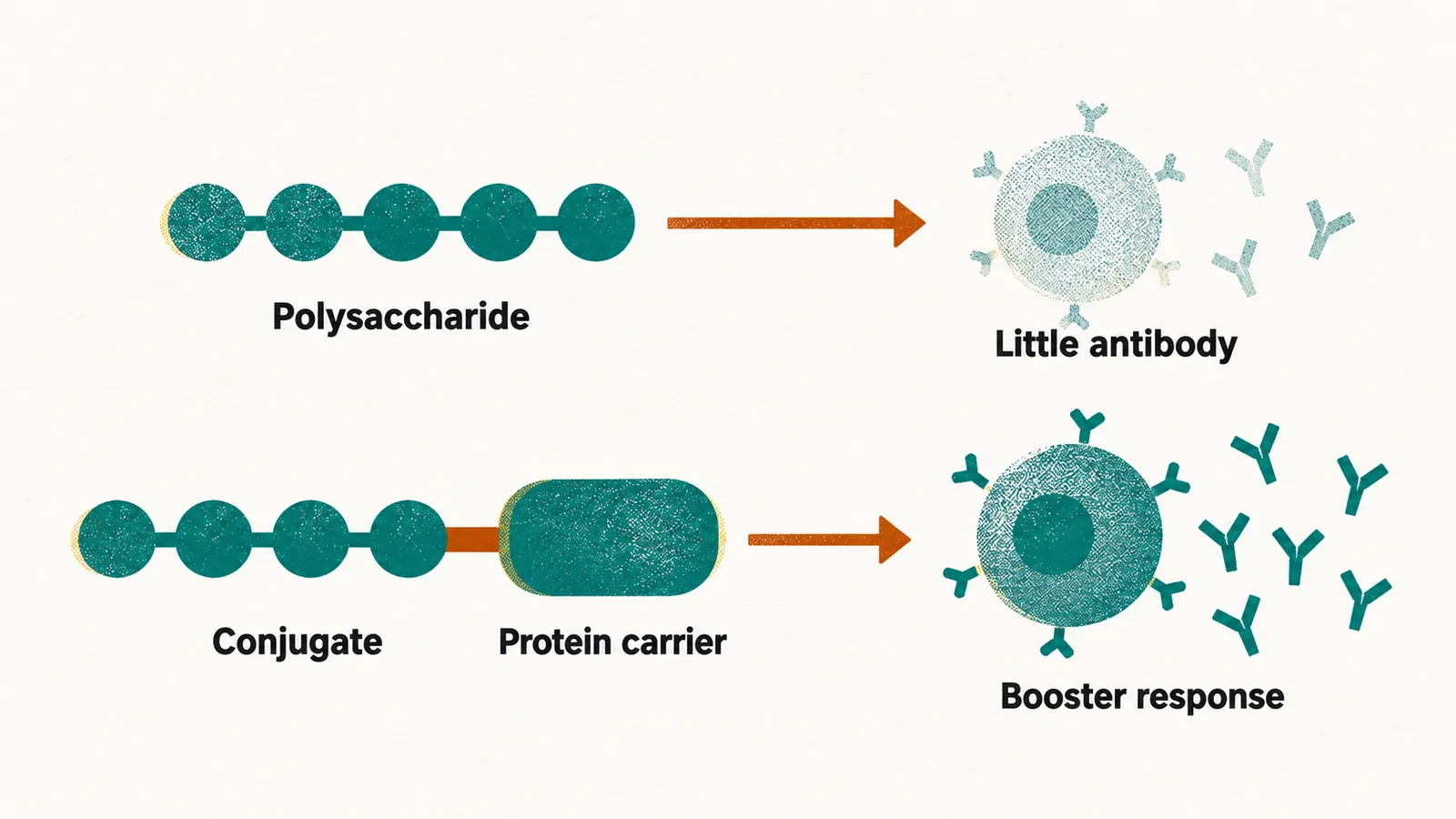
A pure polysaccharide antigen stimulates B cells without T-cell help. That T-independent response is adequate in an adult but, in children under 2 years, it produces little antibody, no reliable memory, and no booster response when the dose is repeated. This is why the first Hib vaccine, a pure polysaccharide product available in the second half of the 1980s, was not consistently immunogenic in the under-twos. Conjugating the polysaccharide to a protein carrier converts the response into a T-cell-dependent one: the carrier peptide is presented with T-cell help, which allows affinity maturation and memory, so infants mount protective antibody and repeat doses boost it. The same problem explains why the 23-valent pneumococcal polysaccharide vaccine is not effective below the age of 2 years while the conjugate pneumococcal vaccine is the one used in infants.
| Vaccine | Platform | Consequence |
|---|---|---|
| Hib (current) | Polysaccharide conjugated to a protein carrier | Immunogenic in infants, booster response on repeat dosing |
| Hib (original, late 1980s) | Pure polysaccharide | Not consistently immunogenic under 2 years, no booster response |
| Pneumococcal conjugate (PCV) | Polysaccharide conjugated to a carrier protein | Used from 2 months of age |
| Pneumococcal polysaccharide (PPSV23) | Pure polysaccharide | Reserved for older children and adults |
What live-attenuated vaccine implies clinically
Because the organism replicates, live-attenuated vaccines behave differently in three ways. They are neutralised by pre-existing antibody, which is why the MMR vaccine is not given before 12 months — maternal antibody would inactivate it — and why passively acquired immunoglobulin delays live vaccination. They are contraindicated in severe immunodeficiency and avoided in pregnancy, because replication is the mechanism. And they can, rarely, revert: oral polio vaccine was withdrawn in Italy and most high-income countries after it was recognised that it can cause vaccine-associated paralytic poliomyelitis and generate circulating vaccine-derived poliovirus.
What else is in a vaccine
Two categories of additive come up in conversations with families, and the first follows directly from the weakness of non-replicating antigens.
- Adjuvants encourage a stronger immune response to the antigen. Aluminium salts are the commonest. They are needed mainly for subunit and toxoid vaccines, which are less immunogenic than a replicating organism.
- Excipients are everything else in the product: preservatives, stabilisers, buffers, surfactants and emulsifiers, solvents, diluents, and residuals from the manufacturing process. They are there for stability, sterility and solubility, and residual amounts in the finished product are typically far below clinically relevant thresholds. The specific list for any vaccine is in its product information.
The Italian legal framework
The platform explains how each vaccine is built; the schedule decides when it is given, and in Italy part of the schedule is set by law. Before 2017, most vaccination in Italy was recommended rather than required, and coverage was drifting. Law 119 of 31 July 2017, converting the decree-law of 7 June 2017, made ten vaccinations mandatory for children and adolescents up to 16 years:
- Polio, diphtheria, tetanus, pertussis, hepatitis B and Haemophilus influenzae type b, delivered as the hexavalent vaccine.
- Measles, mumps, rubella and varicella, delivered as the quadrivalent MMRV vaccine or as MMR plus monovalent varicella.
The same law keeps a longer list of vaccinations that are offered actively and free of charge without being mandatory: pneumococcal conjugate, rotavirus, meningococcal B, meningococcal ACWY, HPV, influenza, and hepatitis A for risk groups and travel. The document that defines the current timetable is the National Vaccination Prevention Plan 2023–2025 (PNPV 2023–2025), published in the Gazzetta Ufficiale on 21 August 2023, whose national calendar separates the mandatory from the recommended offers. Regions implement the plan and can vary in some details, and the influenza offer is restated each year in a Ministry of Health circular.
The Italian calendar
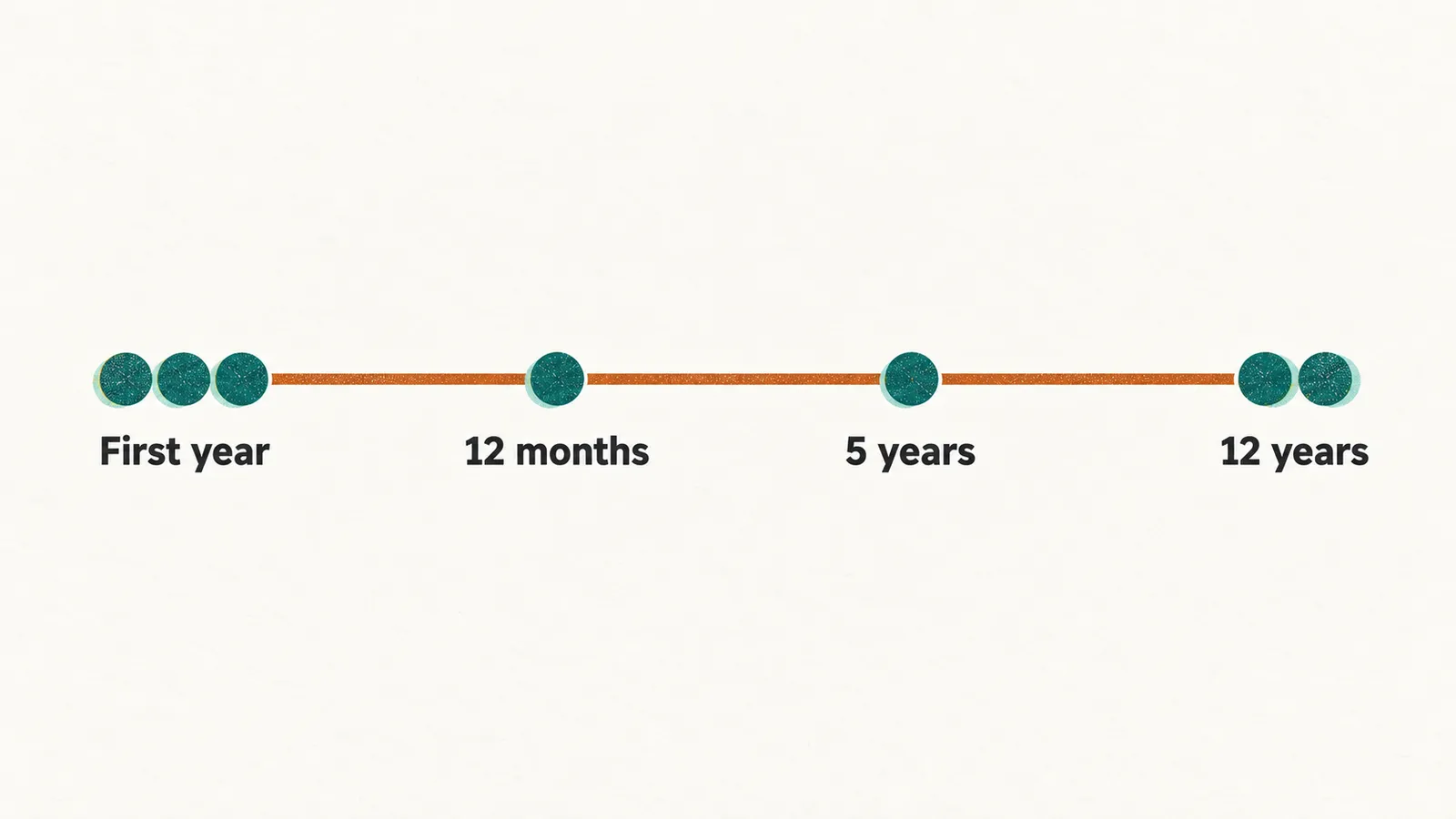
The calendar turns the mandatory and recommended lists into ages. Most doses fall in four periods: the first year of life, the first birthday, age 5, and early adolescence.
| Vaccine | Age at which it is offered |
|---|---|
| Hexavalent — DTaP, IPV, hepatitis B, Hib (mandatory) | 2 months (from day 61), 4 months (from day 121) and 10 months (from day 301), co-administered with the pneumococcal conjugate vaccine |
| Pneumococcal conjugate (PCV) | Same three visits: 2, 4 and 10 months |
| Rotavirus (oral, live-attenuated) | From 6 weeks; 2 or 3 doses depending on the product, and the course must be completed by 24 or 32 weeks of age depending on the product |
| Meningococcal B | 3 and 5 months with a booster at 15 months; the first dose may be brought forward to 2 months |
| MMRV, or MMR plus varicella | 12 months, co-administered with MenACWY; second dose at 5 years |
| Meningococcal ACWY (conjugate, quadrivalent) | 12 months, co-administered with MMRV; again from 12 years |
| dTaP–IPV | Fourth dose at 5 years; adolescent booster from 12 years |
| HPV (9-valent) | From 11 years, 2 doses 6 months apart up to 14 years; 3 doses from 15 years; catch-up offer continues into adolescence and early adulthood |
| Influenza | Annually; in Italy free for all children from 6 months to 6 years and for older children with risk conditions |
| Hepatitis A | Risk groups, including travel to high-endemicity areas |
Why the timetable has this shape
Each interval in the schedule is answering a question about the infant immune system.
The two-month start. Transplacental maternal antibody, acquired in the third trimester, protects the newborn and then wanes over the first months of life. Two months is the earliest age at which the immune system mounts a reliable response to conjugated and toxoid antigens while that antibody is still providing some cover. The second dose at 4 months is the completion of the primary series, and the dose at 10 to 11 months is a booster that consolidates immunity before the second year. The hexavalent and the pneumococcal conjugate vaccine are given at the same visits on different legs, so that the number of injections per visit stays manageable.
MMR at 12 months, not earlier. Measles maternal antibody persists through most of the first year and neutralises the vaccine if it is given too early, so the first dose waits until after the first birthday, when seroconversion becomes reliable. A second dose at 5 years closes the gap for the small proportion of children who do not respond to the first. When measles vaccination has to be brought forward during an outbreak, the anticipated dose does not count towards the schedule: the child still needs two further doses, the next one at 12 to 15 months and another at least 28 days later. Varicella follows the same timetable and can be given as the quadrivalent MMRV vaccine.
Rotavirus as early as possible. Rotavirus gastroenteritis is the leading cause of severe dehydrating diarrhoea in infancy, with the highest incidence between 6 and 24 months and a mean age at infection of about 9 to 15 months. The vaccine is oral and live-attenuated, and its licensed age windows are strict — the first dose by 12 to 15 weeks depending on the product, and the course completed by 24 or 32 weeks — because the risk of intussusception (the telescoping of one segment of bowel into the next) is related to age at vaccination. That is why rotavirus is the one vaccine in the schedule whose window closes rather than extends.
The adolescent visit. The dTaP–IPV booster, the second MenACWY dose and the HPV series coincide in early adolescence, which is convenient and also deliberate: immunity to pertussis wanes, meningococcal disease has a second incidence peak in the teenage years, and HPV vaccine works best before exposure to the virus.
Contraindications and precautions
Because the schedule is meant for almost every child, the exceptions need precise words. The distinction between the two terms is the point: a contraindication is a condition that makes a serious adverse reaction likely and therefore the vaccine should not be given, whereas a precaution means the vaccine may increase the chance or severity of a reaction or may fail to produce immunity, so the decision needs to be weighed.
Permanent contraindications in the Italian and international schedules are few:
- A severe allergic reaction to a vaccine component or to a previous dose.
- Encephalopathy, such as coma, a decreased level of consciousness or prolonged seizures, not attributable to another cause and occurring within 7 days of a previous dose of a pertussis-containing vaccine. The seven-day window is the operative part; a stable pre-existing neurological condition is not a contraindication, and DTaP is deferred in a progressive neurological disorder until the child’s neurological status is clarified and stabilised.
- Severe combined immunodeficiency and a history of intussusception, both specific to the live oral rotavirus vaccine.
Minor illness is not a contraindication: a child with a low-grade fever or a mild upper respiratory infection can be vaccinated. Live vaccines require separate reasoning in immunocompromised children and in pregnancy.
Vaccination in pregnancy
Pregnancy is also where vaccination can protect a child who has not yet been born. Two vaccines protect the newborn before the schedule begins. Tdap (diphtheria, tetanus, acellular pertussis) is given in each pregnancy, ideally in the third trimester around 28 weeks, so that maternal antibody crosses the placenta and covers the infant during the months before the first pertussis dose at 2 months. Influenza vaccination is recommended in any trimester during the influenza season, both because pregnancy increases the risk of severe influenza and because the transferred antibody protects the infant while too young to be vaccinated.
From the calendar to the diseases
Each line of the calendar answers a particular disease: a toxin that can damage the heart, a polysaccharide capsule that the infant immune system barely responds to, a virus that harms the fetus. The ten diseases behind the mandatory vaccinations, each with its mechanism, the complication that justifies prevention and the vaccine detail, are set out in Pediatric Vaccine-Preventable Diseases: The Mandatory Schedule.