Treating group A Streptococcus (GAS) pharyngitis is easier than it looks, and the difficulty is almost entirely about restraint. The organism has never developed resistance to penicillin anywhere in the world, so the drug that worked in the 1950s still works; the antibiotics that fail, or that are merely unnecessary, are the broad-spectrum ones that get prescribed when the prescriber is not sure what else to do. The practical rule is the narrowest agent that reliably works for the individual child, held steady for the good of the next one. That discipline is called antibiotic stewardship.
Why treat at all
Four reasons justify antibiotics in confirmed GAS pharyngitis, and the evidence for each is uneven. Most of the evidence comes from pooled trials and is expressed as a risk ratio or an odds ratio: a value below 1 means the outcome was less common with antibiotics, and when the 95% confidence interval (CI) includes 1 the difference is not statistically significant. The number needed to treat is how many patients must receive the antibiotic for one of them to benefit.
- Symptom reduction. Compared with placebo or no treatment, antibiotics reduce the proportion of patients still having a sore throat at day 3 (risk ratio 0.70, 95% CI 0.60–0.80; number needed to treat to prevent one sore throat at day 3 fewer than 6) and reduce headache at day 3 (risk ratio 0.49, 95% CI 0.34–0.70). They do not significantly reduce fever at day 3 (risk ratio 0.75, 95% CI 0.53–1.07). The absolute benefit shrinks with time: 82% of patients given placebo or no treatment are symptom-free by one week.
- Fewer suppurative complications. Treated patients are less likely to develop acute otitis media within 14 days (Peto odds ratio 0.21, 95% CI 0.11–0.40) or a peritonsillar abscess (quinsy) within two months (Peto odds ratio 0.16, 95% CI 0.07–0.35).
- Prevention of acute rheumatic fever. Across 18 studies and 12,249 participants, antibiotics reduced acute rheumatic fever within two months (Peto odds ratio 0.36, 95% CI 0.26–0.50). Most of these trials date from the 1950s, when rheumatic fever was far more common than it is in most settings today. This is the outcome that makes treatment non-negotiable in settings where rheumatic heart disease still occurs.
- Reduced transmission. Pharyngeal bacterial load falls sharply within the first 24 hours of effective therapy.
One outcome does not belong on the list: antibiotics have not been shown to prevent acute post-streptococcal glomerulonephritis. In the pooled analysis of 10 studies and 5,147 participants there were too few cases to show an effect either way, so the evidence is insufficient rather than negative. Glomerulonephritis is therefore not a reason to prescribe.
First-line treatment: amoxicillin at the streptococcal dose
Amoxicillin is the first-choice antibiotic for GAS pharyngotonsillitis where oral penicillin V is not available, which is the situation in Italy, where pediatric penicillin V formulations were withdrawn in the early 1980s. In the United States and Denmark, oral penicillin V remains first-line and is equally effective.
| Agent | Dose and duration |
|---|---|
| Amoxicillin (first choice in Italy) | 50 mg/kg/day in 2 divided doses (25 mg/kg per dose, maximum 500 mg per dose) for 10 days (the European product labelling and the 2024 Italian intersociety consensus); an accepted alternative is 50 mg/kg once daily, maximum 1 g/day, also for 10 days |
| Penicillin V (first choice where available) | 250 mg two to three times daily for 10 days in children, and four times daily in adolescents and adults |
| Benzathine penicillin G (intramuscular) | Single dose, 600,000 units if the child weighs 27 kg or less, 1.2 million units if more |
The streptococcal dose is not the pneumococcal dose
The dose discriminator that matters most is this: amoxicillin for GAS is 40–50 mg/kg/day; amoxicillin for pneumococcus is 80–90 mg/kg/day. Amoxicillin, like the other penicillins and the cephalosporins, is a β-lactam antibiotic: it acts by binding the bacterial penicillin-binding proteins. The higher pneumococcal dose exists to overcome reduced penicillin susceptibility in Streptococcus pneumoniae, which comes from altered penicillin-binding proteins; GAS has no such resistance to overcome. Published practice spans 40–90 mg/kg/day for pharyngitis, not exceeding 3 g/day, which is exactly why the indication has to be attached to the number.
| Pathogen and setting | Amoxicillin dose | Why |
|---|---|---|
| GAS pharyngitis | 40–50 mg/kg/day | No resistance; the smallest effective exposure is the stewardship-correct one |
| Pneumococcal acute otitis media | 80–90 mg/kg/day | Altered penicillin-binding proteins reduce susceptibility in some strains, so higher tissue concentrations are needed |
Dosing frequency and adherence
A twice-daily regimen is as effective and better tolerated than the same daily dose divided three times, which matters because adherence is the real threat to the ten-day course rather than the drug. Once-daily dosing is effective in children older than 3 years.
Where adherence is genuinely impossible — impaired intestinal absorption, inability to take oral medication, or repeatedly missed doses in a child at high risk of suppurative complications, such as an immunodeficient child — intramuscular benzathine penicillin is the alternative, at the cost of an injection that is painful and must be given by a trained professional.
Why ten days, when the child feels well on day three
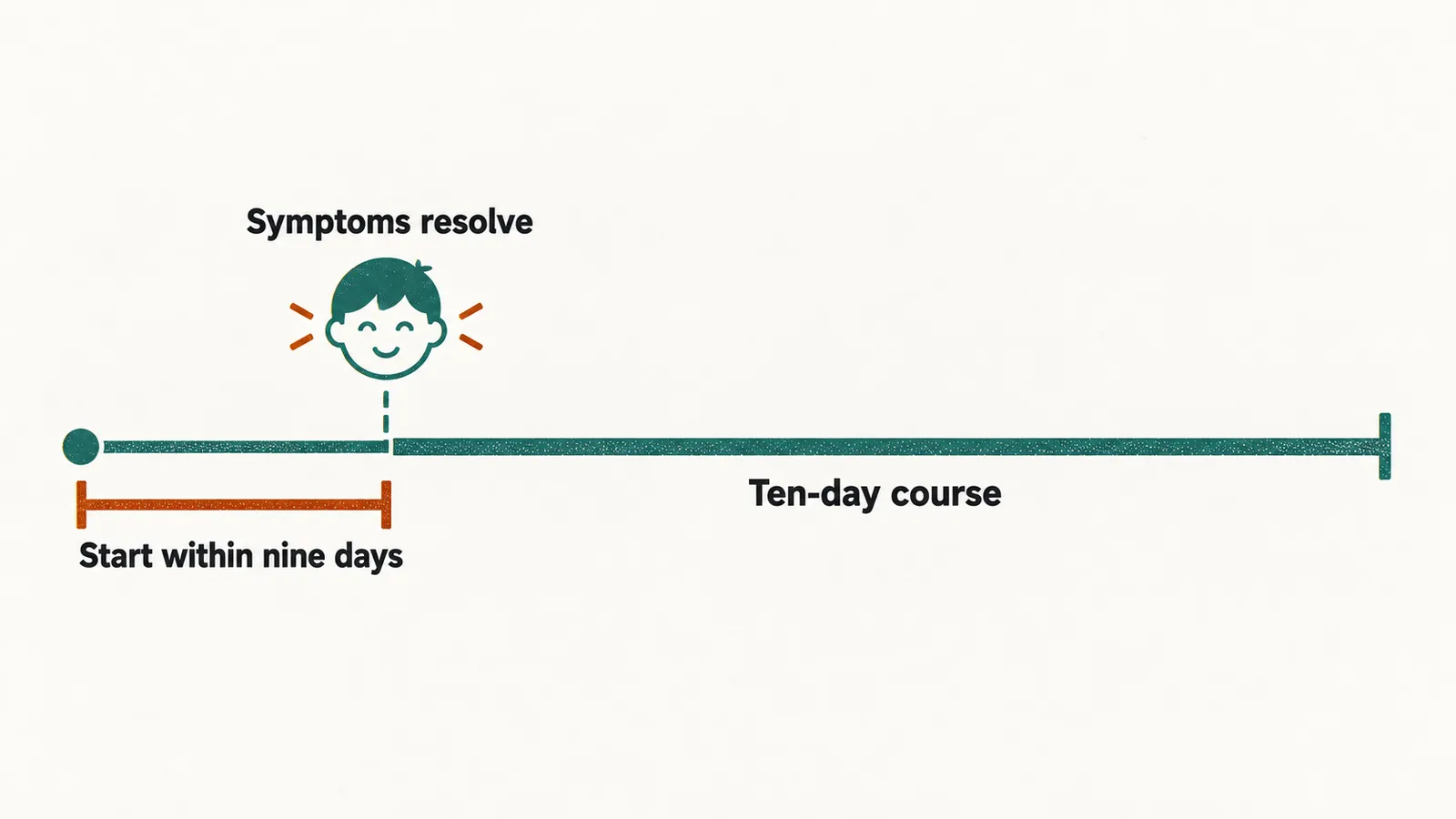
Symptoms resolve after two to three days of treatment. The remaining days are not for the sore throat: they are the eradication phase, and eradication is what prevents rheumatic fever.
Antibiotic treatment started within about nine days of the onset of symptoms still prevents acute rheumatic fever; treatment started later does not. This single fact explains why GAS pharyngitis is treated at all in settings where rheumatic fever is rare, why the full ten-day course is completed even though the child feels well on day 3, and why a two-day wait for a culture result is acceptable when no rapid test is available. It is also the reason a positive rapid test should be acted on in the same encounter rather than deferred.
A shorter course has been studied — a six-day amoxicillin regimen performed similarly to ten days of penicillin V in one trial — but the evidence on complications is too weak to generalise, partly because the studies were done in populations with a low incidence of rheumatic fever and were followed for only about a month. Some guidelines (NICE, and the German guideline) accept five to ten days or five to seven days respectively; the 2024 Italian intersociety consensus deliberately retains 10 days for children, including in low-incidence regions, on the grounds that the critical outcomes have not been studied adequately.
The clinical work this creates is communicative, not pharmacological. Families stop treatment when the child feels well, and the reasons are predictable: multiple drugs, frequent dosing, duration, disappearance of symptoms, side effects, taste and cost. Explaining that the last seven days prevent a heart complication years later is what keeps the course going.
What not to give, and why
Restraint applies to the choice of drug as well as to the course. Because GAS remains susceptible to penicillin, a broader agent adds nothing against the target and exposes the rest of the child’s flora for no gain.
Amoxicillin-clavulanate. Clavulanate inhibits β-lactamases, the bacterial enzymes that inactivate β-lactam antibiotics. GAS does not produce β-lactamases, so the inhibitor adds nothing against the target and instead broadens the spectrum to cover β-lactamase-producing oral anaerobes, Haemophilus influenzae, Moraxella catarrhalis, methicillin-sensitive Staphylococcus aureus and Escherichia coli. The drug works against GAS; it should not be used because of what it does to the rest of the flora. In Italy, a 2023 nationwide survey of 107 pediatric emergency units found that about 25% of units prescribe amoxicillin-clavulanate for GAS pharyngitis.
Third-generation cephalosporins as a routine choice. In Italian pediatric primary care, third-generation cephalosporins are prescribed in roughly 28% of pharyngitis cases. Their spectrum resembles that of amoxicillin-clavulanate and they are unnecessarily broad for a penicillin-susceptible organism.
Macrolides as first-line therapy. Macrolide-resistant GAS exists and its prevalence varies by region and period. Recent Italian estimates put resistance at up to about 18%, while earlier Italian surveys reported rates as high as 30% to 40% in some periods and centres. Whatever the local figure, the consequence is the same: a macrolide is a weaker choice than a penicillin, and it is reserved for children who cannot safely receive a β-lactam.
Antibiotics for other bacteria on the swab. Antibiotics given for non-streptococcal bacterial pharyngotonsillitis — a swab growing Fusobacterium, other anaerobes or Staphylococcus aureus — are not recommended in previously healthy children, because in that group the illness is self-limiting and antibiotics do not meaningfully change symptoms or complications. A child with an underlying condition in whom such a decision is being considered is a case for specialist advice.
When a β-lactam appears to fail
If a child has been given a broad β-lactam — typically amoxicillin-clavulanate — and is still febrile after three days, the question is not which resistant GAS strain is involved. GAS does not resist amoxicillin. The differential is:
- The illness was never bacterial. Most pharyngitis is viral, and antibiotics do not treat it.
- Intracellular and atypical bacteria. β-lactams act on the bacterial cell wall, which Mycoplasma does not have, and they penetrate cells poorly, so Mycoplasma pneumoniae and Chlamydia species are not covered. These are treated with macrolides in children (tetracyclines are age-restricted; fluoroquinolones are not routine pediatric drugs).
- Methicillin-resistant Staphylococcus aureus, which is not covered by amoxicillin-clavulanate.
- Pseudomonas aeruginosa and, rarely, fungal infection, particularly in an immunocompromised child.
The reasoning step that makes this list useful is the one about the cell wall: when a cell-wall antibiotic fails, think about organisms that have no cell wall to attack, or that sit where the drug does not reach.
Recurrence: the β-lactamase co-coloniser
Most apparent recurrences of GAS pharyngitis after a course of amoxicillin are not resistant GAS. Three explanations should be considered first: non-adherence to a ten-day course, reinfection from a household contact, and carriage rather than true relapse in a child with an unrelated viral illness.
One further proposed explanation is indirect pathogenicity: the child’s throat is co-colonised by Staphylococcus aureus or Haemophilus influenzae, which produce β-lactamases in the immediate environment and inactivate the amoxicillin before it reaches the GAS in the tonsillar crypts. The organism was never resistant; the drug was destroyed around it. The three explanations above are at least as common in practice as this one.
When treatment is genuinely needed for relapse, options that survive β-lactamase activity include the β-lactamase-stable oral cephalosporins cefaclor and cefprozil, with cefuroxime axetil as a further alternative; cefaclor in a five-day course has been compared with ten days of amoxicillin with comparable clinical results in a single small trial. A first-generation cephalosporin such as cephalexin is also active against GAS and appears among the alternatives for penicillin-allergic patients, though it is broader than penicillin and therefore not the first choice in a child who can take amoxicillin.
Two caveats belong with these suggestions. The Cochrane review of antibiotic choices for recurrent pharyngotonsillitis could reach no conclusion because no trial met its inclusion criteria. And the Italian consensus recommends antibiotic therapy in relapsing disease only for children being considered for tonsillectomy, using amoxicillin-clavulanate, clindamycin, or amoxicillin plus rifampicin during the final four days, as an attempt to avoid surgery. Tonsillectomy remains the only intervention proven to reduce the frequency of episodes, and it carries its own risks.
Suspected penicillin allergy
Proven penicillin allergy is uncommon: prevalence is on the order of 0.7% to 1%, and anaphylaxis is far rarer still. Most children labelled penicillin-allergic are not allergic — maculopapular rashes, urticaria and vomiting are common features of the viral infections for which the antibiotic was prescribed in the first place. The decision should therefore be made by risk stratification rather than by reflex.
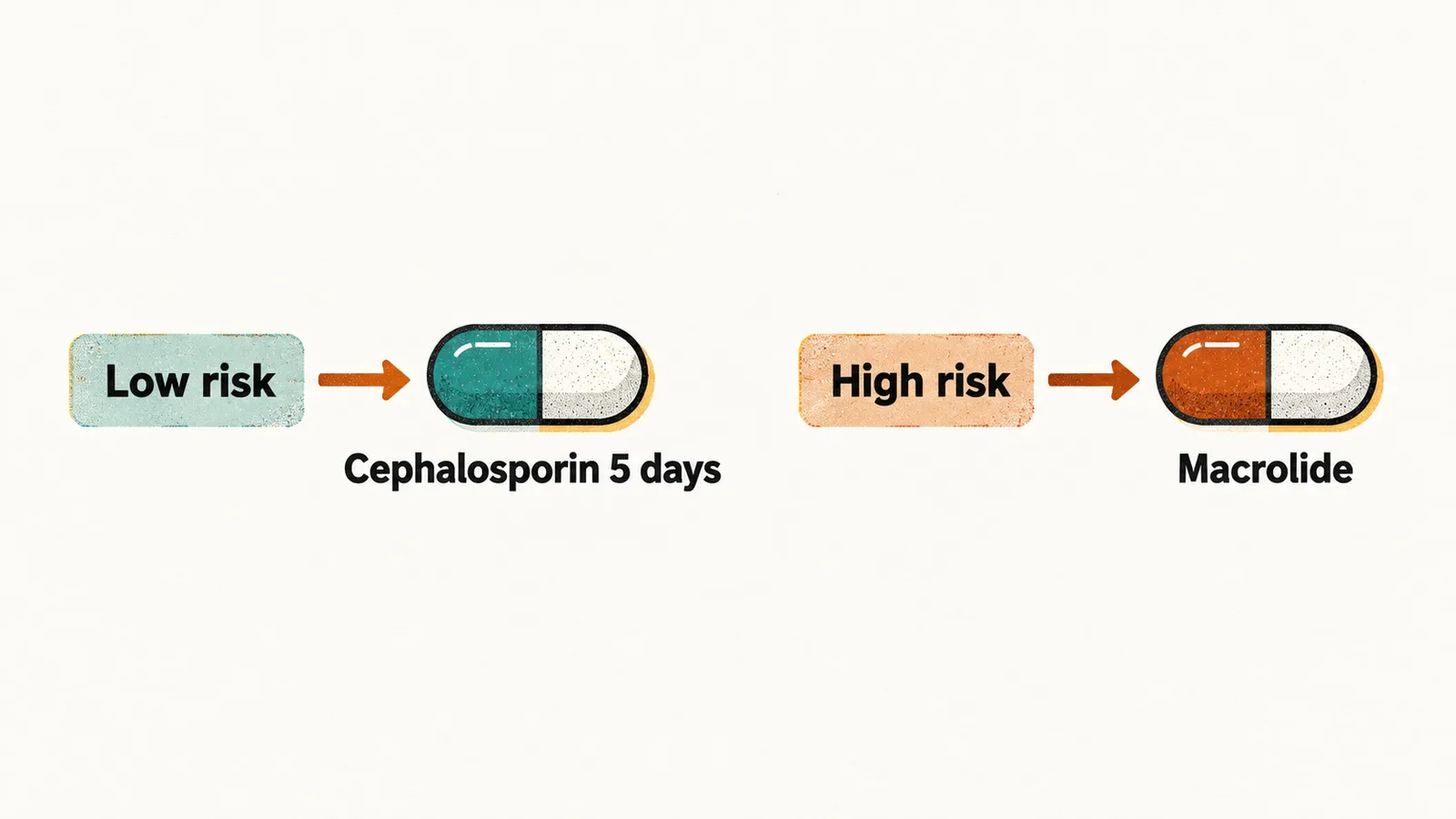
- Low risk of a severe reaction (for example, a delayed maculopapular rash): a third-generation cephalosporin for 5 days is the recommended alternative in the Italian consensus. Cross-reactivity between penicillins and cephalosporins is low when the original reaction was not immediate.
- High risk (immediate type I features such as anaphylaxis, angioedema or urticaria within an hour): a macrolide — azithromycin 12 mg/kg once daily for 5 days, or 20 mg/kg once daily for 3 days, maximum 500 mg per day; clarithromycin 15 mg/kg/day in divided doses for 10 days; or clindamycin 7 mg/kg/dose three times daily for 10 days — accepting that a proportion of strains will be macrolide-resistant.
An allergy work-up is the definitive answer, and a child who has been given an alternative for years without one is a child who may be taking a worse antibiotic forever for a reaction that never happened.
Symptom relief
Only paracetamol or ibuprofen are recommended for the pain and fever of acute pharyngitis in children, together with adequate fluids. Systemic corticosteroids and topical anaesthetics are not recommended for uncomplicated GAS pharyngitis: they do not alter the course and they add adverse effects, and topical anaesthetics carry a risk of toxicity in young children.
Contagiousness, school and follow-up
Transmission falls quickly once effective therapy starts: the bacterial load in the pharynx drops substantially within the first 24 hours of treatment, and children are most contagious in the days before and immediately after the illness becomes apparent. Rules about how long a child must stay at home or stay away from school are administrative rather than microbiological, and they differ between countries and even between regions of the same country — many services ask for at least 24 to 48 hours of effective antibiotic therapy and clinical improvement before the child returns, and the local rule is the one to follow.
A test of cure is not recommended: a routine follow-up swab after adequate treatment adds cost and confusion without changing management.
Why this remains a treatment problem
There is no licensed vaccine against group A Streptococcus, which is the reason pharyngitis remains an antibiotic-stewardship problem rather than a vaccination problem: streptococcal pharyngitis, scarlet fever and their complications are still prevented by diagnosis and a correctly chosen antibiotic. For many other serious childhood infections, prevention comes first, through a routine schedule of vaccines matched to each pathogen’s biology.