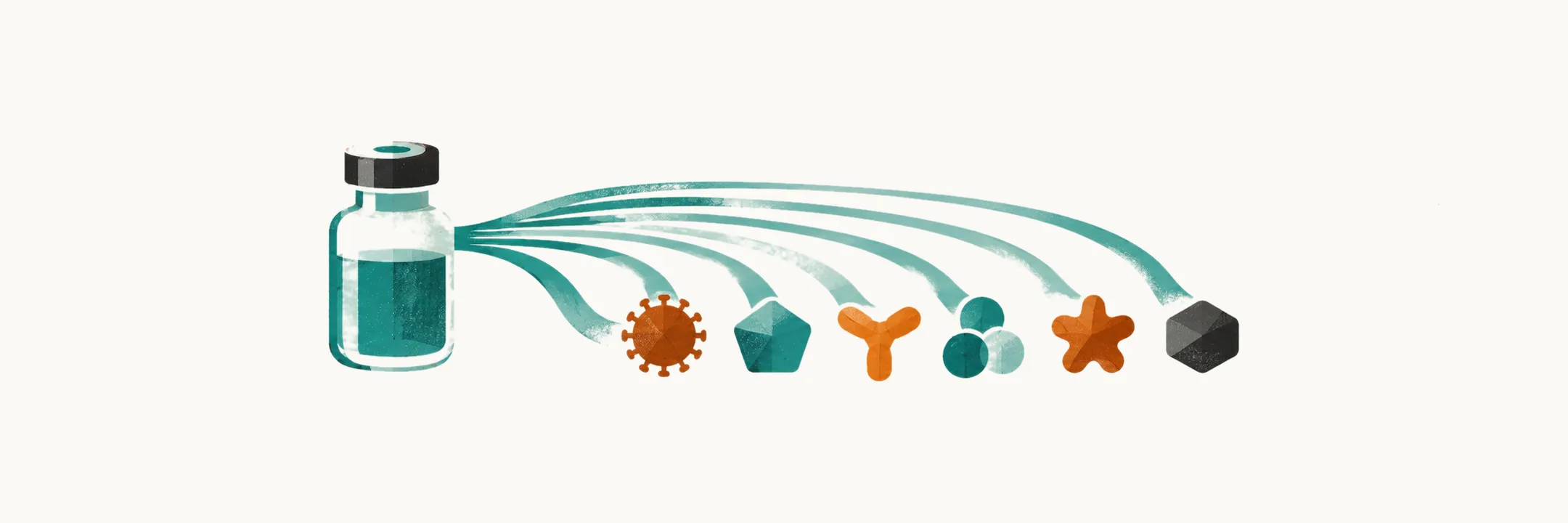
The Italian pediatric schedule requires ten vaccinations: diphtheria, tetanus, pertussis, poliomyelitis, hepatitis B and Haemophilus influenzae type b, delivered together in the hexavalent vaccine, and measles, mumps, rubella and varicella, delivered as the quadrivalent MMRV vaccine or as MMR plus monovalent varicella. Law 119 of 2017 made all ten mandatory for children and adolescents up to 16 years of age. The ten diseases are easiest to understand grouped by the kind of vaccine that prevents each one, because the vaccine platform is the reason the disease behaves the way it does — a toxigenic disease is prevented by a toxoid, an encapsulated bacterium needs a conjugate, and viral diseases are prevented by live-attenuated or inactivated vaccines depending on the virus.
The six diseases in the hexavalent vaccine
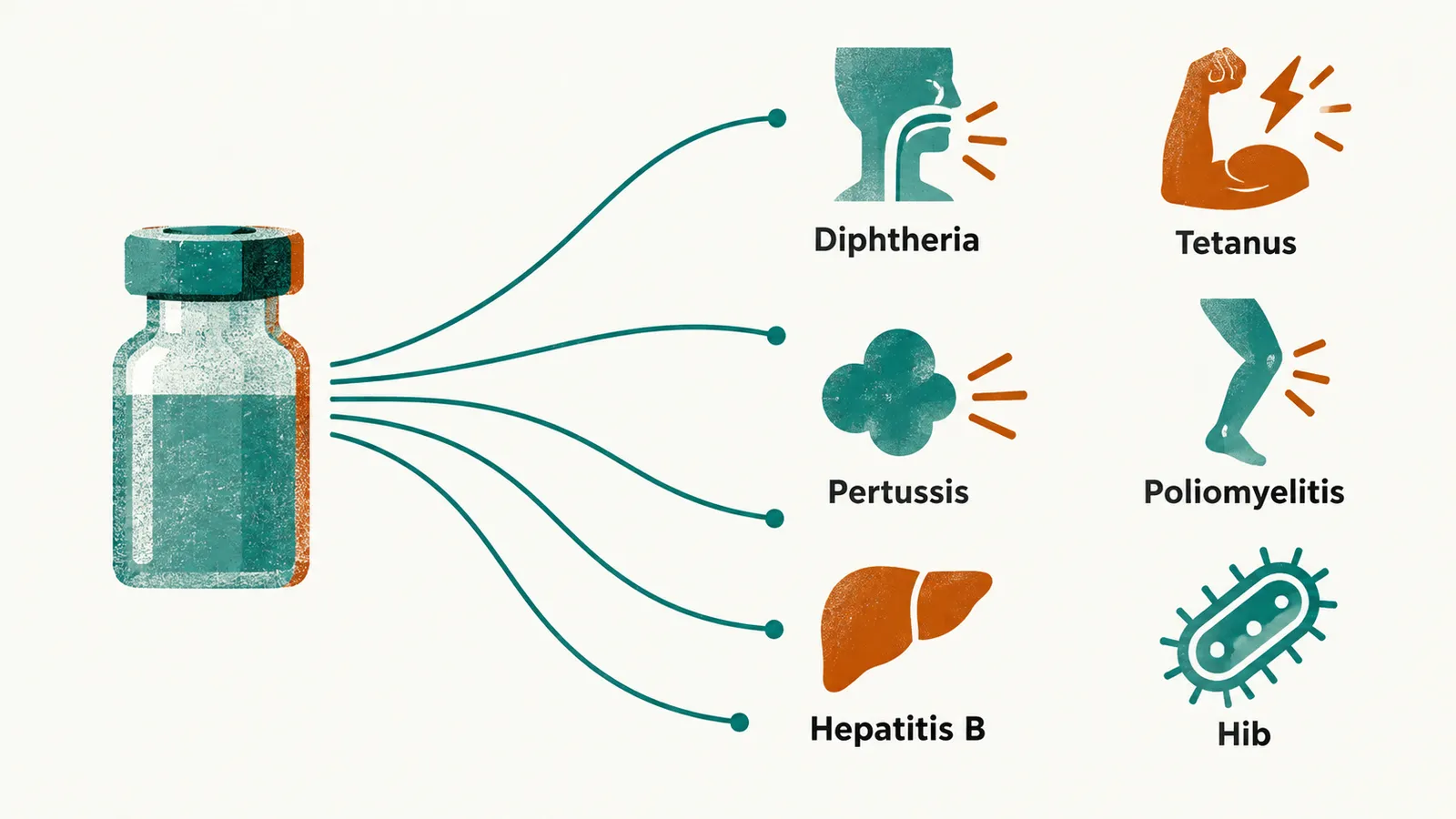
The hexavalent vaccine combines diphtheria and tetanus toxoids, acellular pertussis antigens, inactivated poliovirus, hepatitis B surface antigen and Hib conjugate in a single injection given at 2, 4 and 10 months. None of its components can replicate, so it mixes several platforms in one product: toxoids (toxins chemically inactivated so that they raise antibody without causing disease) against the two toxin-mediated diseases, diphtheria and tetanus; purified protein antigens against pertussis and, as a recombinant protein, against hepatitis B; an inactivated virus against polio; and a conjugate against Hib.
Diphtheria
Corynebacterium diphtheriae colonises the pharynx and produces an exotoxin. After an incubation of 2 to 5 days come malaise, sore throat, difficulty swallowing, loss of appetite, hoarseness and mild fever, and within two or three days an adherent grey membrane appears on the oral mucosa. Extensive membrane causes life-threatening airway obstruction, and the toxin produces systemic disease, above all myocarditis and neuritis. The death rate is 5% to 10% even with treatment.
Two rules govern management. Treatment starts on suspicion, before bacteriology returns, and consists of antitoxin, which neutralises only circulating toxin that has not yet bound to tissue, together with antibiotics for 14 days — penicillin, or erythromycin 40–50 mg/kg/day in divided doses, maximum 2 g/day — plus airway support. And the membrane bleeds when it is peeled, which distinguishes it from the non-bleeding pseudo-membrane of Epstein–Barr virus.
The vaccine is a toxoid: immunity lasts at least ten years after the primary series and a booster, and efficacy is about 90%, with milder disease in the minority who are fully vaccinated and still become ill. Diphtheria has re-emerged where coverage has fallen, and imported cases appear in countries whose immunisation programmes have been disrupted.
Tetanus
Clostridium tetani is a spore-forming anaerobe whose toxin, tetanospasmin, blocks inhibitory neurotransmission and produces trismus (spasm of the jaw muscles), risus sardonicus (a fixed grimace from facial spasm), opisthotonus (arching of the back from spasm of the trunk muscles) and autonomic instability. It is not transmitted between people: the spores are environmental, and disease follows a wound. Neonatal tetanus is the commonest form in low-income settings, with an incubation of about 3 to 14 days after birth, a sudden failure to suck, irritability and increasingly frequent convulsions; mortality is 25% to 90% depending on intensive care.
Treatment is human tetanus immunoglobulin — a single dose of 500 IU intramuscularly, with 3,000 to 6,000 IU also cited as effective — plus wound cleaning and debridement, spasm control, antibiotics and supportive care. When immunoglobulin is unavailable, equine antitoxin is the alternative, with the attendant risk of serum reactions. As with diphtheria, the immunoglobulin binds only toxin that is still free.
The vaccine is a formaldehyde-inactivated toxoid adsorbed onto aluminium salts to increase antigenicity. Toxoid content is measured in Lf (flocculation units): the tetanus toxoid content is 10 to 20 Lf per dose in DTP vaccines and about 5 Lf per dose in the Td preparations used from around 6 to 7 years of age.
Pertussis
Bordetella pertussis causes a paroxysmal cough lasting weeks, with whooping in older children and apnoea in infants, who are the group at risk of death and the group most likely to need hospitalisation for supportive care, sometimes in intensive care. Antitoxin is not available; the treatment is a macrolide given for 14 days — erythromycin 40–50 mg/kg/day in divided doses — although shorter courses of azithromycin or clarithromycin have similar efficacy. Early treatment may modify the course, and treatment at any stage limits spread, which is why it is given to a child whose cough has already lasted two weeks.
The vaccine is acellular (DTaP), and immunity wanes after both disease and vaccination, which is why boosters are needed in the preschool and adolescent years and why vaccinating the mother in the third trimester of pregnancy is the way to protect a newborn who is too young to be vaccinated.
Poliomyelitis
Poliovirus enters by mouth, replicates in the pharynx and gastrointestinal tract, spreads haematogenously to lymphatics and the central nervous system, and destroys motor neurons. About 70% of infections in children are asymptomatic; about 24% produce a minor, non-specific illness; fewer than 1% produce paralysis.
The inactivated vaccine introduced in 1955, now used as enhanced-potency IPV, produces protective antibody to all three poliovirus types in 90% or more of recipients after two doses and at least 99% after three, probably life-long, with only rare local reactions. The oral live vaccine, no longer used in Italy, is the reason the two vaccines must be distinguished: it can cause vaccine-associated paralytic poliomyelitis and can generate circulating vaccine-derived poliovirus.
Hepatitis B
Hepatitis B virus has infected more than 2 billion people alive today, and about 254 million were living with chronic infection in 2022 (earlier estimates were around 350 million). Roughly 1.1 million deaths a year are attributed to it, chiefly through cirrhosis and hepatocellular carcinoma, which is one of the leading causes of cancer death in Africa, Asia and the Pacific region.
Perinatal transmission is the mechanism that makes infant vaccination urgent. Two viral markers in the mother’s blood predict the risk: hepatitis B surface antigen (HBsAg) and hepatitis B e antigen (HBeAg). Mothers who are HBsAg-positive and HBeAg-positive infect 70% to 90% of their newborns, and about 90% of infected infants become chronic carriers; mothers who are HBsAg-positive but HBeAg-negative infect about 20%, of whom roughly 90% also become chronic carriers. There is no specific therapy for acute infection; interferon alfa achieves long-term remission in a minority, and nucleos(t)ide analogues such as entecavir or tenofovir are used for chronic infection.
Hepatitis B vaccines have been available since 1982. The first was derived from the plasma of HBsAg-positive carriers; the recombinant vaccine was the first genetically engineered vaccine and is now standard. Infants born to HBsAg-positive mothers receive the first dose within 12 to 24 hours of birth together with hepatitis B immunoglobulin.
Haemophilus influenzae type b
Hib causes meningitis, epiglottitis, pneumonia and sepsis, and it was a leading cause of childhood bacterial meningitis before conjugate vaccination. Its vaccine is the textbook illustration of the conjugate principle described in Pediatric Vaccines: Types and the Italian Schedule: the original pure polysaccharide product was not consistently immunogenic under 2 years and produced no booster response, while the conjugated vaccine is immunogenic in infants and boosted by repeat doses. Invasive Hib disease has become rare wherever the conjugate vaccine is used.
The four live-attenuated childhood vaccines
Measles, mumps, rubella and varicella are all prevented by live-attenuated vaccines, given as the quadrivalent MMRV vaccine or as MMR plus monovalent varicella at 12 months and again at 5 years. Because these vaccines work by replicating, maternal antibody would neutralise them in early infancy, which is why the first dose waits until 12 months.
Measles
Measles is the most transmissible of the vaccine-preventable diseases, with a basic reproduction number — the average number of people one case infects in a fully susceptible population — in the range of 12 to 18, and its infectious droplets remain airborne for up to 2 hours: long enough for transmission in a waiting room, an airport queue or a crowded indoor space after the index case has left. A child is contagious for days before the rash appears, which is why diagnosis comes too late to prevent exposure. Measles follows the clinical course in detail.
The illness begins with conjunctivitis, coryza and cough, followed by a cranio-caudal maculopapular rash that spreads as the fever continues. Complications are common and are the reason the disease is taken seriously:
| Complication | Approximate frequency | Notes |
|---|---|---|
| Otitis media | About 1 in 10 cases | Often bacterial superinfection |
| Pneumonia | As many as 1 in 20 cases | The commonest cause of death from measles; may be viral, bacterial or mixed. Viral pneumonia during the rash does not respond to antibiotics; bacterial pneumonia after the rash does |
| Acute encephalitis | 1 per 1,000 cases | Often results in permanent brain damage |
| Death | 1 to 3 per 1,000 cases | From respiratory and neurological complications |
| Subacute sclerosing panencephalitis (SSPE) | Rare, and higher the younger the child was at infection — around 1 in 1,367 when measles occurred before age 5 | Always fatal; develops 7 to 10 years after the acute illness, with behavioural and cognitive decline, myoclonus, seizures and progressive neurological loss |
Treatment is supportive, with vitamin A for children with measles in two doses on consecutive days as recommended by the World Health Organization, and antibiotics only for bacterial complications. Prevention requires two doses and coverage of 93% to 95%; the 2019 resurgence, when an estimated 207,500 people died worldwide, followed a period of falling coverage and vaccine hesitancy.
Mumps
Mumps virus has an incubation period of 12 to 25 days and a non-specific prodrome of myalgia, malaise, headache and low-grade fever before parotid swelling, which is not present in every case. Complications include orchitis in 12% to 66% of postpubertal males (the higher figures come from the pre-vaccine era), aseptic meningitis (up to 10% of unvaccinated patients), pancreatitis (up to 4%), encephalitis (0.02% to 0.3%) and sensorineural hearing loss, which is usually unilateral. In the post-vaccine era, meningitis, encephalitis, pancreatitis and hearing loss have each been reported in 1% or less of infected people. The vaccine is a live-attenuated component of MMR; outbreaks still occur among vaccinated adolescents and young adults because immunity wanes, and public health authorities may recommend an additional dose during an outbreak.
Rubella
Rubella is usually a mild illness — an incubation period of about 14 days, a rare prodrome in children, a 2- to 3-day pink maculopapular rash starting on the face and neck, and lymphadenopathy that begins before the rash and lasts weeks. Arthralgia or arthritis occurs in up to 70% of adult women and is rare in children.
Its importance is entirely obstetric. Rubella infection in the first trimester affects up to 85% of infants, causing deafness, eye defects, cardiac defects, microcephaly, intellectual disability, bone lesions and liver or spleen damage, and it can cause fetal death or premature delivery. The live-attenuated vaccine is therefore given to children chiefly to protect future pregnancies through herd immunity, and susceptible women are vaccinated postpartum rather than during pregnancy. Childhood Exanthems sets rubella alongside the other febrile rashes of childhood.
Varicella
Varicella-zoster virus spreads by droplets, direct contact and airborne aerosol, with an incubation period of 14 to 16 days (range 10 to 21) and an infectious period beginning 1 to 2 days before the rash. Successive crops of lesions appear over several days and sit at different stages of evolution at the same time, starting on the scalp, face and trunk.
| Complication | Frequency or risk |
|---|---|
| Bacterial infection of skin lesions | The commonest complication |
| Pneumonia | Viral or bacterial |
| Cerebellar ataxia | About 1 in 4,000 cases |
| Encephalitis, aseptic meningitis, facial nerve palsy | Recognised CNS complications |
| Reye syndrome | Associated with aspirin use during the acute illness |
| Hospitalisation in children | 2 to 3 per 1,000 cases |
| Death in children | About 1 per 60,000 cases |
Two special situations carry much higher stakes. Congenital varicella syndrome follows maternal infection before 20 weeks and causes limb hypoplasia, dermatomal skin scarring, eye abnormalities and neurological damage, and carries high mortality in affected infants, although the risk after primary maternal infection appears to be low, below 2%. Neonatal varicella occurs when the mother’s rash appears from 5 days before to 2 days after delivery: the newborn is exposed to a high viral load without having received protective maternal antibody, roughly 20% to 50% of exposed newborns become infected, and case fatality was historically as high as 30% when the rash began at 5 to 12 days of life.
The vaccine is live-attenuated, given in two doses, and has been mandatory in Italy for children born from 2017. Given within 3 to 5 days of exposure in a susceptible contact it may prevent or attenuate the illness; immunocompromised children, pregnant women and neonates who cannot receive it are offered varicella-zoster immunoglobulin or prophylactic aciclovir. Post-exposure prophylaxis protocols, for varicella as for the other diseases here, follow national guidance and specialist advice. Varicella covers treatment thresholds and risk groups in more detail.
Beyond the mandatory ten
The ten vaccinations above are the ones the law requires, and the schedules for children with underlying conditions and the immunisation of immunocompromised children follow national guidance and specialist advice. Italy also offers other vaccines actively and free of charge without making them mandatory, against pneumococcal and meningococcal disease, rotavirus, HPV, influenza and hepatitis A: Pediatric Vaccines Outside the Mandatory Schedule.