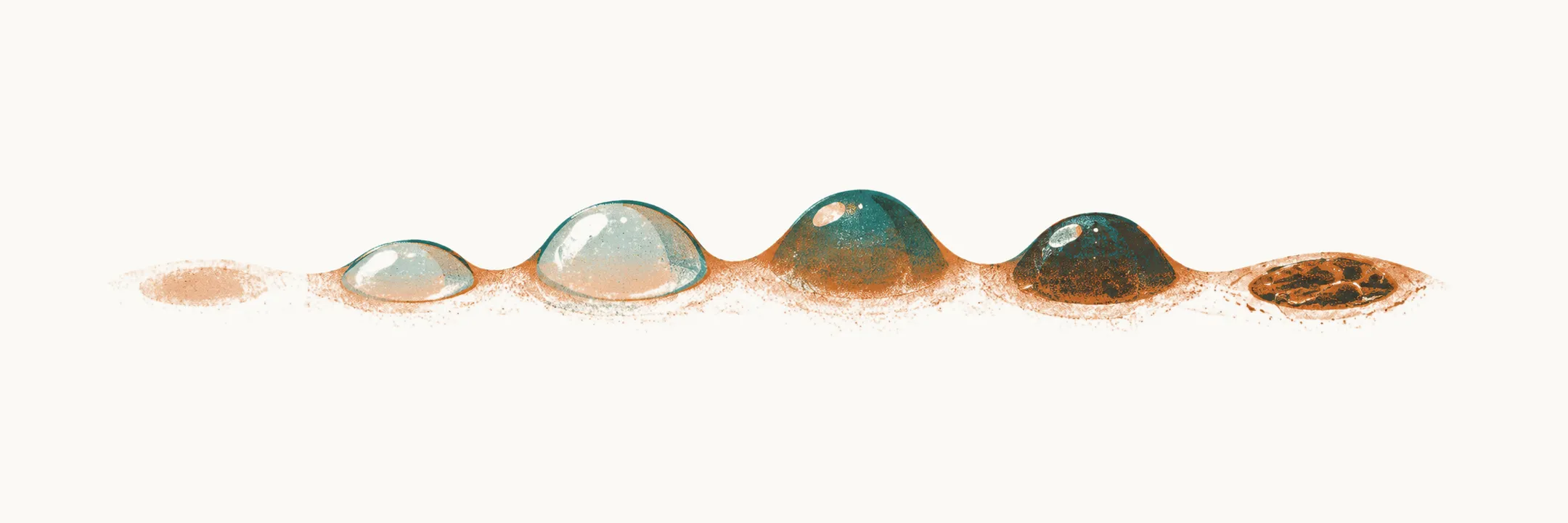
Varicella, or chickenpox, is diagnosed from the skin rather than by exclusion, and it is the only vesicular member of the six classic childhood exanthems: when lesions at several stages of evolution are present at the same time, that finding is usually enough to make the diagnosis.
The virus and its two diseases
Varicella-zoster virus (VZV) is a double-stranded DNA herpesvirus. Primary infection produces varicella, after which the virus establishes lifelong latency, a dormant state, in the dorsal root ganglia (the clusters of sensory nerve cell bodies beside the spinal cord). Reactivation decades later produces herpes zoster (shingles), usually confined to the dermatome of the affected ganglion, the strip of skin supplied by that nerve root. Varicella and zoster are therefore one virus behaving in two different ways, and a person with zoster can transmit varicella to a susceptible contact through contact with the lesions.
Transmission and contagiousness
VZV spreads by three routes: respiratory droplets, direct contact with the fluid in the vesicles, and airborne transmission of aerosolised virus in closed spaces. It is highly contagious, to the point that up to 90% of susceptible close household contacts develop varicella after exposure.
The incubation period is typically 14-16 days after exposure, with a range of 10-21 days. A person with varicella is contagious from 1-2 days before the rash appears until all the lesions have crusted, so the infectious period begins before the diagnosis is obvious.
Clinical course
A mild prodrome of fever and malaise may precede the rash by 1-2 days, and is more prominent in adolescents and adults than in young children, in whom the rash is often the first abnormality noticed.
The lesions evolve through recognised stages — macule, papule, vesicle, pustule, crust — and each stage lasts hours to a day or so. Because new lesions keep appearing for the first 4-5 days while older ones are already crusting, lesions at several different stages coexist, which is the feature that separates varicella from other vesicular eruptions such as insect bites, herpes simplex or eczema herpeticum, where the lesions tend to be synchronised.
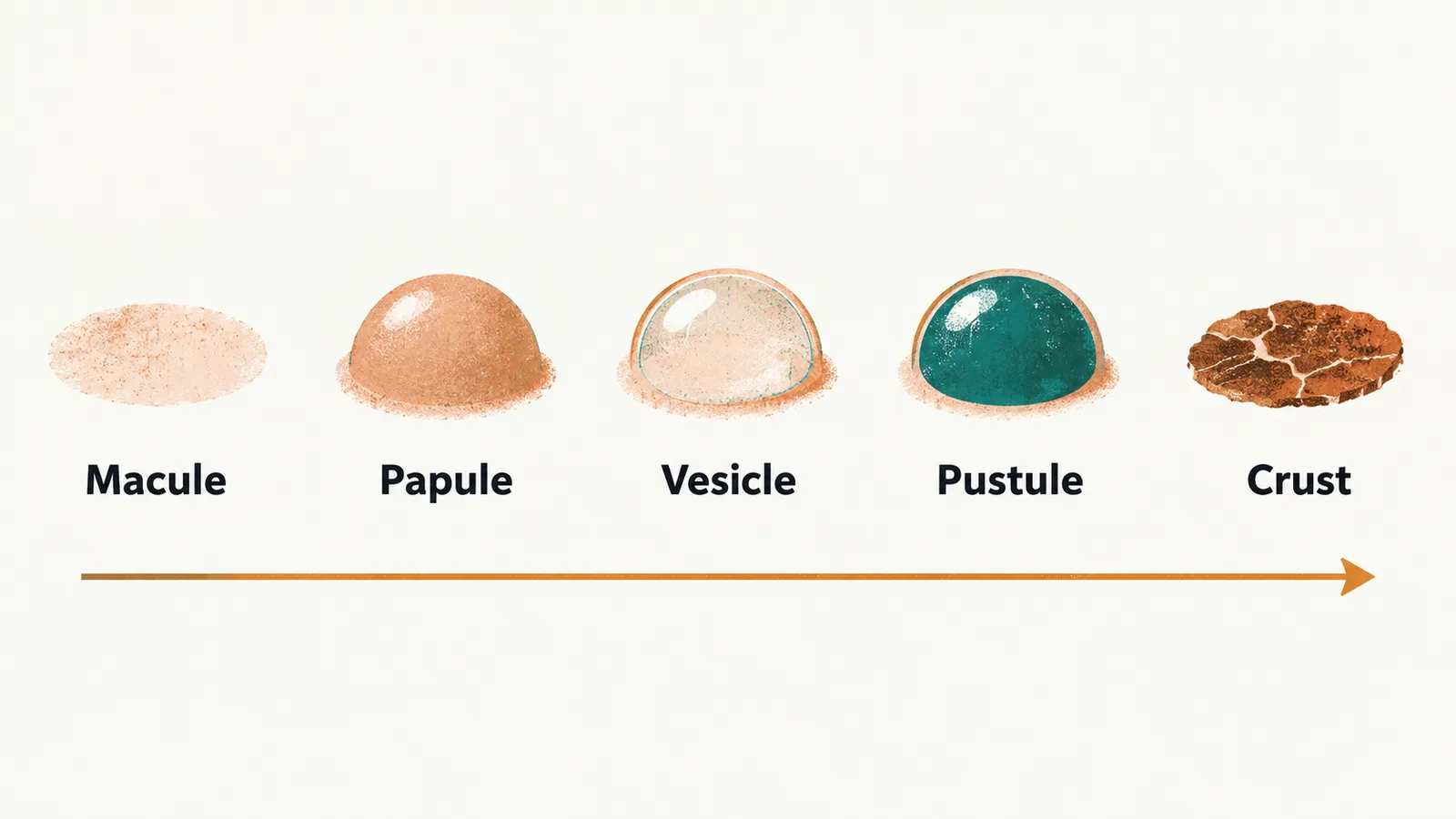
The rash is intensely itchy. It begins centrally, on the head and trunk, and is more concentrated on the trunk than on the limbs (a centripetal distribution). Vesicles may also appear on mucous membranes, including the palate and pharynx. Crusting usually begins within about 5-7 days of rash onset.
Treatment: who needs an antiviral
The question is which children need an antiviral on top of symptomatic care. In immunocompetent children older than 28 days who are otherwise healthy, antiviral treatment is not normally required. The illness is self-limited and the outcome is good, and antivirals do not change that enough to justify them.
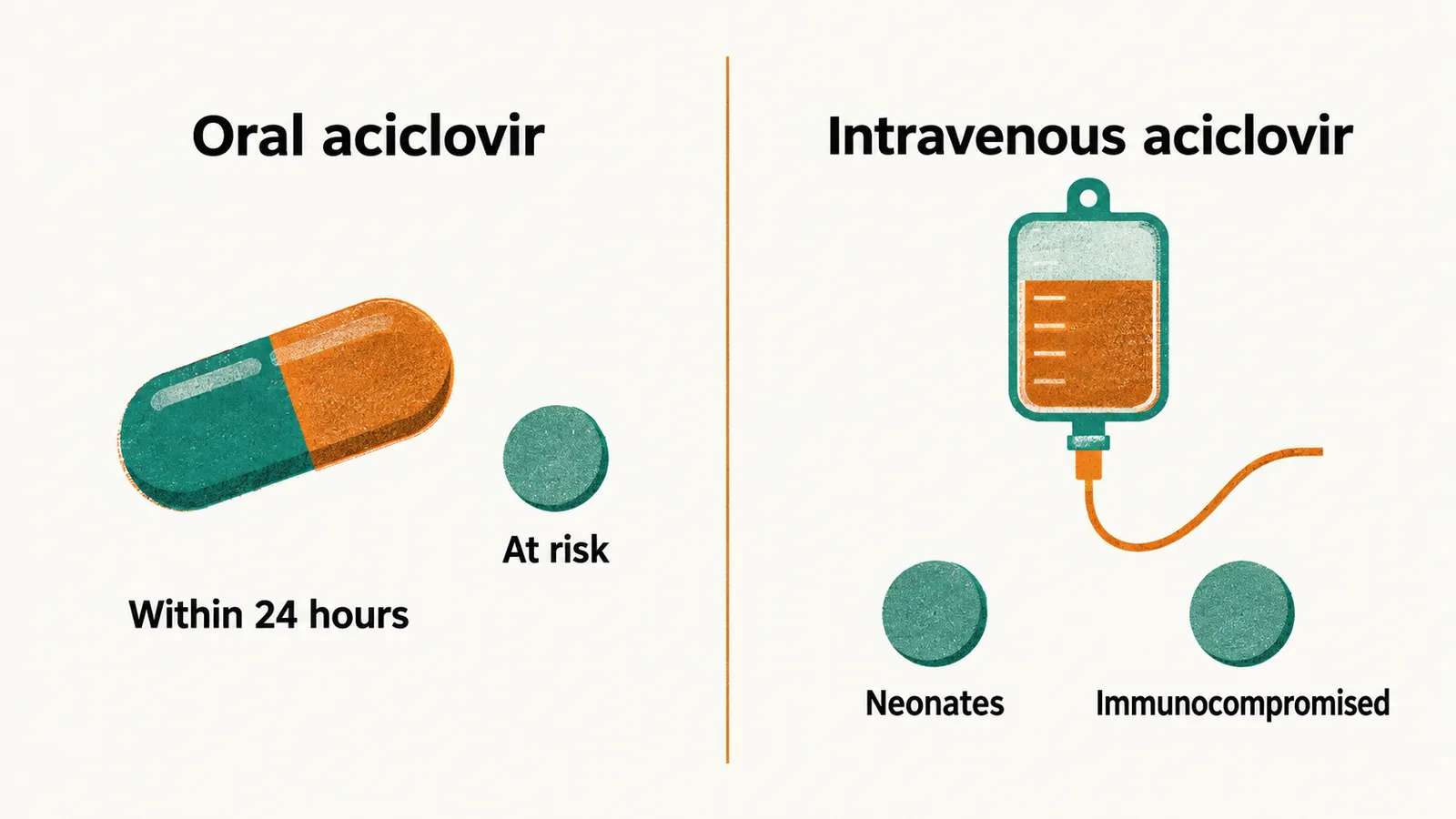
Oral aciclovir is considered for children at risk of more severe disease:
- Older than 13 years, unvaccinated, presenting within 24 hours of rash onset
- Concurrent severe skin disease, such as eczema
- Chronic pulmonary disease — cystic fibrosis, chronic lung disease, asthma requiring inhaled corticosteroids, interstitial lung disease
- Taking aspirin
- Currently receiving short courses or intermittent oral corticosteroids (for example 1-2 mg/kg prednisolone for a wheeze or asthma exacerbation)
The typical oral regimen in children aged 29 days to 12 years is aciclovir 20 mg/kg per dose four times daily for 5 days; doses and durations in other age groups are age-dependent and follow the local formulary. Aciclovir works best when started within 24 hours of the rash appearing.
Intravenous aciclovir is used for neonates under 7 days old, immunocompromised children, children who continue to develop new crops of lesions beyond 5 days, and children admitted with viral or serious bacterial complications.
Symptomatic care matters as much as the antiviral decision: paracetamol for fever, an oral antihistamine for itch, short nails and loose clothing to reduce scratching and secondary infection, and adequate fluid intake. NSAIDs such as ibuprofen are contraindicated in varicella, because of the association with severe skin and soft tissue infection. Families should be told to return if fever recurs or persists beyond day 3 of the rash, if new lesions keep appearing beyond day 5, or if there are respiratory or neurological symptoms.
Complications
Which complication matters depends on who is infected: the commonest can affect any child who scratches, while the gravest fall on adults, immunocompromised patients, and babies whose mothers are infected in pregnancy or around delivery.
| Complication | Population at risk | Notes |
|---|---|---|
| Secondary bacterial infection (impetigo, cellulitis, abscess) | Any child, through scratching | The commonest complication; suspect it with persisting or recurring fever |
| Varicella pneumonia | Adults and immunocompromised patients far more than children | High mortality in adults |
| Cerebellar ataxia (unsteady, uncoordinated movement) | Young children, uncommon | Post-infectious and usually self-limited |
| Encephalitis | Rare | Direct viral or post-infectious |
| Neonatal varicella | Mother infected from 5 days before to 2 days after delivery | See below |
| Congenital varicella syndrome | Maternal infection before 20 weeks | Limb hypoplasia (underdevelopment), cicatricial (scarring) skin lesions, eye and neurological abnormalities |
Neonatal and congenital varicella
Two different problems arise when a mother has varicella during pregnancy or around delivery, and their timing explains both.
Neonatal varicella occurs when the mother develops the rash from 5 days before to 2 days after delivery. In that window the baby is exposed to a high viral load but has not yet received protective maternal antibody, and roughly 20-50% of exposed newborns develop varicella. The risk of death is low when the newborn’s rash starts in the first 4 days of life, but rises to around 20% when it starts between 5 and 12 days; without treatment, historical case fatality approached 30%. Newborns in this exposure window are therefore treated with varicella-zoster immunoglobulin and, if they develop disease, intravenous aciclovir.
Congenital varicella syndrome follows maternal infection in the first 20 weeks of pregnancy and occurs in roughly 2% of those pregnancies. It causes cicatricial skin scarring in a dermatomal pattern, limb hypoplasia, eye abnormalities and neurological impairment, and carries a high mortality in affected infants.
Prevention
Prevention works at two points: routine vaccination of children, and protection of susceptible contacts after an exposure. Varicella vaccine is part of the Italian mandatory immunisation schedule, given as the combined MMRV (measles-mumps-rubella-varicella) vaccine: a first dose in the second year of life and a booster at 5-6 years.
The vaccine cannot be given before the first birthday, because maternal antibody neutralises it, so infants under 13 months remain susceptible — and older people whose immunity has waned add a second susceptible group. That is why varicella has not disappeared despite good coverage.
After exposure, varicella vaccine given within 3-5 days may prevent the illness or attenuate it in susceptible contacts who can receive it. High-risk contacts who cannot — immunocompromised children, pregnant women, neonates and preterm infants — are offered varicella-zoster immunoglobulin (ready-made antibody against the virus) or, in some situations, prophylactic aciclovir, following national post-exposure guidance.