Rubella, also called German measles, is the mildest of the six classic childhood exanthems and is caused by rubivirus, a single-stranded RNA virus in the Matonaviridae family. It is a different virus from measles, despite the older name. Its importance lies almost entirely in who is not immune rather than in what it does to the child; rubella in pregnancy and congenital rubella syndrome belong to the topic of congenital and maternal infections.
The virus, and how it spreads
Rubella virus has no reservoir other than humans. It is transmitted by direct or droplet contact with nasopharyngeal secretions, replicates first in the nasopharynx and regional lymph nodes, and then reaches the blood.
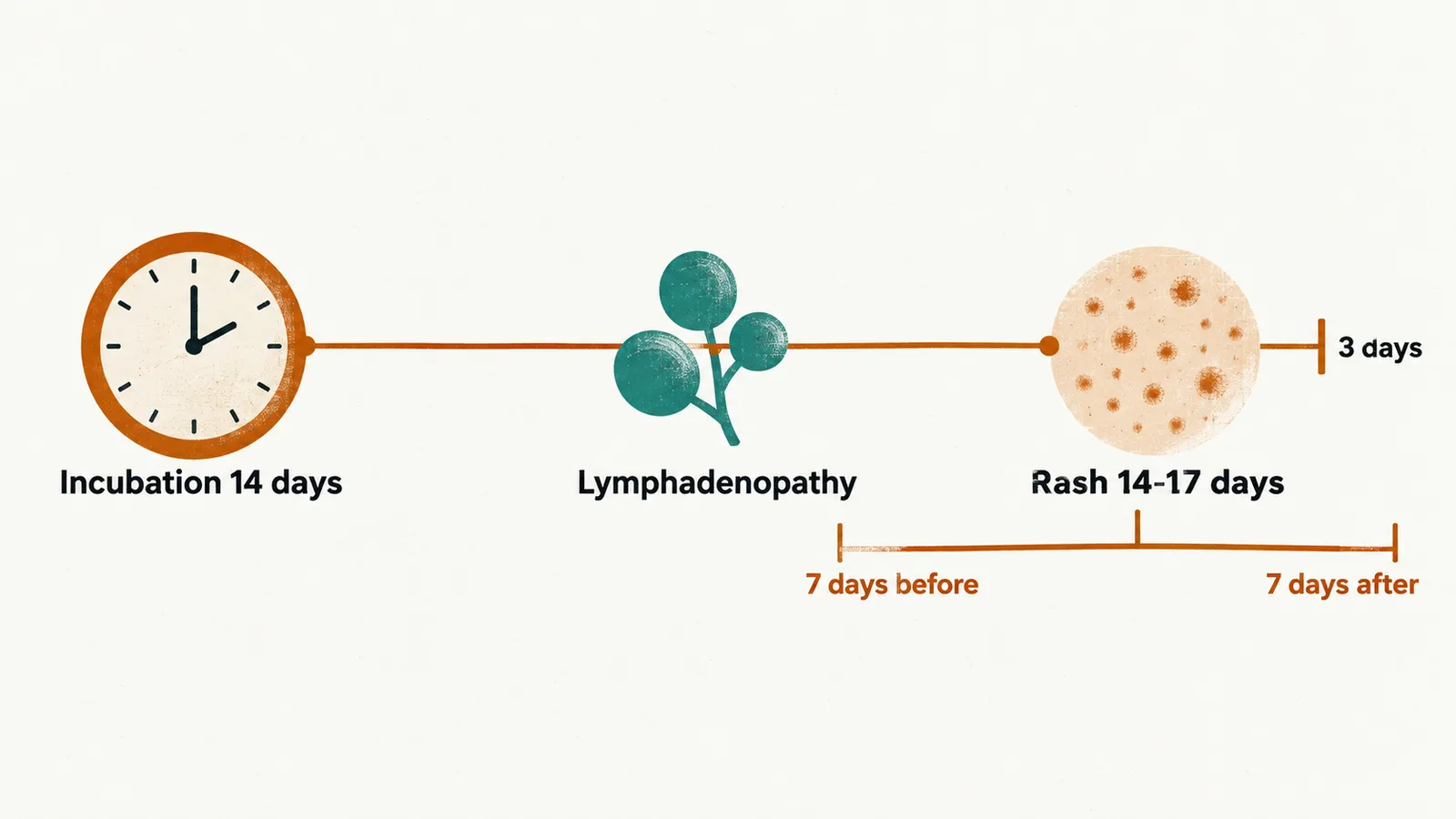
The incubation period averages 14 days (range 12-23 days). Up to half of infections are subclinical, producing no symptoms, which is why rubella can circulate without anyone noticing: the illness is transmitted by people who never develop a rash and never know they were infected.
Clinical course
What rubella looks like depends on age. In young children the rash is usually the first symptom, and a prodrome (a phase of symptoms before the rash) is uncommon. In older children and adults there may be a 1-5 day prodrome of low-grade fever, malaise and upper respiratory symptoms before the rash appears.
Lymphadenopathy (lymph node enlargement) is the most useful early finding. Postauricular (behind the ears), occipital (at the back of the head) and posterior cervical lymph nodes enlarge; the enlargement characteristically begins about a week before the rash, may be generalised, and can persist for several weeks. It is more prominent and more useful diagnostically than the lymphadenopathy of the other classics.
The rash is maculopapular (flat and raised red spots) and appears 14-17 days after exposure. It begins on the face, becomes generalised within about 24 hours, spreads rapidly downwards, lasts about 3 days, and fades without desquamation (peeling). It is fainter than a measles rash and does not coalesce into confluent patches. Small red spots on the soft palate (Förchheimer spots) are described in a minority of cases but are not diagnostic.
Age matters again for joint symptoms, which are rare in children and in adult men, but occur frequently in adult women — in up to 70% in reported series — usually beginning around the time the rash appears and lasting up to about a month.
Diagnosis
Measles, scarlet fever, fifth disease and drug eruptions all produce rashes that can pass for rubella, so confirmation rests on laboratory testing rather than on the appearance of the rash. Recent infection is demonstrated by rubella-specific IgM (the antibody class of a recent infection), by a significant rise in IgG (the longer-lasting antibody class) between paired samples, or by PCR on a throat or nasopharyngeal swab; IgG without IgM documents immunity in someone whose vaccination history is unclear.
Management and prevention
There is no specific antiviral treatment, and care is supportive. Management therefore turns to limiting spread, because the weight of rubella falls on the non-immune people around the child.
A person with rubella is most contagious when the rash erupts, and can transmit from about 7 days before to 7 days after its appearance. The prodrome and the subclinical cases are infectious too, which is why exposure usually happens before the rash identifies the illness. Suspected cases are isolated until 7 days after the rash appears and reported to public health authorities, and contact assessment begins as soon as rubella is suspected, rather than waiting for laboratory confirmation.
Two doses of MMR (measles-mumps-rubella) vaccine prevent rubella. In the Italian national vaccination plan (PNPV 2023-2025) the first dose is given in the second year of life and a booster at 5-6 years; the delay beyond the first birthday has a biological reason, because maternal antibody neutralises the vaccine if it is given earlier.