
The six classic childhood exanthems are separated less by the rash they produce than by what follows it. Two of them can kill or disable: measles, through pneumonia and a late neurological disease, and scarlet fever, through immune-mediated damage to the heart and kidneys that appears weeks after the sore throat. The other four are usually benign, and each has one situation in which it is not.
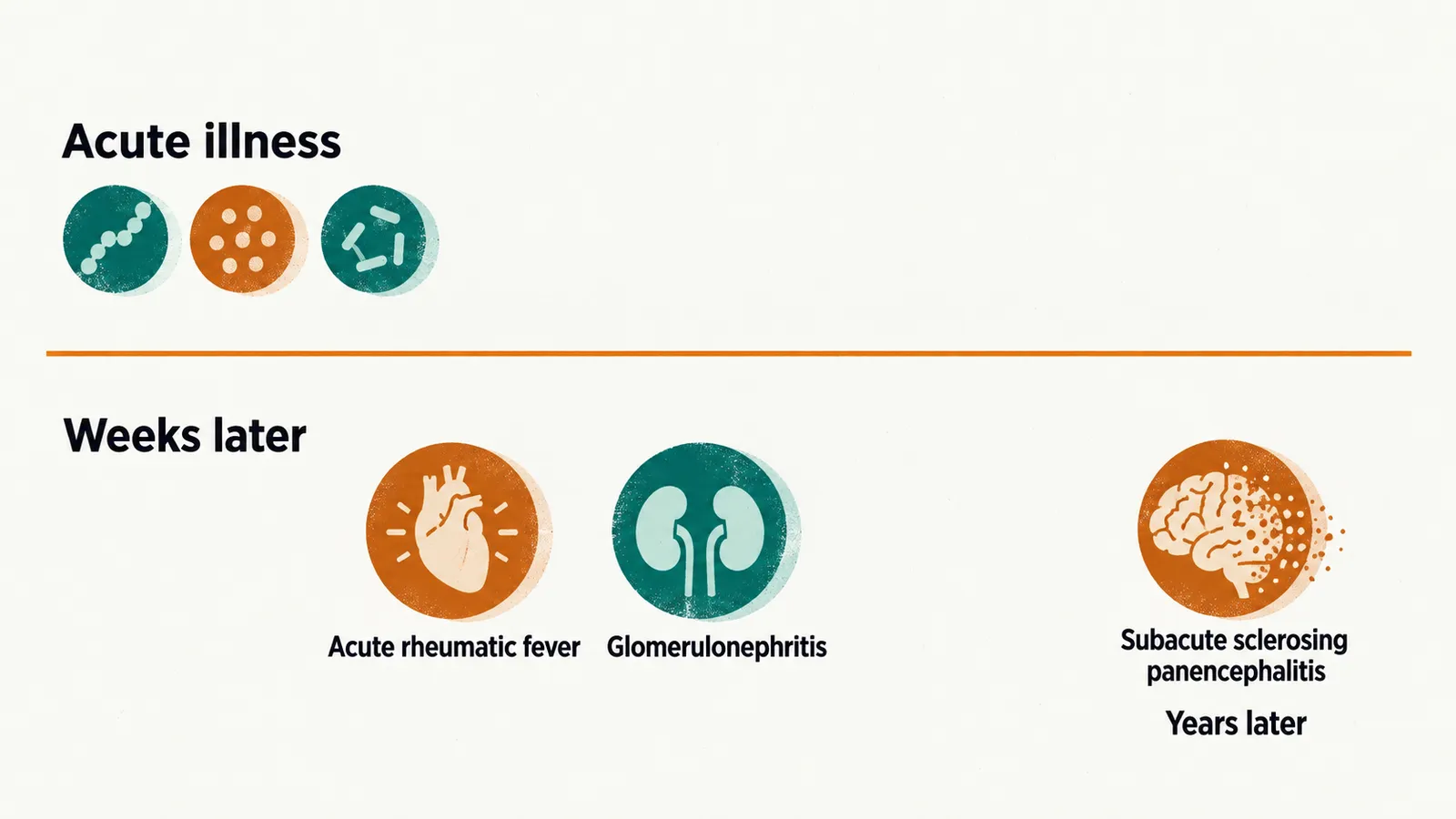
Complications are easier to remember by their timing, because the timing points to the mechanism: damage during the acute illness comes from the pathogen or the immune response to it, whereas damage weeks or years later comes from an immune response that has outlived the infection.
Measles
Measles shows both kinds of timing. Its acute complications — otitis media (middle-ear infection), diarrhoea, pneumonia and encephalitis — arise during the illness, whereas subacute sclerosing panencephalitis (SSPE), a progressive and fatal brain disease, appears 7-10 years later.
| Timing | Complication | Frequency |
|---|---|---|
| Acute | Otitis media | About 1 in 10 children |
| Acute | Diarrhoea | Fewer than 1 in 10 |
| Acute | Pneumonia, viral, bacterial or mixed | As many as 1 in 20 children; the commonest cause of death in young children |
| Acute | Encephalitis | About 1 in 1,000; may leave deafness or intellectual disability |
| Late (7-10 years) | Subacute sclerosing panencephalitis | About 1 in 1,367 when measles occurred before age 5, and about 1 in 609 when it occurred before 12 months |
The most important point in this table is the age gradient: the younger the child at primary measles, the higher the risk of the late neurological complication — and infancy is also the age at which measles vaccine cannot yet be relied on because of maternal antibody. Infancy, in other words, is the age at which primary measles carries the greatest risk.
Scarlet fever
Complications divide by mechanism, and the timing differs accordingly.
Suppurative complications (those that form pus) result from spread of the infection itself: cervical lymphadenitis, peritonsillar and retropharyngeal abscess, otitis media, and invasive group A streptococcal disease with sepsis, cellulitis, pneumonia, septic arthritis or osteomyelitis.
Immune-mediated complications appear weeks after the acute illness. Like the scarlet fever rash itself, which is an immune reaction to a circulating streptococcal toxin rather than infection of the skin, they are caused by the immune response rather than by bacteria in the affected organ:
- Acute rheumatic fever — the dominant cause of acquired valvular heart disease in populations with limited antibiotic access. Carditis (inflammation of the heart), arthritis, chorea (involuntary jerky movements), erythema marginatum (a ring-shaped rash) and subcutaneous nodules are its manifestations. It typically appears about 1-5 weeks after the preceding streptococcal pharyngitis or skin infection.
- Post-streptococcal glomerulonephritis — a nephritic presentation with haematuria (blood in the urine) and hypertension, appearing about 10 days after pharyngitis and up to 3 weeks after a skin infection.
- PANDAS (paediatric autoimmune neuropsychiatric disorders associated with streptococcal infections) — the neuropsychiatric presentation described after streptococcal infection, for which the evidence base is weaker than for the other two.
Acute rheumatic fever and post-streptococcal glomerulonephritis both rest on molecular mimicry: antigens on the streptococcus resemble proteins of the human heart and kidney, so the antibody response it provokes also recognises the patient’s own tissue. Treating the pharyngitis with a full 10-day antibiotic course prevents acute rheumatic fever, and the window matters — treatment started within about 10 days of symptom onset still prevents it, while later treatment does not. Prevention of post-streptococcal glomerulonephritis by antibiotics is not established, so it can follow whether or not the pharyngitis was treated.
Rubella
Rubella is the mildest of the six, and its importance lies almost entirely in who is not immune rather than in what it does to the child. Joint symptoms are rare in children and in adult men, but occur frequently in adult women — in up to 70% in reported series — usually beginning around the time the rash appears and lasting up to about a month. The consequential problem is infection in pregnancy and congenital rubella syndrome, which belong to the topic of congenital and maternal infections.
Fifth disease
Parvovirus B19 infects the red cell precursors of the bone marrow and halts red cell production (erythropoiesis), so its complications depend on how much each person relies on continuous red cell production; the joint symptoms come from the immune response instead. In a transient aplastic crisis, red cell production stops for a time in a person who depends on a high output, and anaemia worsens rapidly; hydrops fetalis is an abnormal accumulation of fluid in the fetus that follows severe fetal anaemia.
| Population | Complication | Mechanism |
|---|---|---|
| Healthy children | Usually none; occasional arthralgia | The marrow compensates |
| Healthy adults, more often women | Polyarthropathy syndrome | Immune complex deposition |
| Chronic haemolytic anaemia | Transient aplastic crisis | Arrest of erythropoiesis at the proerythroblast stage |
| Pregnancy, particularly mid-trimester | Fetal anaemia and hydrops fetalis | Fetal erythropoiesis arrested, leading to high-output cardiac failure |
| Immunocompromised | Chronic anaemia, pure red cell aplasia | Persistent infection without immune control |
The situation worth anticipating is the household one: a pregnant woman whose child develops parvovirus B19 infection is at risk of exposure during the child’s febrile viraemic phase, which is precisely when no one yet knows the diagnosis. By the time the slapped-cheek rash appears the child is no longer infectious, and the mother’s exposure window has usually passed.
Roseola
Roseola’s complication comes from its fever: febrile seizures. They occur in roughly 10-15% of children with a primary HHV-6B infection (the human herpesvirus 6 variant behind most cases of roseola), mostly in the 6-18 month age band. They are usually simple: generalised, brief, without focal features or persistent neurological findings. They reflect how an immature brain reacts to a fever that climbs quickly, rather than spread of the virus into the central nervous system.
If the child looks well after a brief generalised seizure and the fever has a recognisable source, no lumbar puncture and no empirical antibiotics are needed. A child who stays drowsy, has focal signs, or has a prolonged or repeated seizure is a different problem: meningitis and encephalitis take priority there, and the rash should not be taken as the explanation.
Varicella
Varicella’s complications depend on who is infected: the commonest can affect any child who scratches, while the most serious fall on adults, immunocompromised patients, newborns and fetuses.
| Complication | Population | Notes |
|---|---|---|
| Secondary bacterial infection | Any child, through scratching | The commonest complication; suspect it if fever persists beyond day 3 of the rash |
| Varicella pneumonia | Adults and immunocompromised patients | High mortality in adults |
| Cerebellar ataxia (unsteady, uncoordinated movement) | Young children | Post-infectious, usually self-limited |
| Encephalitis | Rare | Direct viral or post-infectious |
| Neonatal varicella | Mother infected 5 days before to 2 days after delivery | Roughly 20-50% of exposed newborns affected; mortality concentrated in babies whose rash starts at 5-12 days of life |
| Congenital varicella syndrome | Maternal infection before 20 weeks | Occurring in roughly 2% of such pregnancies, with high mortality in affected infants |
Infectious or allergic rashes: the differential that changes management
An exanthem may be infectious or allergic, and the two look similar while requiring opposite management.
| Feature | Infectious exanthem | Allergic exanthem |
|---|---|---|
| Distribution and morphology | Widespread, repetitive lesions | Widespread, repetitive lesions |
| Pruritus | Variable; intense in varicella | Often intense |
| Fever | Usually present | May be present |
| Mucosal involvement | Sometimes (Koplik spots, strawberry tongue) | Sometimes |
| Palms and soles | Usually spared | Often involved |
| Head-to-foot progression | Present in measles | No orderly progression |
| Trigger | Pathogen exposure | Drug or allergen exposure |
| Personal or family history of atopy (a tendency to allergic disease) | No particular association | Often present |
| Response to removing the trigger | The illness runs its course | Resolves after the trigger is withdrawn |
| Response to antihistamines or corticosteroids | Poor | Good |
Two pointers carry most of the weight: involvement of the palms and soles, and the absence of an orderly cranio-caudal (head-to-foot) march. A careful history of drug exposure in the preceding days is the other half of the assessment. Where the trigger continues to be given, a drug eruption can progress to erythroderma (redness of almost the whole skin) with desquamation, so the exposure history is not a formality.
The therapeutic consequence is important: systemic corticosteroids are not used to treat viral exanthems. In varicella they are a recognised risk factor for severe disease, and a child with a viral exanthem given corticosteroids for a presumed allergic rash may do worse rather than better.
Reasoning errors that matter
Giving corticosteroids to a child with a viral exanthem is one of a small set of errors that recur across these six diseases. In each, a reasonable action is taken for the wrong child or at the wrong point in the illness:
- Treating a viral prodrome (the early illness before the rash) with antibiotics. An early maculopapular rash with fever and pharyngitis is often viral; the reverse error, failing to recognise streptococcal pharyngitis in a school-age child, is the more consequential one.
- Missing scarlet fever because the tongue finding is subtle. The cost is acute rheumatic fever, which is preventable within the treatment window and irreversible afterwards.
- Giving aciclovir to a healthy child with varicella, or withholding it from a child in a risk group. The decision is risk-stratified, not universal.
- Not isolating a child with measles for the full contagious period. Measles spreads for days before the rash and through air that remains infectious for up to 2 hours; a waiting room can be a transmission site.
- Failing to connect fifth disease to a pregnant household contact. The exposure happened during the febrile phase, so the assessment belongs there rather than after the rash.
- Investigating roseola and fifth disease as if they were undiagnosed fevers. In both, the diagnosis is clinical and the child needs no tests, no antibiotics and no isolation by the time the rash is visible.