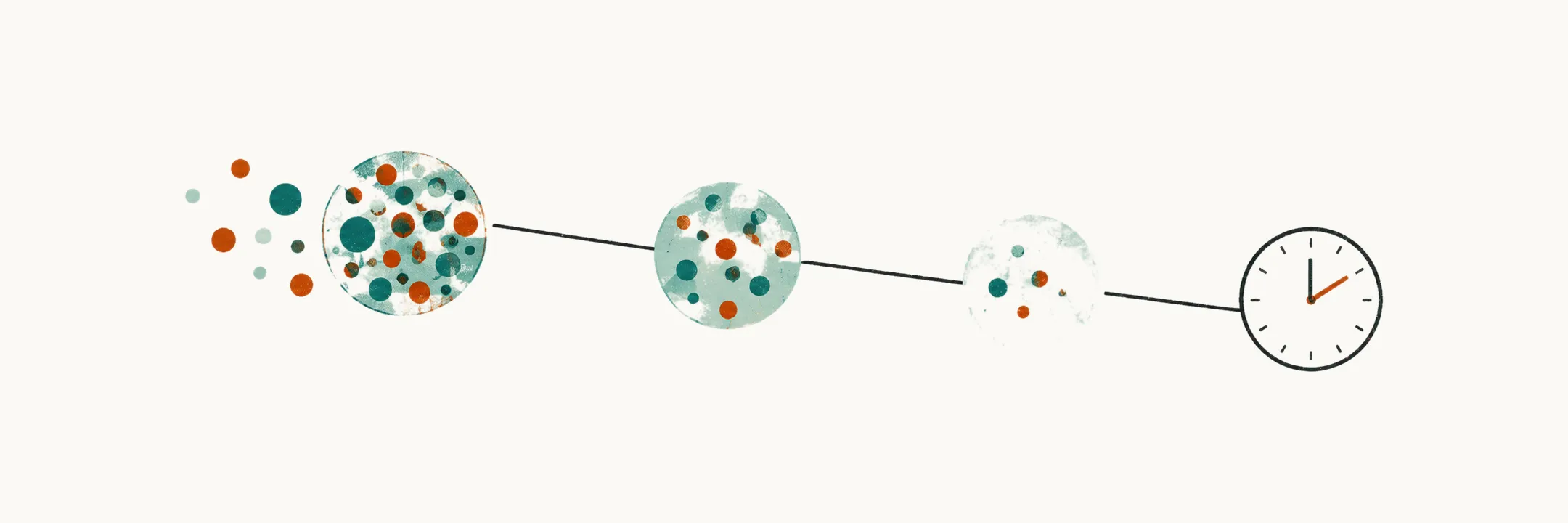
A child with measles is contagious for days before the rash appears, and the virus remains suspended in the air of a room for up to 2 hours after the child has left it. That combination makes measles the most transmissible of the six classic exanthems and the one where the diagnosis has to be considered early; it is also the classic exanthem that most often becomes a serious illness rather than a self-limited one.
The virus, and why it spreads so effectively
Measles is a single-stranded RNA virus of the Paramyxoviridae family, with no animal reservoir other than humans. It enters through the respiratory tract, replicates first in the nasopharyngeal mucosa and regional lymph nodes, and then seeds two successive rounds of viraemia (virus circulating in the blood). The second round delivers virus to the skin, the conjunctiva and the respiratory epithelium, which explains why conjunctivitis is part of the prodrome (the symptomatic phase before the rash) and why the cough outlasts the rash by days or weeks.
Two numbers describe the transmission. The basic reproduction number (R0), the average number of people infected by one case when everyone around is susceptible, is generally estimated at 12-18 in fully susceptible populations, among the highest of any directly transmitted infection. And the virus remains infectious in the air of a closed space for up to 2 hours, so transmission does not require face-to-face contact with the infectious child.
That combination sets an unusually high bar for population protection: measles elimination requires vaccination coverage in the range of 93-95% with two doses.
Three clinical phases
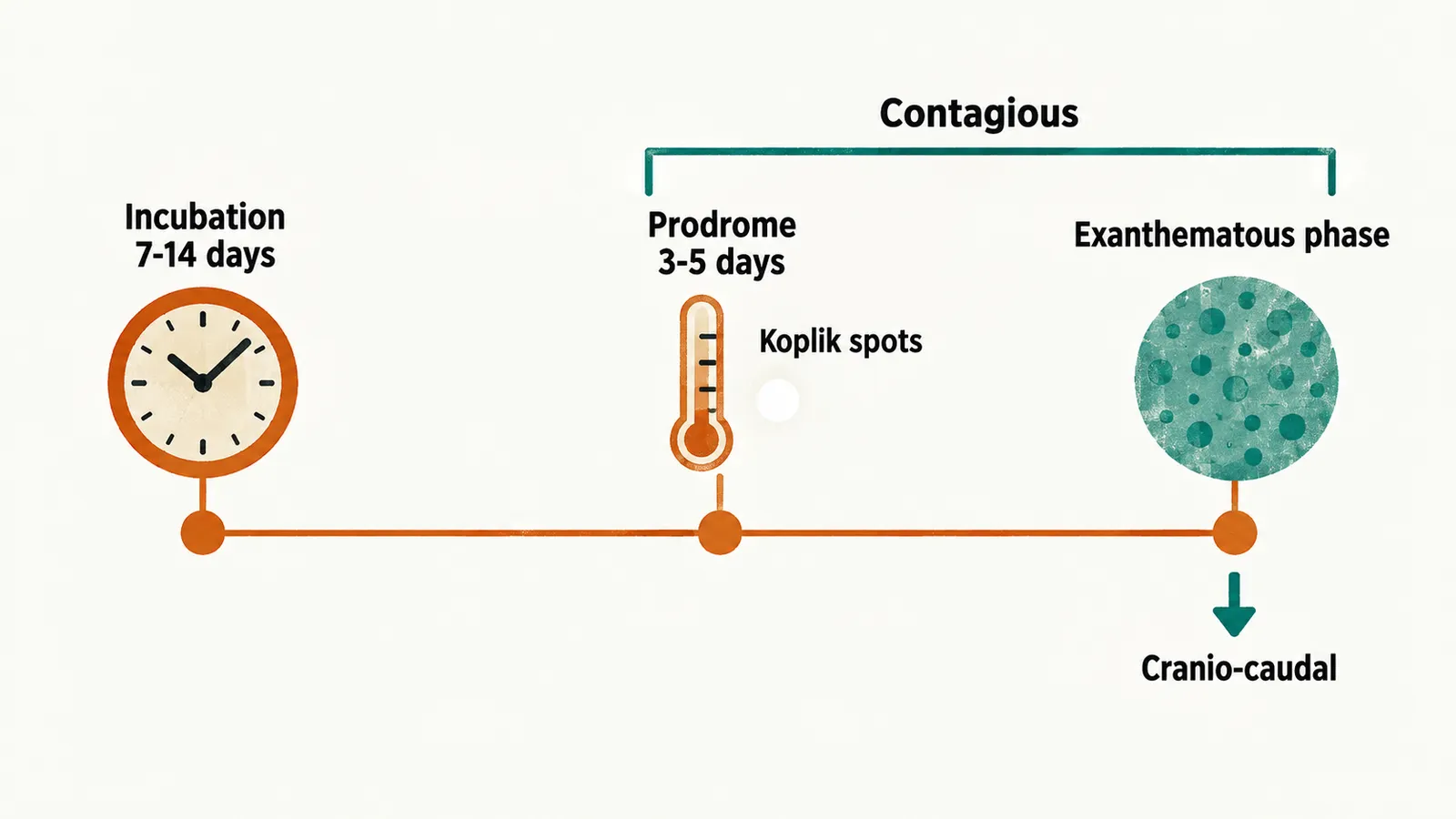
1. Incubation
Symptoms appear 7-14 days after exposure, and the incubation is asymptomatic. Contagiousness begins about 4 days before the rash appears, which means a child is already transmitting while the illness still looks like any other febrile upper respiratory infection.
2. Prodrome
The prodrome lasts 3-5 days and is built around the three C’s — cough, coryza (runny nose) and conjunctivitis — with fever that climbs and may exceed 40 °C. Koplik spots appear 2-3 days after the first symptoms: small white lesions on the buccal mucosa (the inside of the cheeks), sometimes also on the conjunctiva or vaginal mucosa. They are the most specific finding of the whole illness and they disappear as the rash appears, so they are visible only within a narrow window. Vomiting, diarrhoea and lymphadenopathy also occur.
3. Exanthematous phase
The rash appears 3-5 days after the first symptoms, as flat red spots at the hairline and behind the ears. It spreads cranio-caudally (from the head downwards) — face, then neck, trunk, arms, legs and feet, over about 3 days — and then fades in the order in which it appeared, leaving fine desquamation (peeling of the skin). It usually lasts 4-8 days. The fever often spikes again as the rash appears, and the cough remains the longest-lasting symptom, often for around 10 days.
Diagnosis
Measles is diagnosed clinically in a child with a characteristic prodrome, Koplik spots, and a cranio-caudal maculopapular rash. Laboratory confirmation is by measles-specific IgM in serum, the antibody class of a recent infection, which appears from about 3 days after rash onset, or by RT-PCR (reverse-transcription polymerase chain reaction, which detects viral RNA) on a throat or nasopharyngeal swab. Notification is required in countries with mandatory surveillance, and laboratory confirmation should be sought for every suspected case, because the public health consequences of a false positive are considerable.
Complications
Most measles complications arise during or just after the acute illness. The exception is the last row of the table, subacute sclerosing panencephalitis (SSPE), which appears years later.
| Complication | Frequency | Notes |
|---|---|---|
| Otitis media | About 1 in 10 children | Commonest of the common complications |
| Diarrhoea | Fewer than 1 in 10 | Contributes to dehydration and to mortality in low-resource settings |
| Pneumonia | As many as 1 in 20 children | The commonest cause of death from measles in young children; may be viral, bacterial or mixed |
| Acute encephalitis | About 1 in 1,000 | Can leave deafness or intellectual disability |
| Death | 1-3 per 1,000 reported cases | Predominantly from respiratory and neurological complications |
| Subacute sclerosing panencephalitis (SSPE) | About 1 in 1,367 if measles occurred before age 5; about 1 in 609 if it occurred before 12 months | Always fatal |
Complication rates are not uniform across settings. Case fatality is much higher where malnutrition, vitamin A deficiency and limited access to care are common; WHO attributes more than 95% of measles deaths to low-income countries with weak health infrastructure. Children under 5 years and adults over 30 are at the highest risk of complications in any setting.
Measles also depresses immunity for weeks to years afterwards, so that a child is more vulnerable to other infections after recovering than before the illness. The mechanism involves damage to previously acquired immune memory.
Subacute sclerosing panencephalitis
SSPE is a progressive, fatal inflammatory disease of the central nervous system caused by persistent measles virus infection long after apparent recovery. It typically develops 7-10 years after the acute illness, and presents with behavioural change and cognitive decline that progress to myoclonic jerks (sudden, brief muscle twitches), ataxia, seizures and ultimately a vegetative state. There is no curative treatment.
The risk is not evenly distributed: it is highest when the primary infection happens in infancy, which is also the age group in which maternal antibody interferes with vaccination. Catching wild measles before the first birthday is therefore the worst version of the disease, not the mildest.
Management
There is no specific antiviral. Treatment is supportive: fluids, paracetamol or ibuprofen for comfort, and antibiotics only for bacterial complications. A child with measles should be kept away from susceptible contacts, particularly infants and immunocompromised people. WHO recommends vitamin A for all children with measles, given as two doses on consecutive days:
| Age | Dose per day, for 2 days |
|---|---|
| Under 6 months | 50,000 IU |
| 6-11 months | 100,000 IU |
| 12 months and over | 200,000 IU |
A third dose 4-6 weeks later is recommended if there are clinical signs of vitamin A deficiency. The evidence for a mortality benefit is strongest in children under 2 years in populations where deficiency is present.
Prevention
Two doses of live-attenuated MMR (measles-mumps-rubella) vaccine prevent measles. In the Italian national vaccination plan (PNPV 2023-2025) the first dose is given in the second year of life and a booster at 5-6 years. The delay beyond the first birthday is mechanistic: maternal antibody neutralises the vaccine if it is given earlier.
For susceptible contacts, post-exposure prophylaxis can attenuate or prevent disease: MMR within 72 hours of exposure, or immunoglobulin within 6 days for contacts who cannot receive the vaccine — infants under 6 months, pregnant women and immunocompromised people.