
Italy requires ten vaccinations for children and adolescents up to 16 years of age. The rest of its schedule is offered actively and free of charge without being mandatory: pneumococcal conjugate, rotavirus, meningococcal B, meningococcal ACWY, HPV, influenza, and hepatitis A for risk groups and travel. Those vaccines prevent six diseases — pneumococcal disease, meningococcal disease, rotavirus gastroenteritis, human papillomavirus infection, influenza and hepatitis A.
The six fall into three groups. For the first two, the kind of vaccine follows from the biology of the pathogen: a polysaccharide capsule requires a conjugate; a virus that infects the gut needs an oral live-attenuated vaccine with a narrow age window; and a virus whose importance lies in the cancer it causes has to be prevented before exposure rather than treated afterwards. The third group, influenza and hepatitis A, is defined by who is offered the vaccine: influenza every year to young children and to those at risk, hepatitis A to risk groups and travellers.
The two encapsulated bacteria
Streptococcus pneumoniae and Neisseria meningitidis both wear polysaccharide capsules. A pure polysaccharide antigen produces little antibody and no reliable memory in children under 2 years, which is why both are prevented in infancy by conjugate vaccines, in which the polysaccharide is joined to a protein carrier, rather than by polysaccharide alone.
Pneumococcus
Streptococcus pneumoniae causes otitis media, pneumonia, bacteraemia and meningitis. The risk of invasive disease rises with decreased immune function (including haematological malignancy and HIV infection), asplenia (absent or non-functioning spleen), chronic heart, lung, liver or kidney disease, cigarette smoking in adults, cerebrospinal fluid leak and cochlear implant. Pneumococcal meningitis is the leading cause of lasting hearing loss among survivors of bacterial meningitis.
Conjugate vaccines are used in infants — 13-valent and higher-valency conjugates are available, and the product used can vary by region — while the 23-valent polysaccharide vaccine is not effective below 2 years and is reserved for older children and adults. The conjugate vaccine reduced invasive pneumococcal disease directly in vaccinated children and indirectly in the unvaccinated population, which is a herd effect (protection of the unvaccinated by the immunity of those around them) rather than a property of the polysaccharide product.
Meningococcus
Neisseria meningitidis is an aerobic Gram-negative diplococcus with 13 described polysaccharide capsules, which define its serogroups; serogroups A, B, C, W and Y cause almost all invasive disease. Colonisation of the nasopharynx precedes invasion, and a preceding upper respiratory infection may contribute. After an incubation of 3 to 4 days (range 2 to 10), disease presents abruptly with fever, meningeal signs, hypotension and rash.
Overall mortality exceeds 10%, death can occur within 24 to 48 hours, and case fatality reaches 10% to 15%, or up to 40% in meningococcaemia (meningococcal bloodstream infection); about 20% of survivors have permanent complications such as hearing loss, cutaneous necrosis or limb amputation. Incidence peaks in early childhood, adolescence and older age.
Two vaccines cover these serogroups. The recombinant serogroup B vaccine contains recombinant NHBA, fHbp and NadA fusion proteins (50 micrograms each) plus outer membrane vesicles from strain NZ98/254 measured as total protein containing PorA (25 micrograms), adsorbed onto aluminium hydroxide. Meningococcal ACWY conjugate vaccine is given at 12 months and again in adolescence. Close contacts of a case need chemoprophylaxis, which is covered in Meningitis and Pediatric CNS Infections.
Two viruses whose vaccine has a window
Rotavirus
Rotavirus is the most common cause of gastroenteritis worldwide and the leading cause of severe dehydration in infancy. Before the vaccine was introduced, 80% of children in the United States had had rotavirus by the age of 5, with roughly 410,000 physician visits, 205,000 to 272,000 emergency department visits and 55,000 to 70,000 hospitalisations each year. The highest incidence is between 6 and 24 months, with a mean age at infection of 9 to 15 months; 30% to 50% of hospitalisations for gastroenteritis are attributed to rotavirus, and cases cluster in winter and often coincide with respiratory infection.
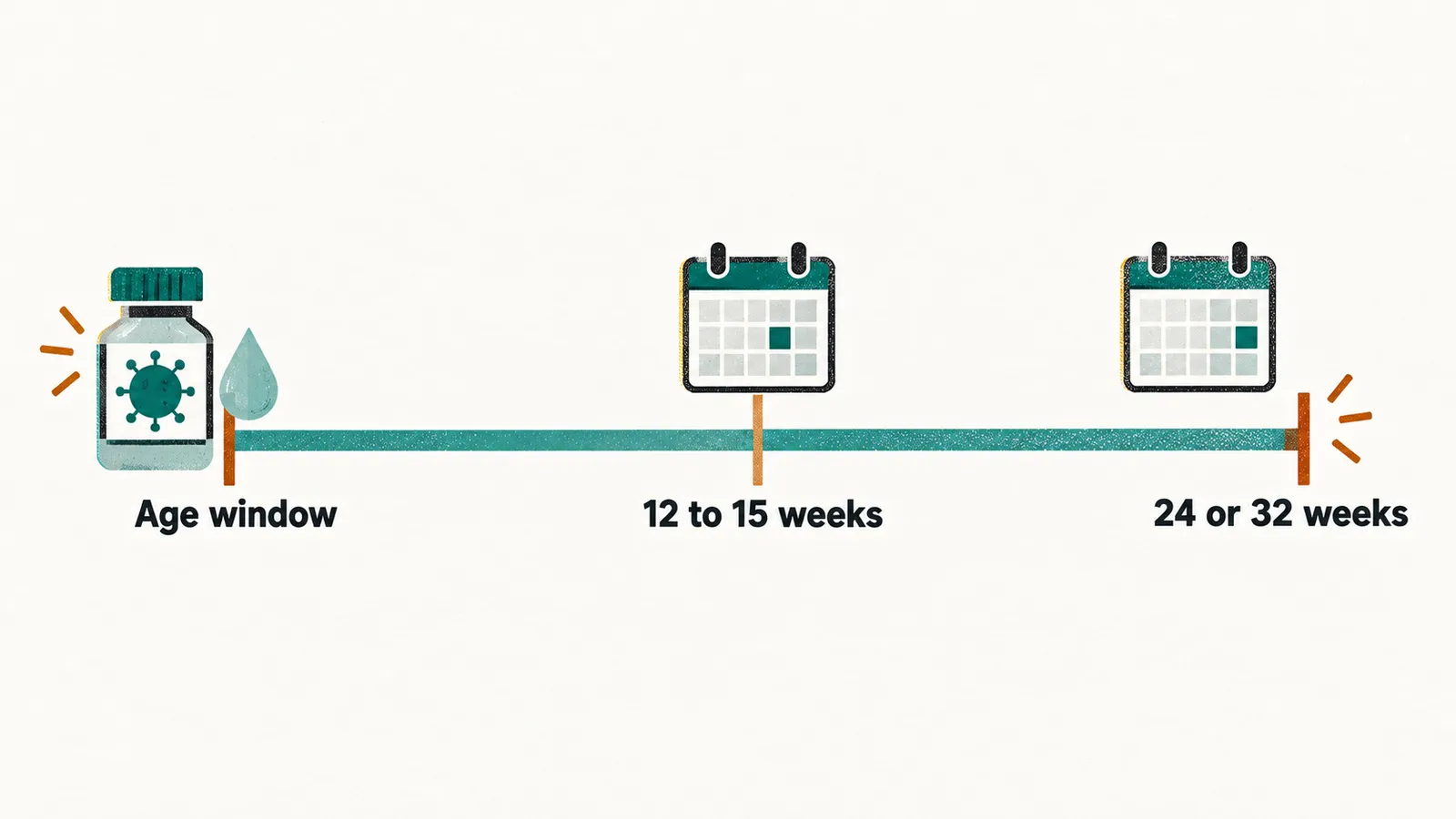
The vaccine is oral and live-attenuated, and it is the one vaccine in the schedule whose age limits exist for safety rather than for immunology: the first dose must be given by 12 to 15 weeks depending on the product and the course completed by 24 or 32 weeks, because the risk of intussusception (the telescoping of one segment of bowel into the next) is age-related. Etiology and Risk Factors of Acute Diarrhea in Children puts rotavirus in the context of the other enteric pathogens, and Pediatric Vaccines: Types and the Italian Schedule gives the timing in the calendar.
Human papillomavirus
More than 200 HPV types have been described on the basis of the outer capsid protein L1, of which about 40 infect the mucosal epithelium. Infection is very common — between 50% and 80% of sexually active people are infected at some point, and in the United States about 13 million people, including teenagers, become infected each year. Most infections are asymptomatic and clear.
The carcinogenic role is what makes vaccination worthwhile. HPV is responsible for nearly all cervical cancers, with types 16 and 18 causing about 70% of them, and it is also implicated in around 90% of anal cancers and a majority of vulvar, vaginal, penile and oropharyngeal cancers. The vaccine prevents infection and does not treat it, which is why the target is vaccination before exposure. The 9-valent vaccine is given as two doses six months apart from 11 years of age and up to 14, and as a three-dose course from 15 years; the Italian catch-up offer continues into early adulthood.
Two vaccines offered by age or risk
Influenza
Influenza A viruses have animal reservoirs — wildfowl in particular — and are the usual source of epidemics and pandemics; influenza B causes smaller, usually milder outbreaks and circulates mainly in humans. The season in Italy runs broadly from late November to the end of March, and children are both at higher risk of complications and a major driver of transmission to the rest of the population.
Complications in children range from acute otitis media in infants and preschool children, through febrile seizures, to myocarditis, myositis and toxic shock syndrome in school-aged children. Influenza myocarditis is rare but can cause sudden death in previously healthy children. Risk is increased in children under 5 years — particularly under 2 — and in adults over 65.
The antiviral oseltamivir can be used from 2 weeks of age and works best when it is started as soon as the illness is recognised; later treatment still has a role but reduced efficacy. Vaccination is annual, and in Italy it is offered free of charge to all children from 6 months to 6 years and to older children with risk conditions. Vaccinating a pregnant woman protects both her, since pregnancy increases the risk of severe influenza, and her infant during the first months of life.
Hepatitis A
Hepatitis A spreads by the faecal-oral route. It is usually self-limiting in young children, in whom it is often asymptomatic or mild, but severity increases with age and it can cause fulminant hepatitis. The vaccine is inactivated and given as a two-dose series, and in Italy it is offered to risk groups, including people travelling to areas of high endemicity.
Offered, not required
The schedules for children with specific risk conditions and the immunisation of immunocompromised children follow national guidance and specialist advice. None of these vaccines is required by law, so the protection each one gives depends on how many people take it up — which is a question about coverage rather than about the product.