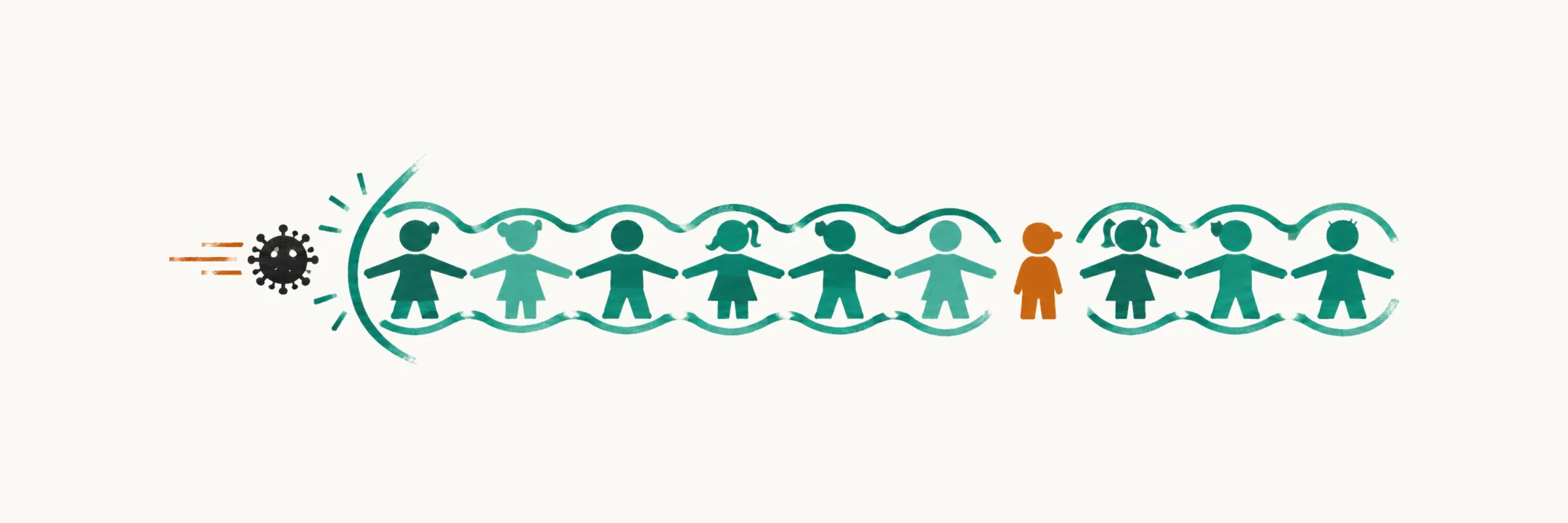
A vaccine protects the child who receives it. Whether a disease keeps circulating in a population is a separate question, and it depends on how many people are immune. Herd immunity is the state in which most of a population has been immunised: the pathogen still exists, but it cannot spread for want of susceptible hosts, so even people who cannot be vaccinated — an infant too young for the first dose, a child with a contraindication, a child whose treatment suppresses the immune system — are protected by the immunity of those around them. That is why a schedule is judged by its coverage as much as by its products, and why a modest fall in coverage can be followed by a large change in disease.
The threshold is not one number
The coverage required rises with how transmissible the pathogen is, because a more contagious organism can sustain transmission in a population with fewer susceptible people. Transmissibility is expressed as the basic reproduction number, the average number of people one case infects in a fully susceptible population. Measles has one of the highest basic reproduction numbers of any human pathogen, and eliminating it requires coverage of 93% to 95% with two doses. The World Health Organization’s target for measles elimination is at least 95% coverage with both doses, sustained in every district rather than reached only on average, because a national figure can hide a cluster of unvaccinated children.
Measles is the most sensitive indicator of a coverage gap, because it spreads so efficiently that a small deficit is enough to sustain an outbreak. Pathogens that spread less efficiently need lower coverage, but the logic behind the figure is the same.
What a coverage gap looks like
An estimated 207,500 people died worldwide of measles in 2019, in a disease whose vaccine is cheap and effective. The gap has not closed since. In 2023 there were an estimated 10.3 million cases worldwide, 20% more than in 2022, and 107,500 deaths, mostly in children under 5 years. In 2024 the World Health Organization European Region reported 127,350 cases, double the number reported for 2023 and the highest the Region had seen since 1997; children under 5 years accounted for 43% of them, and nearly 74,000 people were admitted to hospital.
None of this reflects a failure of the vaccine. Two doses of a measles-containing vaccine prevent about 97% of cases in the children who receive them, which is precisely why a resurgence points at delivery rather than at the product.
Italy: what a mandate did to coverage
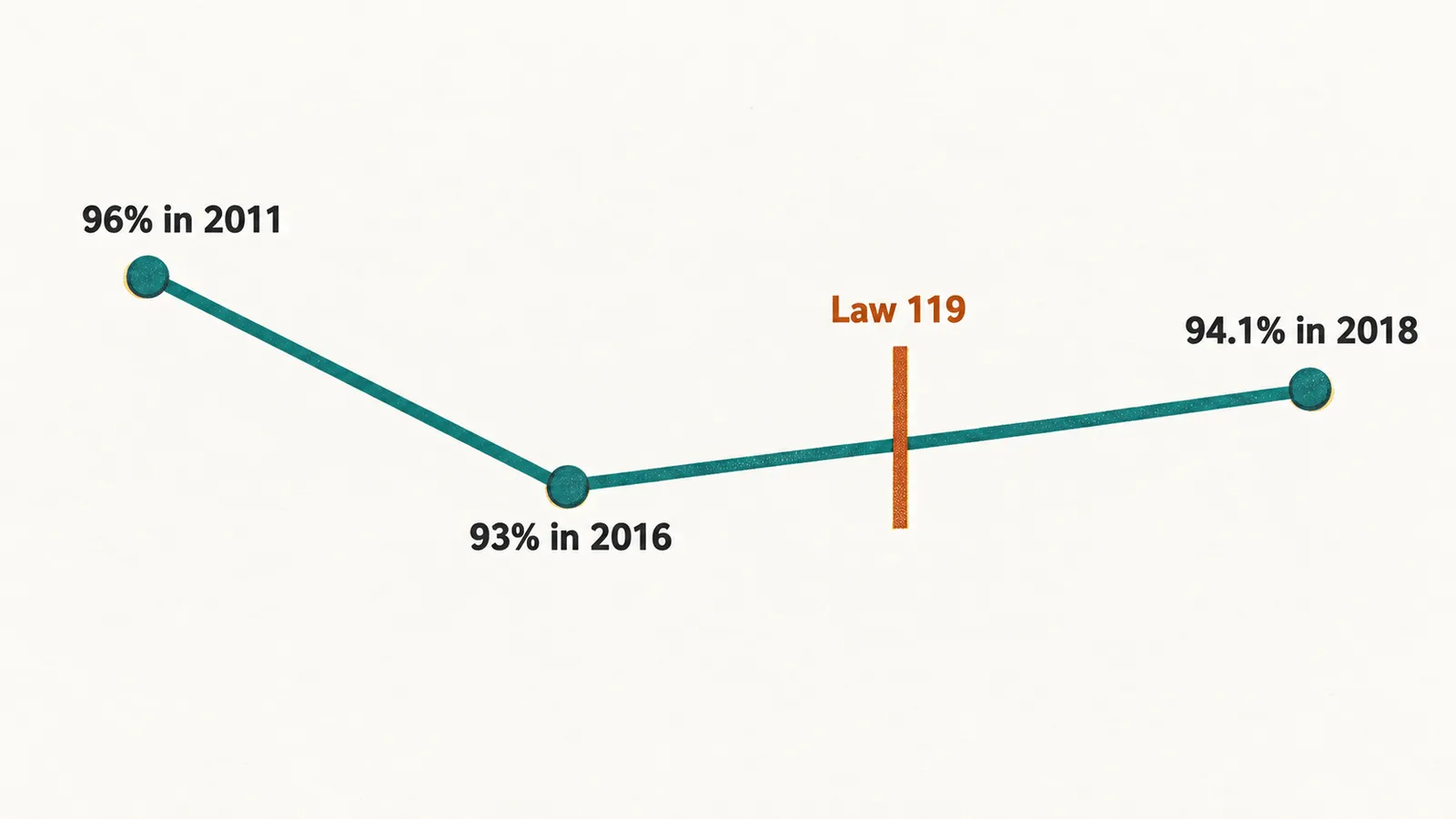
Italy shows both halves of the pattern. Reported polio coverage fell from about 96% in 2011 to about 93% in 2016. Law 119 of 31 July 2017 then extended the vaccinations that are mandatory for minors up to 16 years from four to ten, and coverage rose: measles-containing first-dose coverage went from 87.3% in 2016 to 91.8% in 2017 at 24 months, and reached 94.1% at 30 months as at June 2018. The recovery was real, and the margin it leaves is narrow — measles needs sustained two-dose coverage of 93% to 95%, and coverage that is improving is not yet coverage that is sufficient.
Polio: the last mile
Polio is the clearest example of a disease that vaccination has brought to the edge of eradication without finishing the job. Wild poliovirus type 1 remains endemic in Afghanistan and Pakistan, and the global case count has fallen to the tens: 99 cases in 2024. The World Health Organization still treats the international spread of poliovirus as a public health emergency of international concern, which is a statement about coverage rather than about the virus.
In 2022 virus was detected in London sewage and a paralytic case occurred in New York State in an under-vaccinated community. Both events involved circulating vaccine-derived poliovirus type 2 — virus descended from the live oral vaccine strain and spreading among under-vaccinated people — not the wild virus: the type 2 virus found repeatedly in sewage from north and east London, and the virus that paralysed a young adult in Rockland County, New York, who had never been vaccinated, were genetically linked to each other and to samples from Jerusalem. The oral vaccine that can seed such viruses is no longer used in Italy, but the outbreak it produced was a coverage problem with a coverage remedy: re-emergence was driven by under-vaccination, not by a new strain.
Why the last percent is the hard part
Coverage is the population-scale version of the discipline that antibiotic stewardship applies to one child: use the narrowest effective intervention, and finish it. A ten-day antibiotic course stopped on day three and a two-dose measles schedule allowed to drift below its threshold are the same mistake at different scales, and in both cases the cost is paid later, often by people who were not the ones being treated.