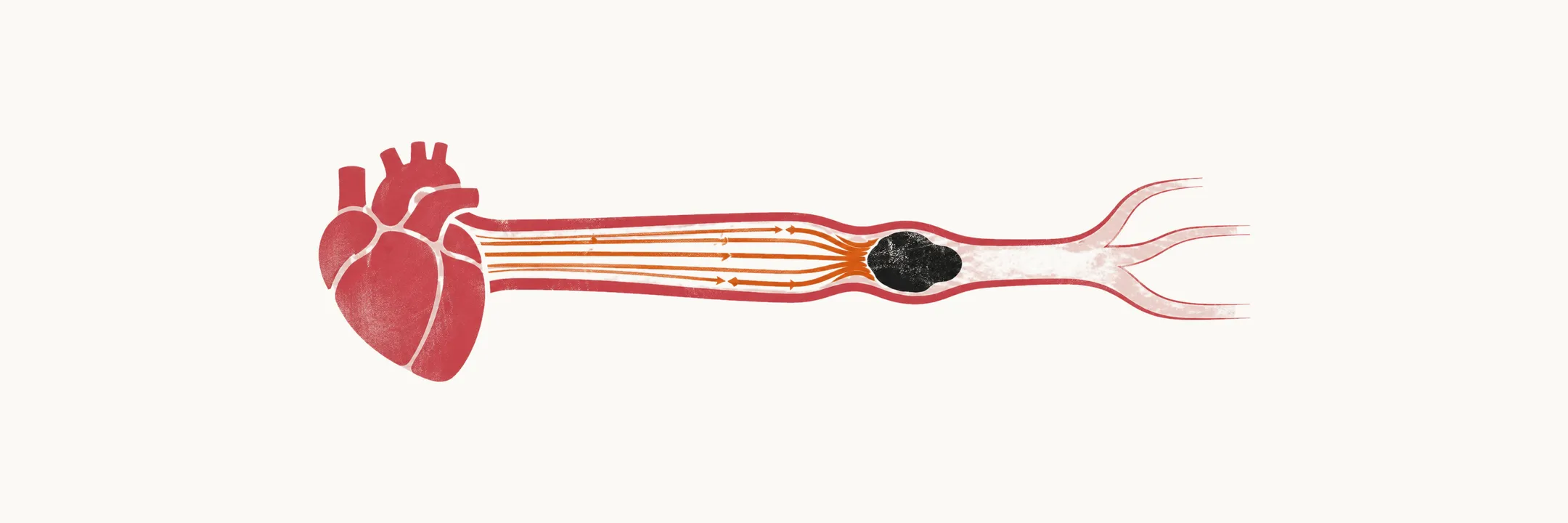
Acute myocardial infarction means death of heart muscle because its blood supply was interrupted for long enough. The event a patient presents with is an acute coronary syndrome (ACS), the umbrella that covers infarction and unstable angina, the ischaemia that leaves no detectable injury. On the ECG, the syndrome divides into ST-elevation myocardial infarction (STEMI), which generally reflects an acutely occluded artery, and non-ST-elevation presentations (NSTEMI and unstable angina). The first clinical questions are how completely the artery is blocked and how much muscle is still salvageable. Since 2026, infarction is classified by what is happening in the artery rather than by type number.
Choose a route through this family
If you are new to the topic, start with who develops infarction and why the muscle dies; how much muscle is lost shapes everything that follows.
- Epidemiology and Risk Factors of Myocardial Infarction: how common infarction is, why most of it now presents without ST elevation, and which risk factors carry the most weight.
- Pathophysiology of Myocardial Infarction: how an unstable plaque closes an artery, why the damage spreads outward from the subendocardium (the innermost layer of the ventricular wall), and how the infarct heals.
Recognition and confirmation come next: noticing the syndrome, proving the injury, and finding the cause when angiography shows no obstructive lesion.
- Presentation of Acute Coronary Syndromes: the typical and atypical ways an acute coronary syndrome appears, and how ischaemic chest pain is separated from its common alternatives.
- Diagnosis and Classification of Acute Coronary Syndromes: how the ECG and troponin, the blood marker of heart-muscle injury, confirm injury and separate STEMI from NSTEMI, how the 2026 classification replaces the numbered types, and when echocardiography helps in the acute phase.
- MINOCA, Takotsubo and Other Non-Atherothrombotic ACS: the acute coronary syndromes that end at a coronary tree without an obstructive lesion, and how the mechanism behind each one is pursued.
Then come the treatments that restore flow and limit damage.
- Reperfusion in Acute Myocardial Infarction: the choice between primary percutaneous coronary intervention (PCI, opening the artery with a catheter, balloon and stent) and fibrinolysis (drugs that dissolve the clot), the time targets behind it, and what happens when the artery reopens but the muscle is not reperfused.
- Antithrombotic and Symptom Pharmacotherapy in ACS: the antiplatelet and anticoagulant drugs that act on the thrombus, how the P2Y12 inhibitors added to aspirin differ, and the drugs used for pain and haemodynamics.
- Acute Management Pathway of Myocardial Infarction: the first minutes at the bedside, the route to the catheterisation laboratory, cardiogenic shock, and the first 24 hours after reperfusion.
Finally, the weeks and years of care after the event.
- Complications of Myocardial Infarction: what can go wrong after infarction and when, from rhythm and pump failure in the first hours to rupture, remodelling and inflammation later.
- Post-MI Long-Term Management: the drugs and targets that lower risk over the years after the event, including lipid lowering, antiplatelet duration and defibrillator timing.
- Cardiac Rehabilitation After Myocardial Infarction: what a rehabilitation programme contains, how exercise is prescribed and individualised, and how patients return to ordinary activity.