In an acute coronary syndrome (ACS), the thrombus that closes a coronary artery is built from platelets and fibrin, so acute pharmacotherapy attacks both. Antiplatelet drugs stop platelets from aggregating on the exposed plaque, anticoagulants limit the fibrin scaffold that holds the thrombus together, and a small group of additional drugs buys time by reducing pain, oxygen demand and sympathetic drive. The urgency and the sequence, though, differ between the two ends of the ACS spectrum: ST-elevation myocardial infarction (STEMI), where the artery is opened at once, usually by primary percutaneous coronary intervention (PCI) with balloon and stent, and non-ST-elevation ACS (NSTE-ACS), where the timing of angiography is set by risk.
Dual antiplatelet therapy
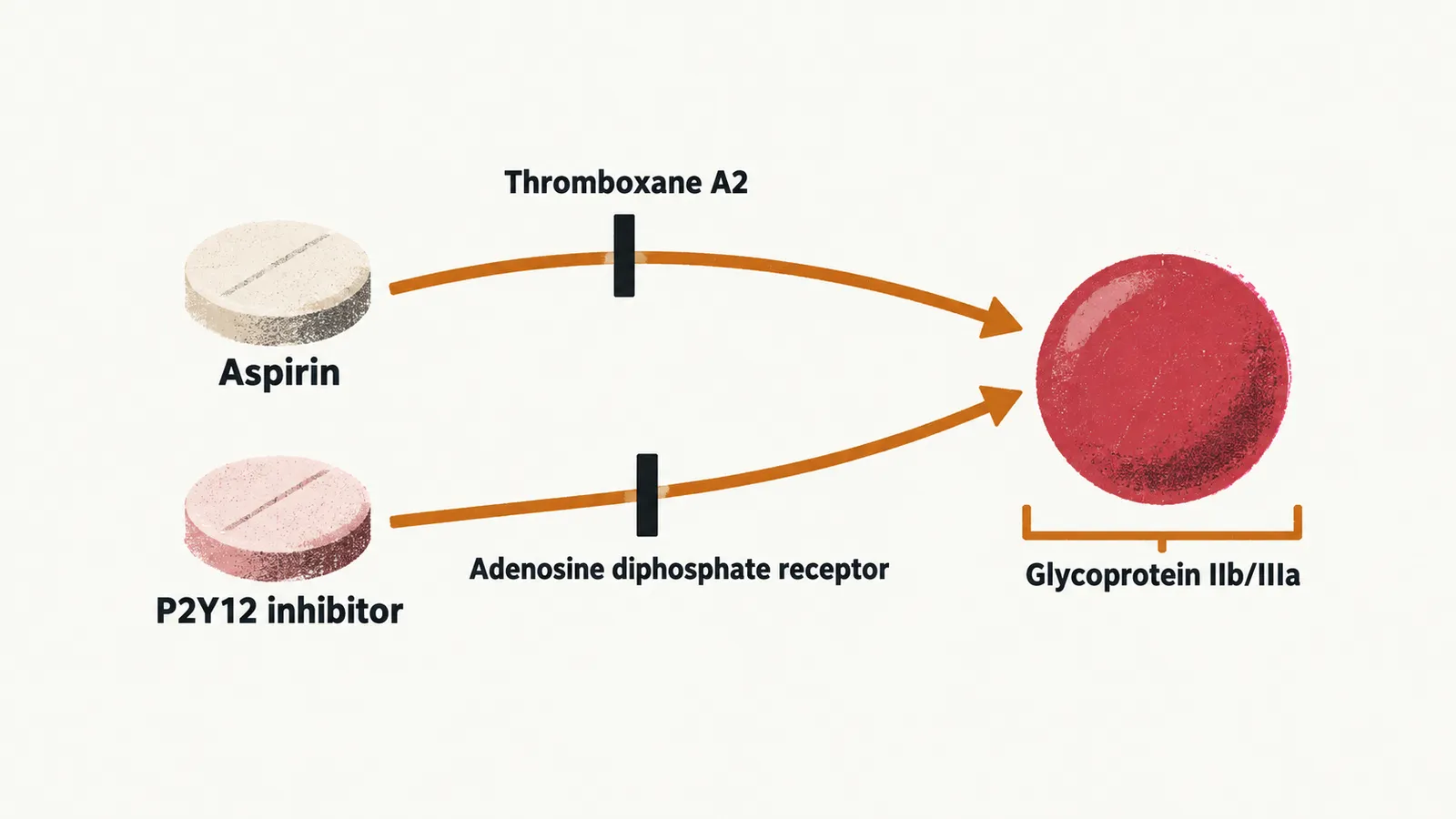
Aspirin irreversibly acetylates cyclooxygenase-1 and blocks thromboxane A2 production, which is one of the two main routes to platelet activation. It is given to every patient with ACS once bleeding contraindications are excluded: a loading dose of 150–300 mg orally, or 75–250 mg intravenously when swallowing is not possible or speed matters, followed by 75–100 mg once daily indefinitely.
A P2Y12 inhibitor blocks the second route, the adenosine diphosphate receptor, and is added to aspirin. Aspirin plus a P2Y12 inhibitor is dual antiplatelet therapy (DAPT), and it is the default antithrombotic background for every ACS patient treated invasively.
The three oral P2Y12 inhibitors differ mainly in how they reach their target. Clopidogrel and prasugrel are prodrugs, inactive until the body converts them, and clopidogrel’s conversion depends on liver cytochrome (CYP) enzymes; ticagrelor acts directly.
| Drug | Loading dose | Maintenance dose | What to know |
|---|---|---|---|
| Clopidogrel | 600 mg orally (300 mg in some settings) | 75 mg daily | Prodrug with a two-step CYP-dependent activation; response varies with CYP2C19 genotype, so onset and effect are less predictable |
| Prasugrel | 60 mg orally | 10 mg daily, or 5 mg daily if age ≥75 years or weight <60 kg | Prodrug with a single activation step, giving faster and more consistent inhibition; contraindicated after any stroke or transient ischaemic attack, and with severe liver disease |
| Ticagrelor | 180 mg orally | 90 mg twice daily | Not a prodrug; binds reversibly and directly, so onset is fastest and recovery does not require new platelet generation; transient dyspnoea in the first days is recognised and usually benign |
Ticagrelor and prasugrel are more effective than clopidogrel and are the preferred agents in most patients, with clopidogrel reserved for situations where they are contraindicated, unavailable, or unsafe — the commonest such situation is the need for concomitant oral anticoagulation.
Where the P2Y12 hierarchy comes from
Three trials established that order of preference. CURE showed that adding clopidogrel to aspirin in non-ST-elevation ACS reduced the composite of cardiovascular death, myocardial infarction or stroke, and made dual antiplatelet therapy the standard of care. TRITON-TIMI 38 compared prasugrel with clopidogrel in patients undergoing PCI and found fewer ischaemic events at the cost of more major bleeding, with the excess concentrated in patients who had already had a stroke or transient ischaemic attack — the finding that became the contraindication. PLATO compared ticagrelor with clopidogrel across the whole ACS spectrum and found a reduction in the composite endpoint at 12 months without a significant increase in overall major bleeding, and it is the only one of the three to reduce cardiovascular death itself (4.0% versus 5.1%), which is why ticagrelor is the usual first choice among the newer agents.
Timing depends on the presentation
Which drug to give is only half the decision; when to give it depends on the presentation.
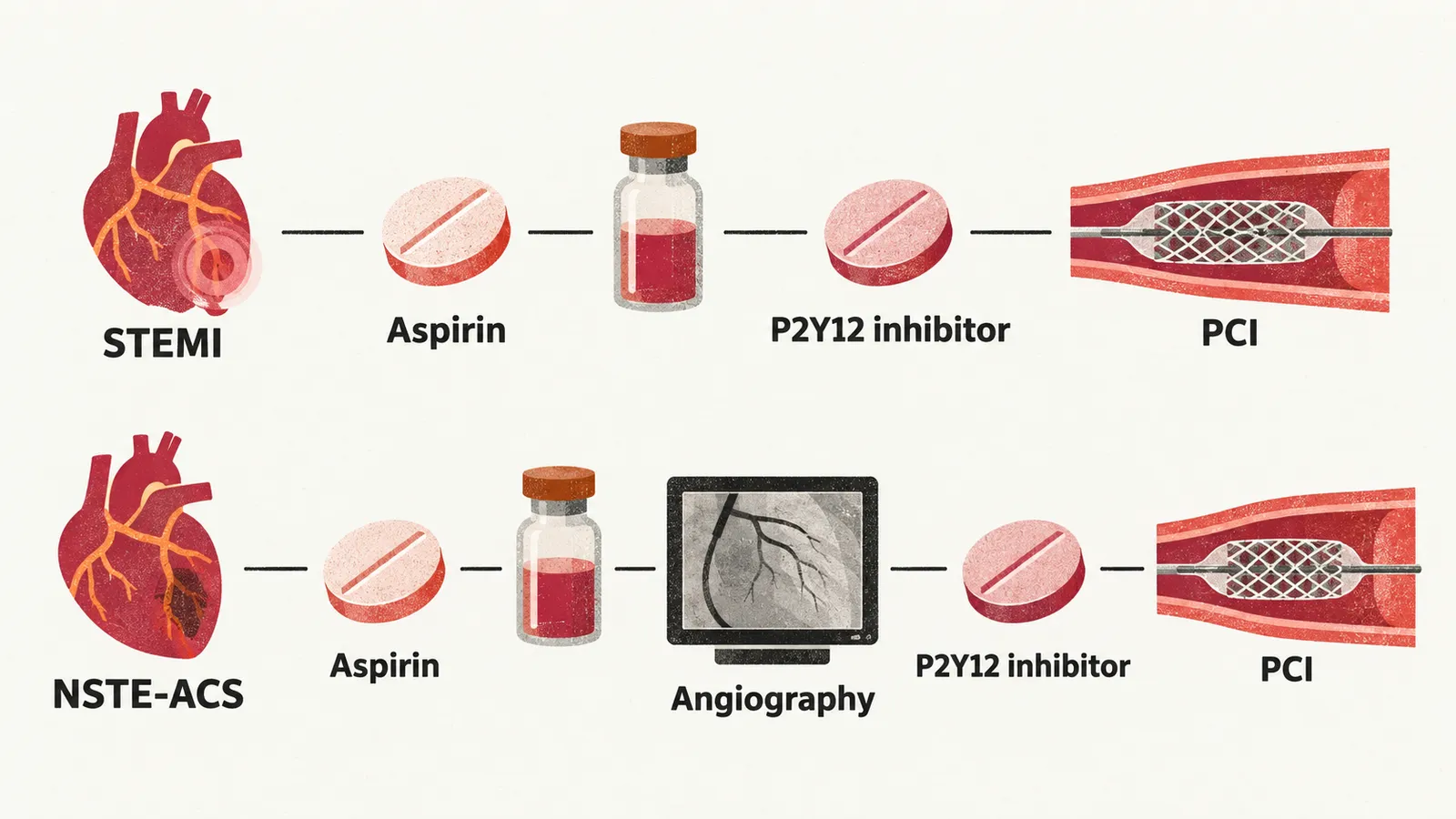
In STEMI treated with primary PCI, a P2Y12 inhibitor is given before or at the time of the procedure. Pre-treatment — giving the drug before the patient reaches the catheterisation laboratory — has only a limited recommendation in current European guidance, and prasugrel should not be used as a pre-treatment dose.
In NSTE-ACS, routine pre-treatment is actively discouraged when the coronary anatomy is unknown and an early invasive strategy is planned. The reason is anatomical: multivessel disease and left main disease are more common in this group, and a patient who needs coronary artery bypass grafting should not arrive in theatre with two antiplatelet drugs on board. The practical sequence is aspirin plus parenteral anticoagulation, angiography, and then the P2Y12 loading dose once PCI is confirmed as the plan. Exceptions exist for patients who will not undergo early angiography and are not at high bleeding risk, in whom pre-treatment may be considered.
After 12 months the P2Y12 inhibitor is usually stopped and aspirin continued indefinitely; shortening or extending that interval is discussed in Post-MI Long-Term Management.
Anticoagulation
Every ACS patient receives parenteral anticoagulation during the acute phase. Which drug depends on what happens next: a patient going straight to the catheterisation laboratory needs an anticoagulant that is short-acting and reversible, whereas a patient waiting for angiography is better served by one that causes less bleeding over the days of medical treatment.
| Setting | Preferred | Notes |
|---|---|---|
| STEMI with primary PCI | Unfractionated heparin, 70–100 U/kg intravenous bolus | Short half-life, titratable, reversible with protamine |
| STEMI with primary PCI, heparin unavailable | Enoxaparin | An accepted alternative in this setting |
| NSTE-ACS awaiting angiography | Fondaparinux subcutaneously | Add an unfractionated heparin bolus if the patient proceeds to PCI |
| Heparin-induced thrombocytopenia, or during PCI | Bivalirudin | Direct thrombin inhibitor |
Fondaparinux is a synthetic, indirect factor Xa inhibitor that acts through antithrombin and does not inhibit thrombin itself, and it has a long half-life. In NSTE-ACS it reduced bleeding compared with enoxaparin, which suits the slower, medically stabilised phase of treatment. It is unsuitable for primary PCI. There is no reversal agent, so anticoagulation cannot be dialled back quickly if a complication occurs, and it does not cover the contact-activated thrombosis generated by wires and sheaths inside the catheter; that is why a heparin bolus is added whenever PCI follows. Unfractionated heparin, which inhibits both thrombin and factor Xa and can be reversed, remains the drug for the catheterisation laboratory.
After a successful PCI there is no routine indication to continue anticoagulation. The stent is protected by DAPT. Anticoagulation is continued or restarted only for a separate indication — left ventricular thrombus, atrial fibrillation with an indication for stroke prevention, or a mechanical valve.
Glycoprotein IIb/IIIa inhibitors
Aspirin and the P2Y12 inhibitors each block one route to platelet activation. The glycoprotein IIb/IIIa inhibitors act further downstream: abciximab, eptifibatide and tirofiban block the final common pathway of platelet aggregation by preventing fibrinogen from cross-linking adjacent platelets. They are potent and intravenous, and they are no longer routine. Their place is bailout during PCI: a large visible thrombus burden that threatens distal embolisation, or no-reflow and slow-flow after stenting despite an open epicardial vessel, when blood fails to reach the muscle through an artery that is open. In an uncomplicated primary PCI they are not recommended, because the added bleeding risk is not offset by a proportional benefit.
Managing symptoms and haemodynamics
The antithrombotic drugs act on the thrombus; the remaining acute drugs act on the patient around it. They do not open the artery. They reduce pain, oxygen demand and the consequences of sympathetic activation while the antithrombotic treatment and reperfusion do the definitive work, and each has limits on when it should be used.
Oxygen depends on the saturation. Routine oxygen is not recommended for patients whose saturation is above 90%; hyperoxia can reduce myocardial oxygen delivery through coronary vasoconstriction. Supplemental oxygen is for hypoxaemia, not for the appearance of distress.
Morphine is effective for severe pain, and it lowers anxiety and sympathetic tone. Its drawback is delayed gastric emptying, which slows absorption of oral antiplatelet loading doses — a practical reason to use it for severe pain rather than by default.
Nitrates, sublingual or intravenous, relieve recurrent angina and reduce preload, the filling of the heart, and help in pulmonary congestion or uncontrolled hypertension. They treat the symptom and the haemodynamic consequence, not the thrombus.
Beta-blockers given intravenously in the acute phase lower heart rate, contractility and blood pressure, and the benefit is greatest in patients who are tachycardic or hypertensive. They must be withheld in heart failure, cardiogenic shock, symptomatic bradycardia or a low-output state, because the patient may be depending on sympathetic drive to maintain cardiac output. Inferior infarction with bradycardia is a common setting in which this matters.