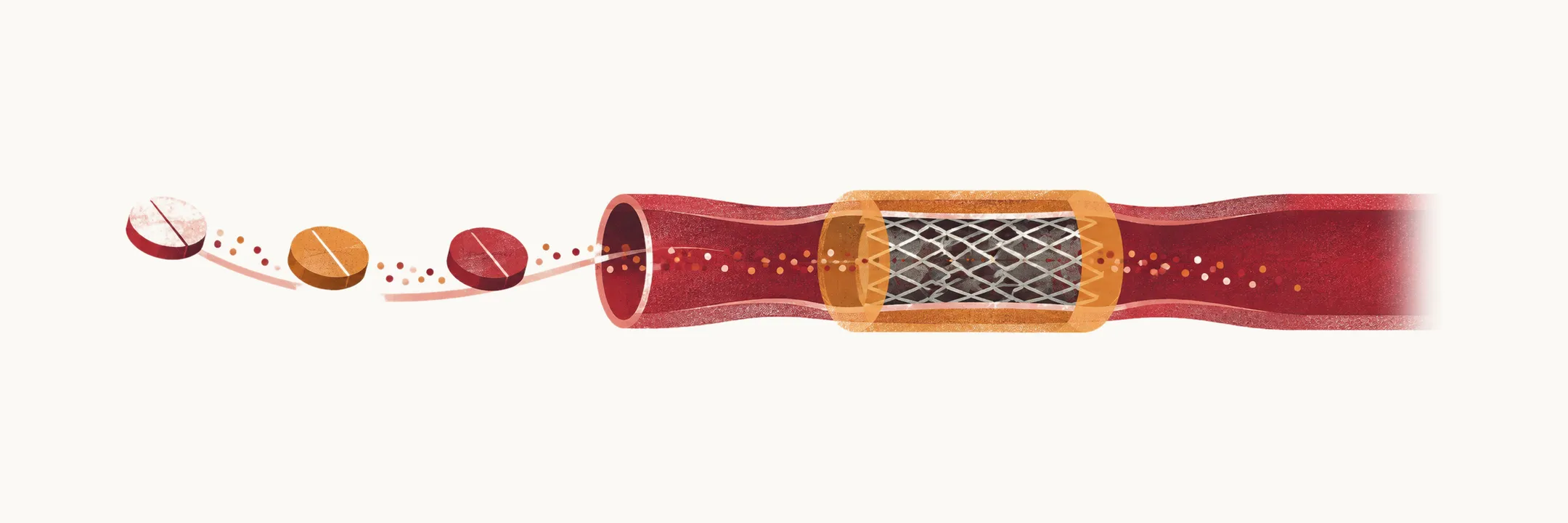
Surviving the acute event is the first part of treatment. The second part lasts years, and it addresses two substrates at once: a coronary tree that remains atherosclerotic well beyond the culprit lesion, and a ventricle that is remodelling — changing in size and shape — in response to lost muscle. Most of the drugs started before discharge work on the second substrate; the antithrombotic and lipid strategies work on the first.
Neurohormonal therapy
When stroke volume falls after an infarction, the body responds through the sympathetic nervous system and the renin–angiotensin–aldosterone system, and that response is maladaptive. Three drug classes reduce mortality after myocardial infarction, and they work through different limbs of that same response.
Beta-blockers lower heart rate, contractility and blood pressure, and suppress the ventricular arrhythmias that cause sudden death. Oral treatment is indicated in all patients with reduced left ventricular ejection fraction (the proportion of blood the ventricle ejects with each beat), and is reasonable to consider in the remainder; the dose is titrated to a resting heart rate of about 55–65 beats per minute. They are contraindicated in cardiogenic shock, severe bradycardia, high-grade atrioventricular block and severe asthma.
ACE inhibitors, or an angiotensin receptor–neprilysin inhibitor (ARNI) where an ACE inhibitor is insufficient, blunt vasoconstriction, aldosterone-driven sodium retention and the direct trophic effect of angiotensin II on the myocardium. Indications are an ejection fraction of 40% or below, an anterior infarct even with preserved function, heart failure, hypertension and diabetes; treatment starts within the first day or two unless hypotension or renal deterioration intervenes. ARNI therapy is the replacement choice in patients who remain symptomatic despite optimal ACE inhibition with an ejection fraction of 35% or below.
Mineralocorticoid receptor antagonists — spironolactone or eplerenone — reduce fibrosis, sodium retention and sympathetic activation, and are indicated with an ejection fraction of 40% or below when there is either heart failure or diabetes, on top of a beta-blocker and a renin–angiotensin system blocker. They raise potassium, so treatment is not started if potassium is already above 5.0 mmol/L or creatinine is above roughly 2.5 mg/dL in men or 2.0 mg/dL in women, and potassium and creatinine are rechecked one to two weeks after starting or up-titrating.
SGLT2 inhibitors (sodium–glucose cotransporter 2 inhibitors) are a fourth class used after infarction. They are a pillar of treatment in established heart failure with reduced ejection fraction, independent of diabetes status. Their position immediately after an acute infarction is narrower: the EMPACT-MI trial, which started empagliflozin within 14 days of admission in patients at risk of heart failure, did not reduce the composite of heart failure hospitalisation or death (8.2% versus 9.1%, hazard ratio 0.90, p=0.21), although heart failure hospitalisation alone was lower. The reasonable reading is that the traditionally proven drugs come first in the acute phase, and SGLT2 inhibitor therapy is based on the patient’s heart failure indication, diabetes or chronic kidney disease rather than on the infarction itself.
Defibrillator timing
The same recovering ventricle decides when an implantable cardioverter-defibrillator (ICD) is offered, and the ventricle needs time to recover. Contractility around the infarct zone is often stunned — temporarily depressed in muscle that is still alive — rather than lost, so ejection fraction measured in the days after the event underestimates the eventual function, and a defibrillator implanted then would treat a temporary state.
Current guidance therefore re-evaluates left ventricular function at least 40 days after infarction (and at least 90 days after revascularisation) before offering an ICD for primary prevention, that is, to prevent a first life-threatening arrhythmia. Primary prevention requires an ejection fraction that remains 35% or below with NYHA class II or III symptoms (heart failure causing slight or marked limitation of ordinary activity) on optimal medical therapy. The exception is secondary prevention, after a life-threatening arrhythmia has already occurred: sustained ventricular tachycardia or ventricular fibrillation occurring more than 48 hours after the infarction, or a cardiac arrest from a shockable rhythm, justifies a device without the waiting period.
Lipid lowering
Treatment of the atherosclerotic coronary tree starts with low-density lipoprotein (LDL) cholesterol. The LDL cholesterol target after an acute coronary syndrome (ACS) is below 1.4 mmol/L (55 mg/dL) with at least a 50% reduction from baseline, which is the very-high-risk target reaffirmed in the 2025 focused update of the European dyslipidaemia guidelines. The escalation follows the same order in everyone:
- High-intensity statin — atorvastatin 40–80 mg or rosuvastatin 20–40 mg — started during the index admission regardless of the admission LDL value.
- Ezetimibe 10 mg daily added if the target is not reached, blocking intestinal cholesterol absorption through the NPC1L1 transporter. The focused update supports starting combination therapy with a high-dose statin plus ezetimibe during the index hospitalisation rather than waiting for an outpatient review.
- A PCSK9 inhibitor — evolocumab or alirocumab by subcutaneous injection — if the target is still not met, or when statin therapy is not tolerated. Bempedoic acid is an alternative in statin intolerance.
Because the relationship between LDL cholesterol and risk is continuous, a further event despite treatment at target is a reason to intensify rather than to accept the achieved level.
Antiplatelet and anticoagulant strategy
Alongside lipid lowering, the coronary tree and any stent are protected by antiplatelet therapy. After percutaneous coronary intervention (PCI), dual antiplatelet therapy (DAPT) with aspirin plus a P2Y12 inhibitor runs for 12 months, which is the default for all ACS patients. Duration is then individualised:
- Shorter courses — 3 to 6 months of DAPT, or even 1 month in selected patients — are chosen when bleeding risk is high, followed by aspirin or a P2Y12 inhibitor alone.
- Longer courses beyond 12 months are considered when ischaemic risk is high and bleeding risk is low, sometimes with a reduced dose of the second agent.
Patients who also need oral anticoagulation (atrial fibrillation requiring stroke prevention, a mechanical valve, or left ventricular thrombus) present the hardest balance: they would otherwise take aspirin, a P2Y12 inhibitor and an oral anticoagulant together, which is triple therapy. The rules are to use clopidogrel as the P2Y12 inhibitor — prasugrel and ticagrelor increase bleeding unacceptably in this combination — to keep triple therapy as short as possible, and to drop aspirin after 1 to 4 weeks, continuing a direct oral anticoagulant plus clopidogrel. This is a change from older practice, where triple therapy often ran for months by default.
Anti-inflammatory treatment
A third approach to the coronary tree, targeting inflammation, is less settled than the first two. Colchicine may be considered after an acute coronary syndrome, particularly when other risk factors remain insufficiently controlled or events recur on optimal therapy. The 2023 European guideline grades it class IIb, level A — a considered option, not a routine one. That grading predates the largest trial in this population, which followed 7,062 patients for a median of three years and found no reduction in the composite of cardiovascular death, recurrent myocardial infarction, stroke or ischaemia-driven revascularisation. The 2025 American guideline reviews the earlier, favourable trials without having that result available. Colchicine is therefore a low-strength option whose place is unsettled, and it should not be presented as established secondary prevention.
Risk-factor targets
Drugs are only part of the long-term plan. Infarction is a point at which risk-factor management becomes concrete, and the non-pharmacological measures among the targets carry real effect sizes:
- Smoking cessation is the single most powerful intervention in a patient who smokes.
- Blood pressure: below 130/80 mmHg for patients with established cardiovascular disease.
- Physical activity: at least 150 minutes of moderate-intensity aerobic exercise per week.
- Diet: a Mediterranean pattern, high in vegetables, fruit, whole grains and unsaturated fat.
- Diabetes: individualised glycaemic targets.
- Influenza vaccination annually, because respiratory infection destabilises atherosclerotic plaques and precipitates coronary events.
Supervised exercise, education and psychosocial support are described in Cardiac Rehabilitation After Myocardial Infarction.