
Most acute coronary syndromes are caused by atherothrombotic occlusion of a coronary artery — a clot forming on a ruptured or eroded atherosclerotic plaque — and the acute pathway is built around reopening that artery. A minority are not. When angiography shows a coronary tree without an obstructive lesion, the diagnosis stops being obvious and becomes the question.
Myocardial infarction with non-obstructive coronary arteries
MINOCA is an acute coronary syndrome with a rise in troponin, the blood marker of heart-muscle injury, and coronary arteries that show no stenosis of 50% or more in any major epicardial vessel (the large arteries on the surface of the heart). Reported prevalence varies widely, from roughly 1% to 14% of patients with an acute coronary syndrome undergoing angiography; the American Heart Association statement gives around 5% to 6% of patients referred for angiography.
MINOCA is an umbrella rather than a diagnosis. The mechanisms it covers include plaque rupture or erosion that leaves no significant stenosis, coronary embolism, vasospasm, microvascular dysfunction, spontaneous coronary artery dissection and myocardial bridging, in which a segment of coronary artery runs through the heart muscle instead of over it. Myocarditis and other non-coronary conditions can produce the same picture, and are what the work-up is designed to exclude.
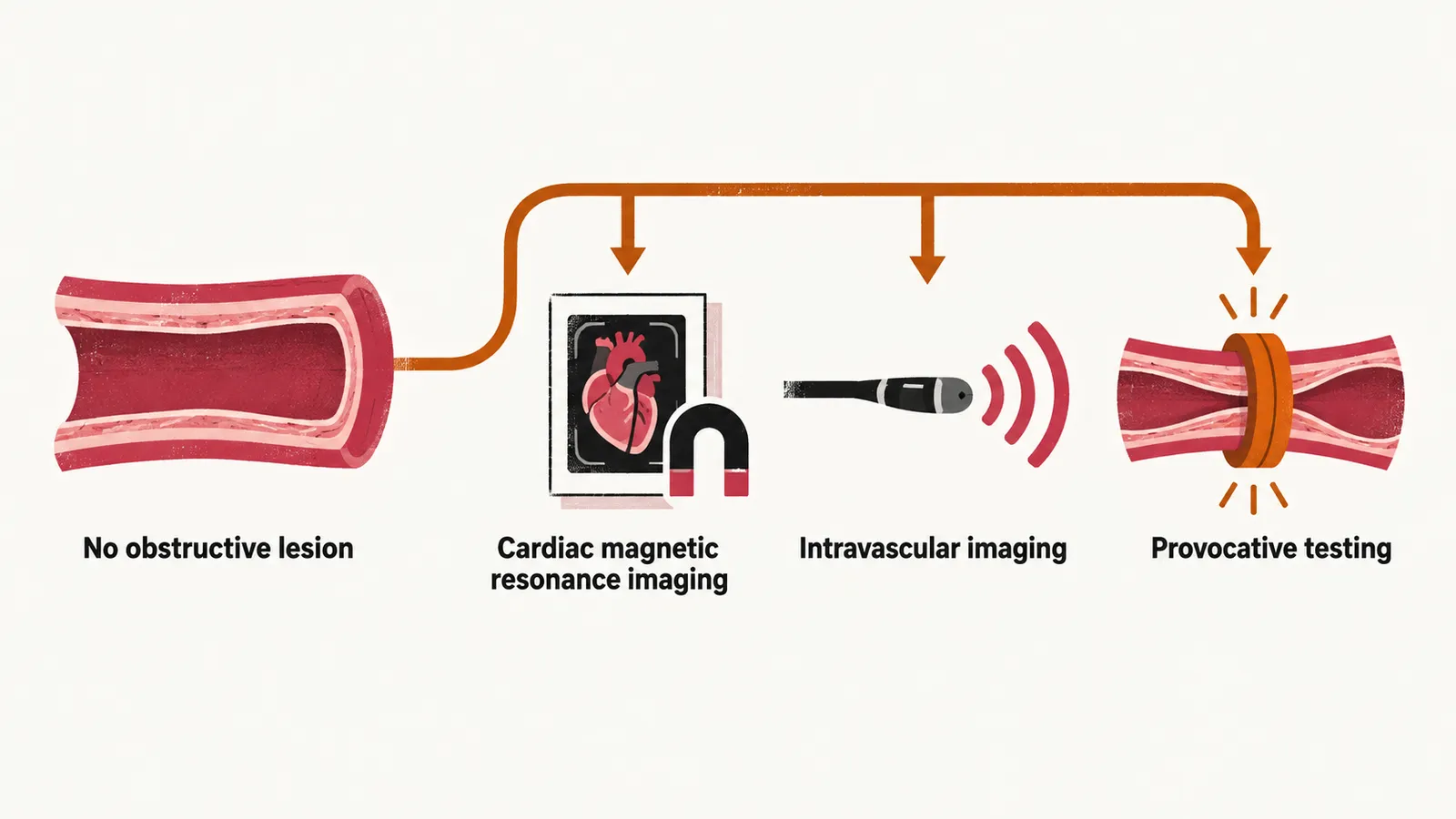
Because the mechanism decides the treatment, the work-up is purposeful rather than incidental. Cardiac magnetic resonance imaging separates true infarction from myocarditis and shows which territory is involved. Intravascular imaging — intravascular ultrasound or optical coherence tomography — examines the plaque and the vessel wall when the angiogram looks normal. Provocative testing identifies coronary spasm. The American Heart Association statement sets out a structured diagnostic pathway for this question.
Spontaneous coronary artery dissection
Spontaneous coronary artery dissection (SCAD) is a tear or an intramural haematoma — bleeding within the vessel wall — that compresses the lumen. It is the mechanism to consider particularly in women under 50 and in pregnancy or the post-partum period, and its management follows different rules from atherothrombotic occlusion.
Embolism, vasospasm and microvascular dysfunction
Three further mechanisms produce infarction without a plaque that needs opening, and they differ in where the problem lies.
Coronary embolism occludes a vessel without a plaque. The embolic material comes from a left-sided thrombus, atrial fibrillation, a vegetation, or a paradoxical route, in which a clot from the venous circulation crosses to the left side of the heart.
Vasospasm can narrow or close a normal artery and is one cause of transient ST elevation that resolves without intervention.
Microvascular dysfunction, a disorder of the small vessels rather than the epicardial arteries, produces ischaemia and troponin release with no epicardial lesion at all.
All three are situations where the standard occluded-artery reflex — reopening and stenting the artery — is the wrong response.
Where these fit in the 2026 classification
The Fifth Universal Definition of Myocardial Infarction treats plaque rupture or erosion, dissection, embolism, vasospasm, microvascular dysfunction and bridging as acute coronary pathologies, and therefore as primary myocardial infarction rather than as exceptions. Documentation now records which mechanism is responsible, so naming the cause is part of the diagnosis rather than a comment on it.
Takotsubo syndrome
Takotsubo syndrome mimics infarction without being one. It accounts for about 1% to 2% of troponin-positive acute coronary syndrome presentations, and for up to about 6% of women presenting with suspected acute coronary syndrome. Chest pain, ST changes and troponin release are present, angiography shows normal or non-obstructive coronary arteries, and the left ventricle shows a characteristic pattern of apical akinesis with basal hyperkinesis: the apex stops moving while the base contracts more vigorously than normal. A physical or emotional trigger often precedes it.
The mechanism is thought to be catecholamine-mediated myocardial stunning — temporary loss of contraction in muscle that is still alive — rather than coronary occlusion, and the wall motion abnormality usually resolves over days to weeks. The international expert consensus document defines the diagnostic criteria and clinical characteristics.
Because the presentation overlaps with ST-elevation infarction, Takotsubo syndrome is usually identified during the angiography performed for suspected occlusion. For most patients with an acute coronary syndrome, though, the cause is the atherothrombotic occlusion that the acute pathway is built to reopen.