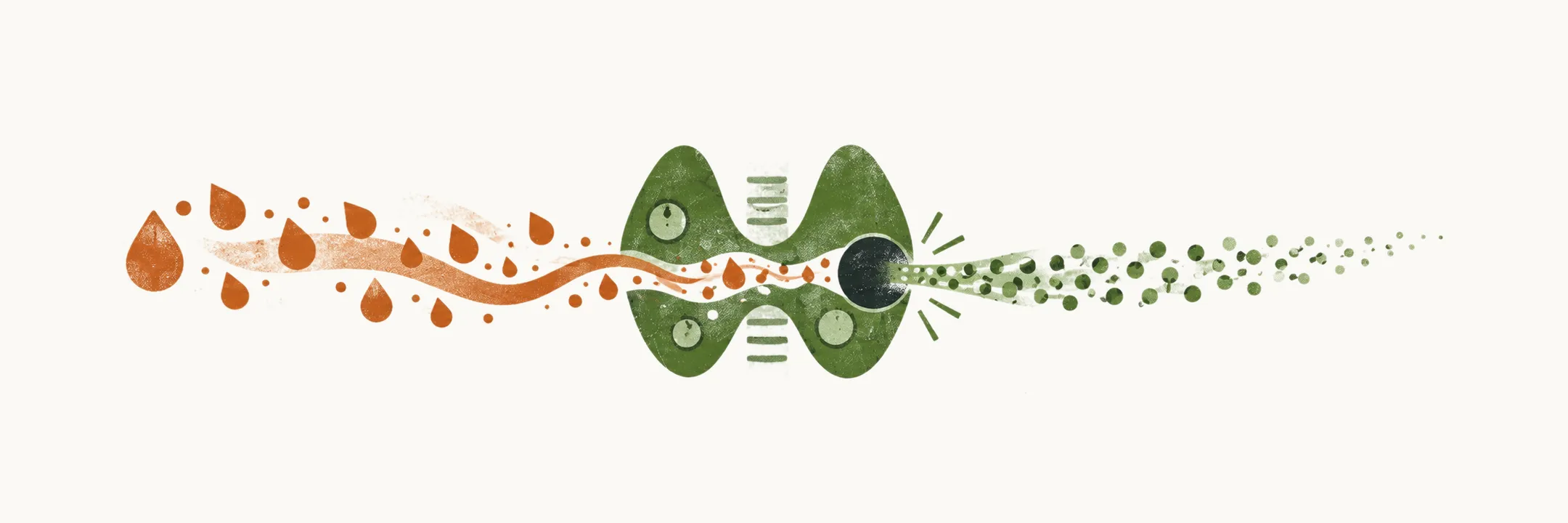
How severe thyrotoxicosis becomes is decided by more than the thyroid hormone level. The supply of iodine reaching the gland, the gland’s production capacity (which grows with its size), the level of TRAb — the antibodies against the receptor for TSH (thyroid-stimulating hormone), which drive Graves disease — and the sensitivity of the peripheral tissues all shift the picture. The tissues also adapt: in hyperthyroidism the enzyme DIO2, which converts thyroxine (T4) into the more active triiodothyronine (T3) inside cells, falls, while DIO3, which inactivates thyroid hormone, rises. The cell therefore activates less hormone and breaks it down faster, so a high circulating level produces a smaller effect at the cellular level than it otherwise would.
Iodine supply is not only a determinant of severity; in one setting it is the cause. Where dietary iodine is insufficient, the gland enlarges to compensate: TSH drives the proliferation of thyroid tissue, producing a simple goiter. Over time part of that tissue becomes nodular, giving multinodular goiter (MNG). Some of these nodules carry an activating mutation in the TSH receptor itself, or in Gsα, the G protein through which the receptor signals, so they take up iodine and produce hormone without waiting for TSH: they are autonomous. When enough autonomous tissue accumulates, the gland turns toxic, and toxic multinodular goiter is the second most common cause of hyperthyroidism after Graves disease.
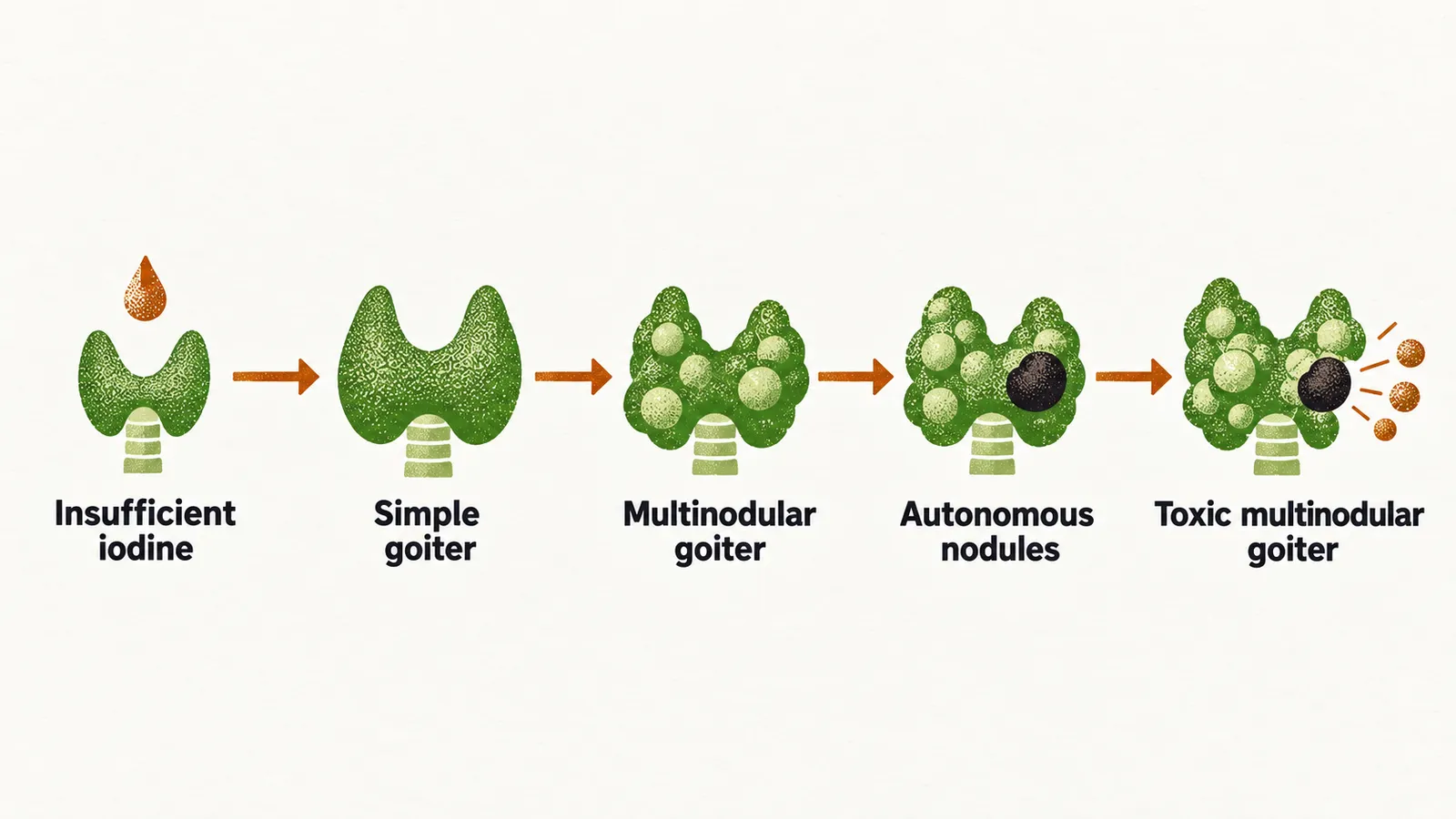
Because autonomous tissue ignores the usual feedback, a sudden increase in iodine supply lets it overproduce hormone. This is iodine-induced hyperthyroidism, the Jod-Basedow phenomenon. The extra iodine can come from drugs — amiodarone, which supplies 30-100 times the normal daily physiological need for iodine, and iodine-containing contrast agents — from iodine-rich foods such as sushi and algae, or from disinfectants. Autonomous nodules are one route to a gland that makes hormone without feedback; the other, and the most common, is an autoimmune one, in which antibodies stimulate the TSH receptor.