Type 2 diabetes mellitus, or T2DM, is polygenic, with many common variants of small effect. It is made by both genetic and environmental factors, and its genetic architecture differs from that of type 1 diabetes, or T1DM.
The difference lies in the size of each variant’s effect, measured as an odds ratio, the factor by which a variant multiplies the odds of disease (1 means no effect). In T1DM, some genes and their polymorphisms are quite common and carry an odds ratio above 2; the strongest of them belong to the HLA class II genes that shape immune self-tolerance. In T2DM, more than 50 genes are known, but their odds ratios are mostly close to 1, up to about 1.4. Because the effect of any one variant is so small, having T2DM on genetic grounds alone requires several polymorphisms at once — sometimes as many as 10 susceptibility genes.
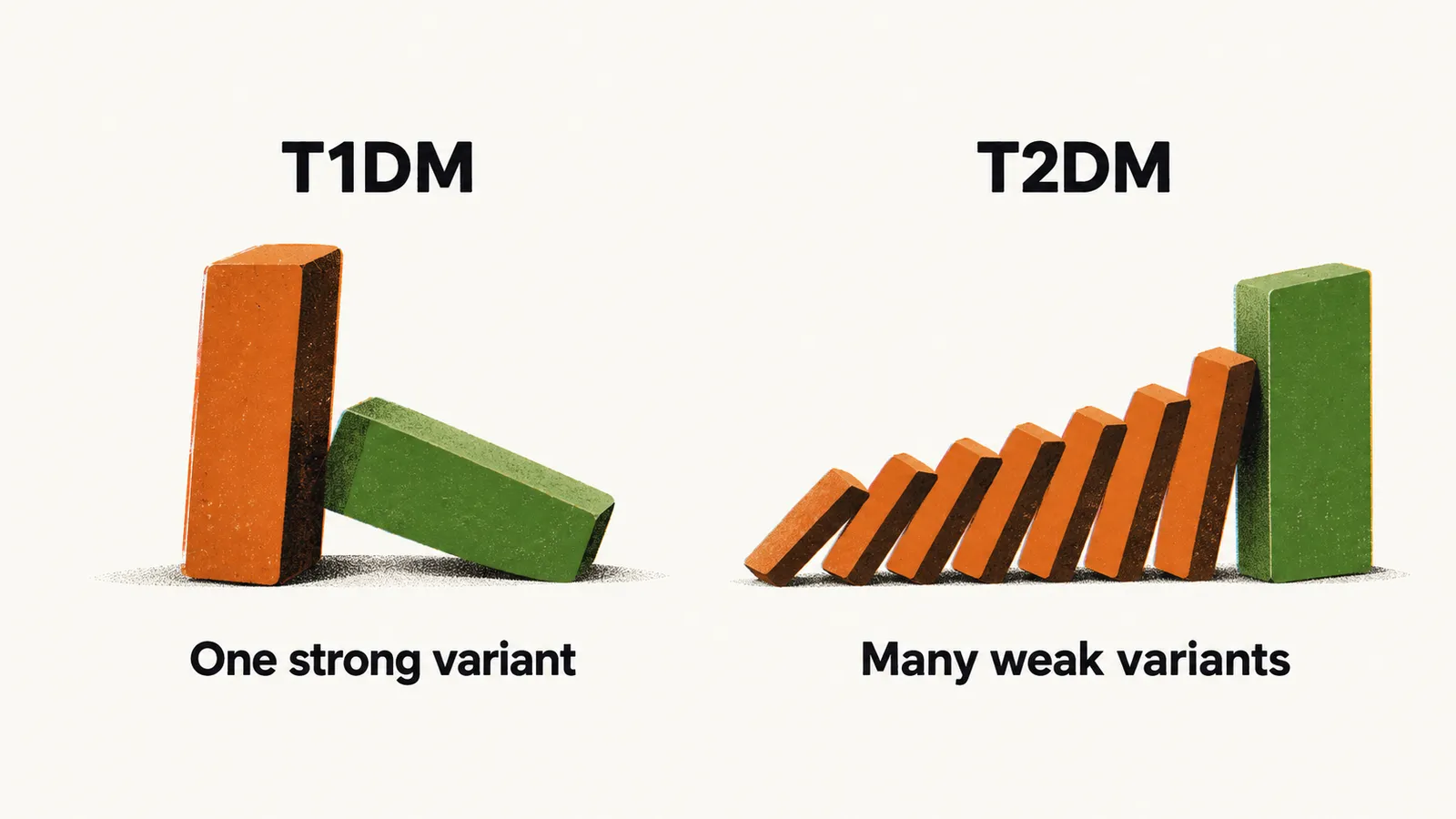
The small effect of each variant must not be read as small overall genetic influence. Twin studies give heritability estimates that range widely by population, from roughly 50% to about 72% of the variation in liability, so the genetic contribution as a whole is substantial even though it is spread across many weak variants. This is exactly why the disease runs in families yet cannot be predicted from a single genotype: even where the variants are common, they are not sufficient to cause the disease by themselves, because of their low effect size.