
Acute lymphoblastic leukemia (ALL) is subclassified in two ways: by the appearance of the blast cells under the microscope, and by the cell markers they carry.
Morphological subtypes of ALL
The French-American-British (FAB) classification divides ALL into three morphological groups by the appearance of the blasts:
| Group | Blast appearance | Typical patient |
|---|---|---|
| L1 | small, uniform blasts | pediatric ALL |
| L2 | large and variable blasts | adult ALL |
| L3 | uniform cells with basophilic or sometimes vacuolated cytoplasm |
Immunologic subtypes of ALL
Appearance alone does not show which lineage a blast belongs to, so monoclonal antibodies against cell-surface and cytoplasmic markers (the CD numbers, named for their cluster of differentiation) are used to distinguish B-ALL from T-ALL and to separate the subtypes within each. A marker is considered positive when at least 20% of the cells are stained with the antibody for that marker.
B-cell subtypes
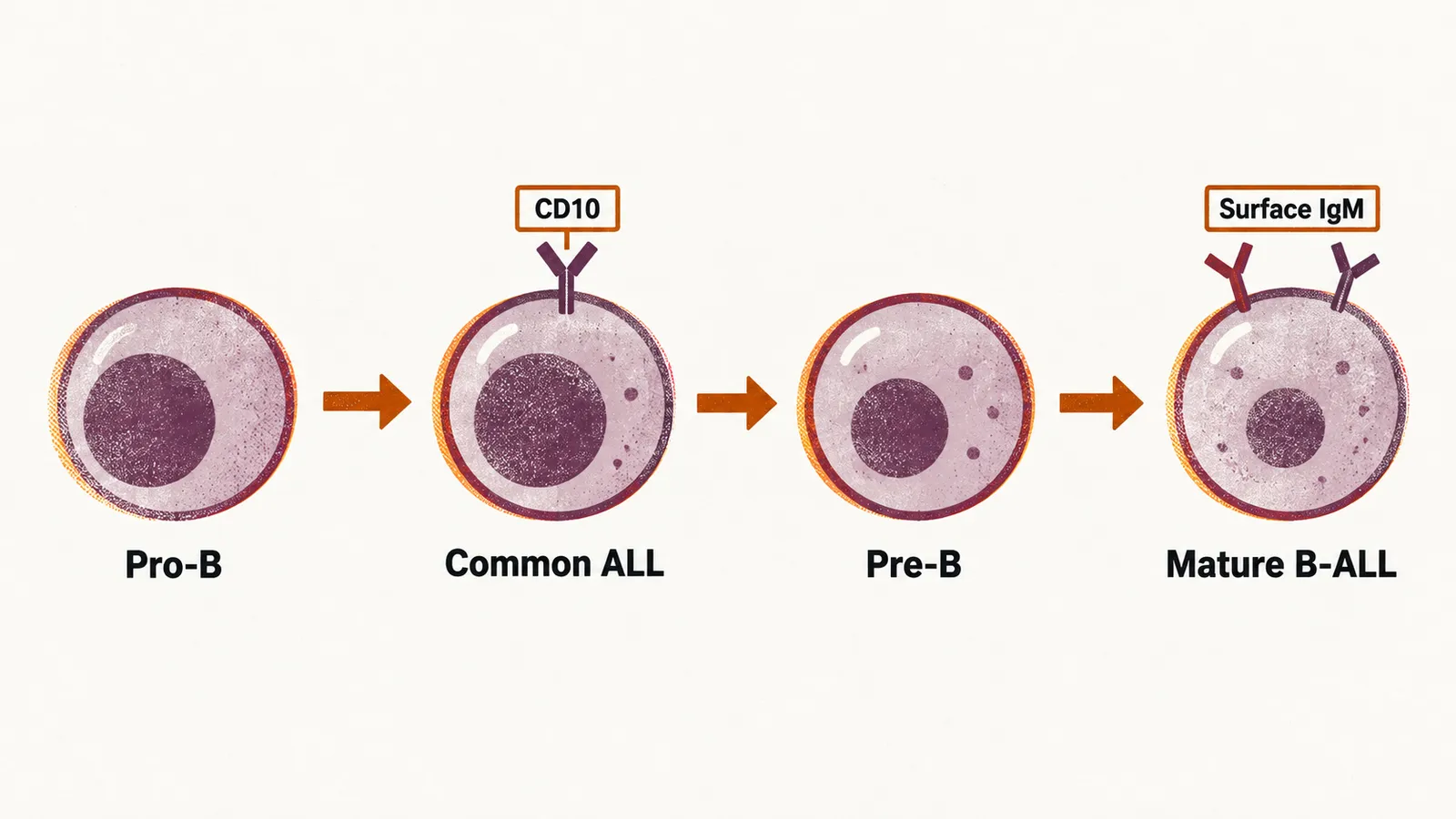
The B-cell subtypes follow the stages of B-cell maturation, from early to mature:
- Pro-B ALL corresponds to early B-cell differentiation. It is positive for HLA-DR, CD19 and terminal deoxynucleotidyl transferase (TdT).
- Common ALL is the most frequent form: more than 70% of adult ALL is of B-cell origin and belongs to this subtype. It carries CD10 and lacks the markers of slightly more mature B cells, such as cytoplasmic or surface immunoglobulin (Ig).
- Pre-B ALL is characterised by the presence of cytoplasmic immunoglobulin, which is not present in common ALL.
- Mature B-ALL is known as Burkitt’s lymphoma, in which the blast cells express biomarkers of mature B cells, that is surface IgM.
T-cell subtype
Approximately 25% of adult ALL is composed of T-ALL; in all the forms of T-ALL there is CD7 and cytoplasmic or surface CD3.
Leukemia with more than one lineage
Biphenotypic, or mixed, leukemia is a single population of blasts that carries the markers of both the myeloid and the lymphoid lineage. It differs from bilineage leukemia, in which two separate populations of blasts are present, each belonging to a different lineage.