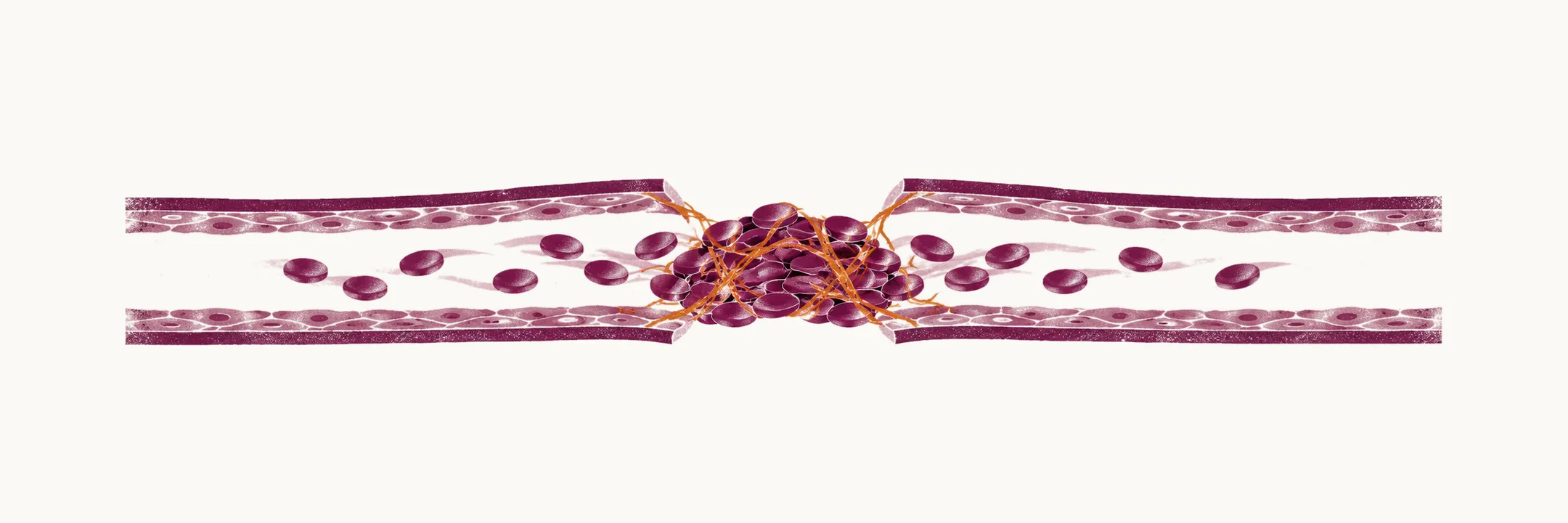
Haemostasis is the dynamic process that keeps blood fluid inside intact vessels and seals a breach when one opens. It is determined by four things: the platelets, the blood vessel wall, the coagulation pathway (the sequence of clotting factors that forms a clot) and the fibrinolytic pathway (which dissolves clots). A bleeding disorder arises when one of these fails, and the failure may be inherited or acquired.
The topic is easiest to organise by where the failure lies. Platelets can be too few, too many, or unable to work properly. Von Willebrand factor (VWF), the protein that tethers platelets to the injured vessel wall, can be deficient or defective. The coagulation factors can be missing or inhibited.
Choose a route through the topic
Read the platelet physiology note first: it sets up the platelet adhesion, aggregation and consumption that the later notes build on. From there the notes move through the platelet count and the platelet-consuming microangiopathies, then von Willebrand factor, the coagulation factors and haemophilia.
Platelet disorders
- Platelet Physiology and the Main Platelet Disorders explains the normal platelet count, life span and activation, and names the four main groups of platelet disorder.
- Platelet Count Disorders: Thrombocytopenia and Thrombocytosis covers how a low platelet count is defined, evaluated and caused — from drugs and infection to the inherited forms — and what a very high count means.
- Heparin-Induced Thrombocytopenia follows the antibody that forms against platelet factor 4 and heparin, and explains the 4T score and the treatment.
- Immune Thrombocytopenic Purpura (ITP) covers antibody-mediated platelet destruction, its course in children and adults, and how it is treated.
- Thrombotic Thrombocytopenic Microangiopathies: TTP and HUS covers the group of disorders defined by microangiopathic haemolytic anaemia with microvascular thrombosis, and its two main members.
Von Willebrand factor
- Von Willebrand Disease and von Willebrand Syndrome follows the protein that tethers platelets to the injured wall — how it is made, multimerised and cleaved, the three inherited types, and the acquired forms.
Coagulation factors
- Coagulation Factor Deficiencies: Patterns, Testing and Acquired Causes covers the bleeding pattern of factor deficiency, the PT, aPTT and mixing tests, and the acquired causes.
- Haemophilia A and B covers the genetics, bleeding phenotypes and treatment of factor VIII and factor IX deficiency.