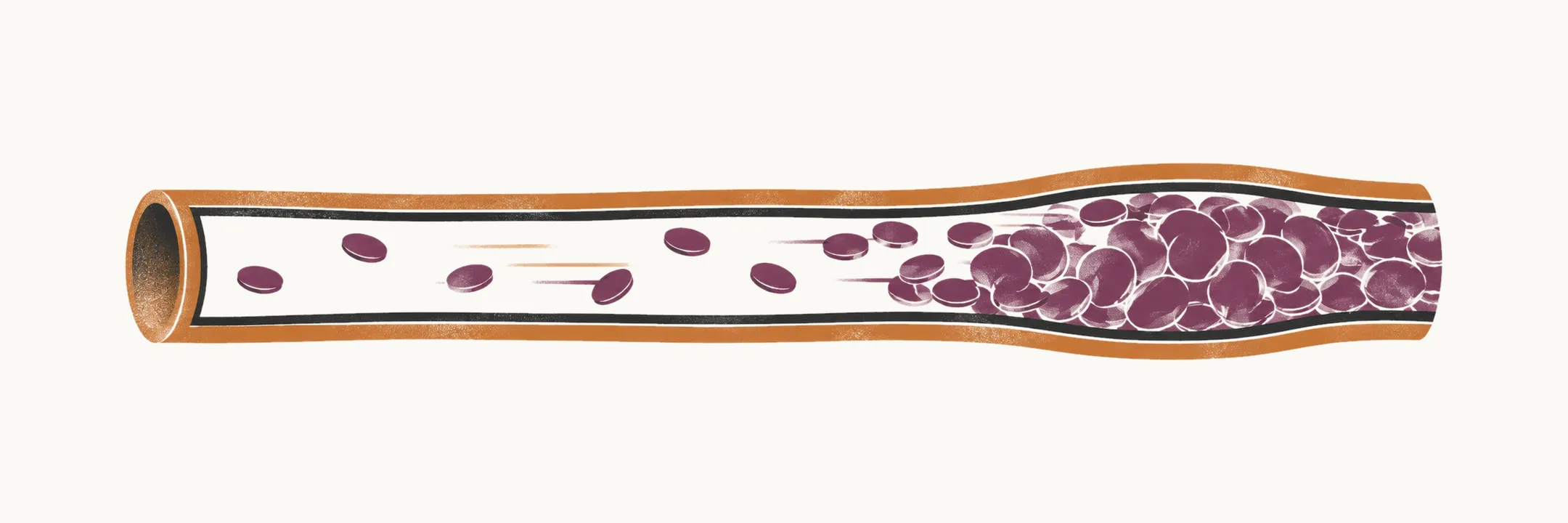
Thrombocytopenia means too few platelets and thrombocytosis means too many. A low platelet count causes bleeding, and a count that is very high can cause bleeding too. The two problems sit at opposite ends of the same cell line, and each has its own causes and its own approach.
Thrombocytopenia
Thrombocytopenia is defined as a platelet count in the peripheral blood lower than 150,000 per microL, confirmed during 2 or 3 different laboratory measurements.
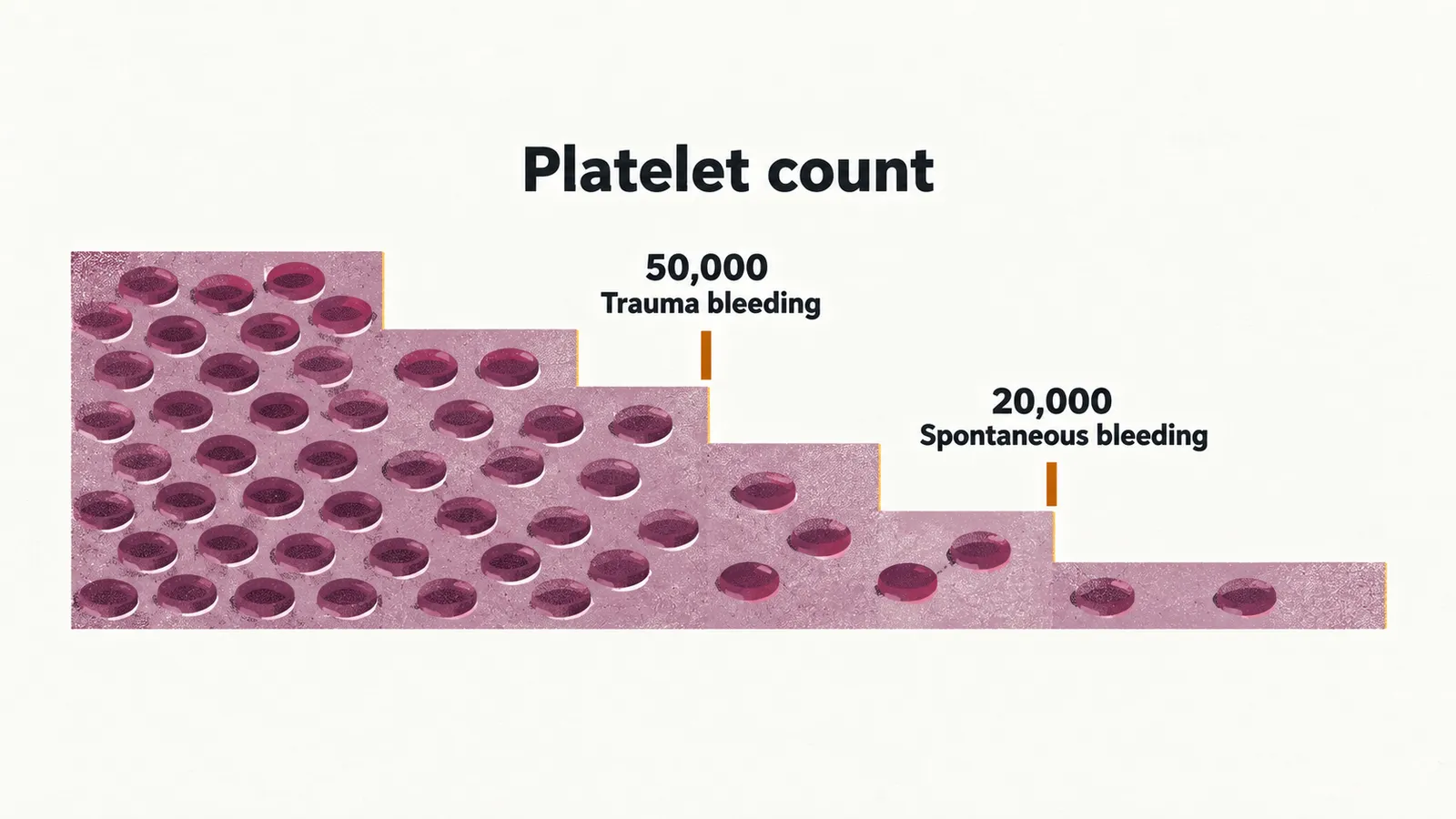
Bleeding depends on how far the count falls. The clinical signs do not appear until the count falls under 50,000, when bleeding after major trauma is seen, and under 20,000, when spontaneous bleeding occurs.
A low count arises in one of three ways:
- decreased bone marrow production — most of the time this is not isolated thrombocytopenia, and it usually runs parallel with a decreased number of red cells and/or white cells, because the whole marrow is affected rather than the platelets alone
- increased sequestration in the spleen — the platelets are produced but held in an enlarged spleen, as in hypersplenism
- increased destruction — platelets are removed from the circulation faster than the marrow replaces them
Evaluating a low platelet count
The very first key step is to rule out pseudothrombocytopenia, an in vitro artefact that lowers the measured platelet count through antibody activity during the clearance of calcium in the sample tube by EDTA, the anticoagulant added to the tube.
The critical components of the evaluation are then the history, the examination and the blood tests.
The history matters most for pharmacotherapy, past or present, including over-the-counter drugs and herbal compounds. A healthy young individual with thrombocytopenia has a small differential diagnosis compared with an old, critically ill patient in the intensive care unit who is using a lot of drugs.
On examination, when the platelet count is decreased significantly, petechiae (small pinpoint haemorrhages in the skin) first appear in regions with high venous pressure, such as the thigh, the ankle and even the feet in ambulatory patients; liver disease or an enlarged spleen should also be considered.
The laboratory work is a complete blood count (CBC) and a peripheral blood smear.
Causes of thrombocytopenia
The most common cause of thrombocytopenia is drugs.
Drug-induced thrombocytopenia
Drugs which are able to cause thrombocytopenia are:
- the vast majority of the chemotherapeutic agents, and radiotherapy directed at bone and at bone marrow with erythropoiesis
- antibiotics, especially beta-lactams such as cephalosporins
- herbal and over-the-counter drugs
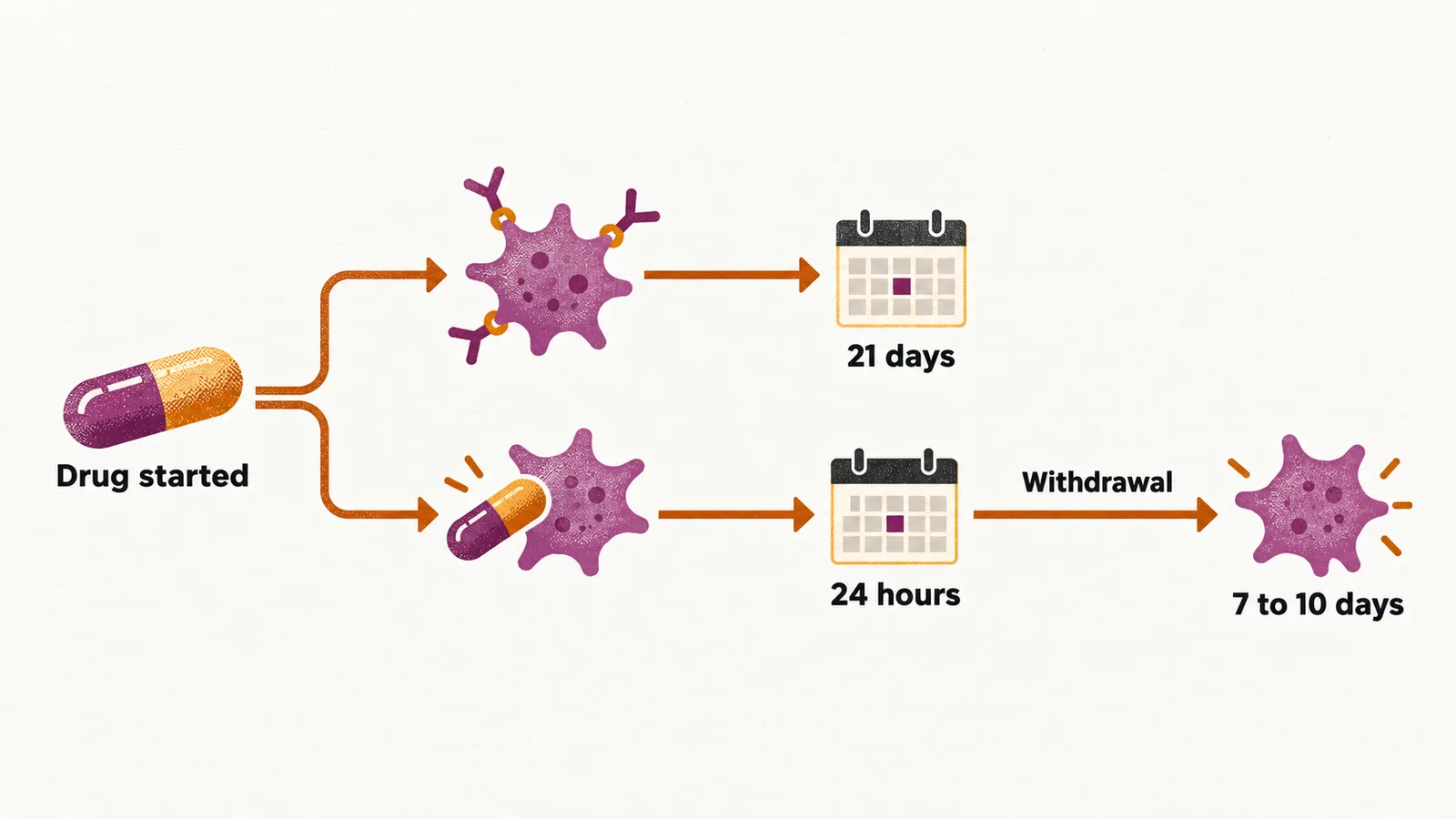
Two mechanisms are worth separating. Classic drug-dependent antibodies are antibodies that are made in the presence of the drug and react with the surface antigens of the platelets; this occurs only in the presence of the drug, and it is mostly caused by sulfonamides and quinine. With these antibodies the thrombocytopenia occurs after an initial duration of exposure to the drug, and the median time is mostly about 21 days. Some drugs instead affect the platelet directly, such as the Gp IIb/IIIa inhibitory drugs, and their thrombocytopenia is manifested within 24 hours after starting the drug. Most of the time, drug-induced thrombocytopenia resolves after 7 to 10 days of withdrawal of the drug.
Heparin-induced thrombocytopenia is a drug-induced form with a different behaviour and its own note: Heparin-Induced Thrombocytopenia. Immune thrombocytopenic purpura, an acquired antibody-mediated form, likewise has its own note: Immune Thrombocytopenic Purpura (ITP).
Infection-induced thrombocytopenia
Both viral and bacterial infections can cause infection-induced thrombocytopenia, mostly in patients with a systemic infection with gram-negative bacteria, and in COVID-19. Infection can affect both platelet production and platelet survival, and it may or may not be associated with disseminated intravascular coagulation, or DIC, in which clotting is activated throughout the circulation.
The thrombocytopenia of infection can be caused by the infectious organism itself and by immune-mediated mechanisms, as in early HIV and infectious mononucleosis. In children, immune-mediated thrombocytopenia usually follows a viral infection and almost always resolves spontaneously.
Inherited thrombocytopenia
The inherited form of thrombocytopenia is very rare. It can be an isolated thrombocytopenia or part of a whole syndrome, and different genetic patterns are seen: autosomal dominant disease is mostly manifested as macrothrombocytopenia (a low count with large platelets), and autosomal recessive disease as congenital amegakaryocytic thrombocytopenia.
The recessive group includes the two classic platelet receptor defects. In Glanzmann thrombasthenia the fibrinogen receptor GpIIb/IIIa is defective, so the platelet number and size are normal but aggregation fails; in Bernard-Soulier syndrome the receptor GpIb/IX for von Willebrand factor (VWF) is defective, so the platelet number is reduced and the platelet size is large. The X-linked form is Wiskott-Aldrich syndrome, a cytoskeleton defect with a small number of platelets of reduced size.
Thrombocytosis
Thrombocytosis is an increased platelet count, and it is almost always due to a cause outside the platelet line itself:
- iron deficiency — a compensation in which the body makes more blood cells in a condition where it cannot make a proper amount of red cells
- inflammation
- cancer
- infection
- myeloproliferative processes such as essential thrombocythaemia and polycythaemia vera
- 5q- myelodysplastic processes
A very high count can itself cause bleeding. In patients with myeloproliferative disorders, a very high number of platelets, something like more than 1.5 million per milliL, leads to bleeding, because the excess platelets clear von Willebrand factor from the plasma.