
Immune thrombocytopenic purpura, or ITP, is an acquired disorder of platelets: thrombocytopenia (a low platelet count) with purpura, the bleeding into the skin that a low count produces. Antibodies against platelet surface antigens cause the platelets to be destroyed, chiefly by macrophages in the spleen, and they possibly also inhibit the release of platelets from the megakaryocytes, the bone marrow cells that make them. The count therefore falls from both the loss of platelets and the failure to replace them.
Course and presentation
The main characterisations of ITP are:
- mostly isolated thrombocytopenia
- a very low platelet count
- mucocutaneous bleeding
The course of the disease differs with age. In children it is acute, self-limited, and mostly occurs after an infection. In adults it is more chronic.
When ITP is caused by the presence of another disease in the patient it is called secondary ITP, which can occur with autoimmune diseases such as systemic lupus erythematosus (SLE), and with infections such as HIV, hepatitis C virus (HCV) and Helicobacter pylori.
Diagnosis
Laboratory tests do not have enough sensitivity and specificity for ITP, so the diagnosis is mainly clinical. Because of this, the peripheral blood smear and bone marrow biopsy are relied upon, and they show:
- large platelets — young, immature platelets that have just budded from the bone marrow
- increased bone marrow megakaryocytes — the feedback mechanism of platelet destruction
The laboratory testing should be based on finding a secondary disorder such as HIV, HCV, a serological test for SLE, and H. pylori. If anaemia is found, the Coombs test (which detects antibodies on red cells) should be performed to rule out Evans syndrome, a combined autoimmune haemolytic anaemia with ITP.
Treatment
Treatment can be complicated, because the patient is managed according to the significance of bleeding rather than the count alone.
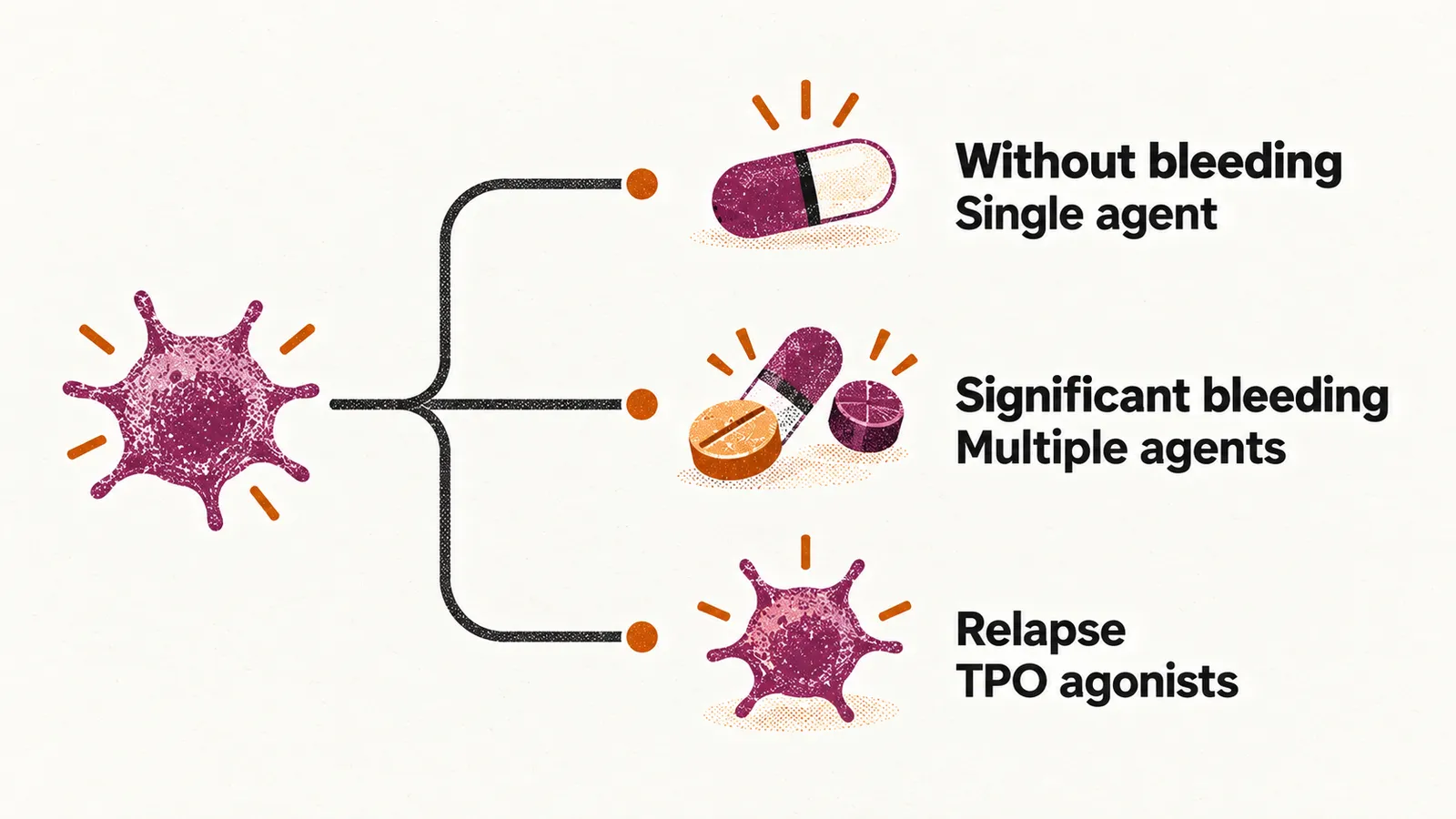
Without bleeding symptoms
A patient without bleeding symptoms is generally managed as an outpatient with a single therapy agent. Traditionally this is prednisone at 1 mg/kg, or a 4-day course of dexamethasone at 40 mg/day. Immune globulins can also be used; they saturate the Fc receptor of immune cells and so prevent those cells from destroying antibody-coated platelets:
- Rh immune globulin — it must be used only in Rh-positive patients; monitoring the patient for 8 hours after its use is advised because of the rare complication of massive haemolysis
- IVIgG (intravenous immunoglobulin G) — it is more effective in patients who are postsplenectomised
With significant bleeding symptoms
A patient with significant bleeding symptoms is generally managed as an inpatient with multiple therapy agents: a combination of high-dose glucocorticoid and IVIgG or Rh immune globulin, plus immunosuppressive agents such as rituximab.
Relapse or unresponsive disease
In patients with relapse of ITP, or who are unresponsive to at least one other therapy, thrombopoietin (TPO) receptor agonists can be used, such as romiplostim, given subcutaneously, and eltrombopag, given orally. Splenectomy could be an option for ITP patients with relapse, but it has a lot of considerations; removing the spleen removes the main site at which antibody-coated platelets are cleared, but it does not treat an autoimmune process that also acts elsewhere.
In ITP the thrombocytopenia is mostly isolated; Evans syndrome is the recognised combination with autoimmune haemolytic anaemia. Thrombocytopenia can also arise together with haemolytic anaemia by a different route, in which platelet-rich thrombi form in small vessels and shear the red cells passing through them: the thrombotic thrombocytopenic microangiopathies.