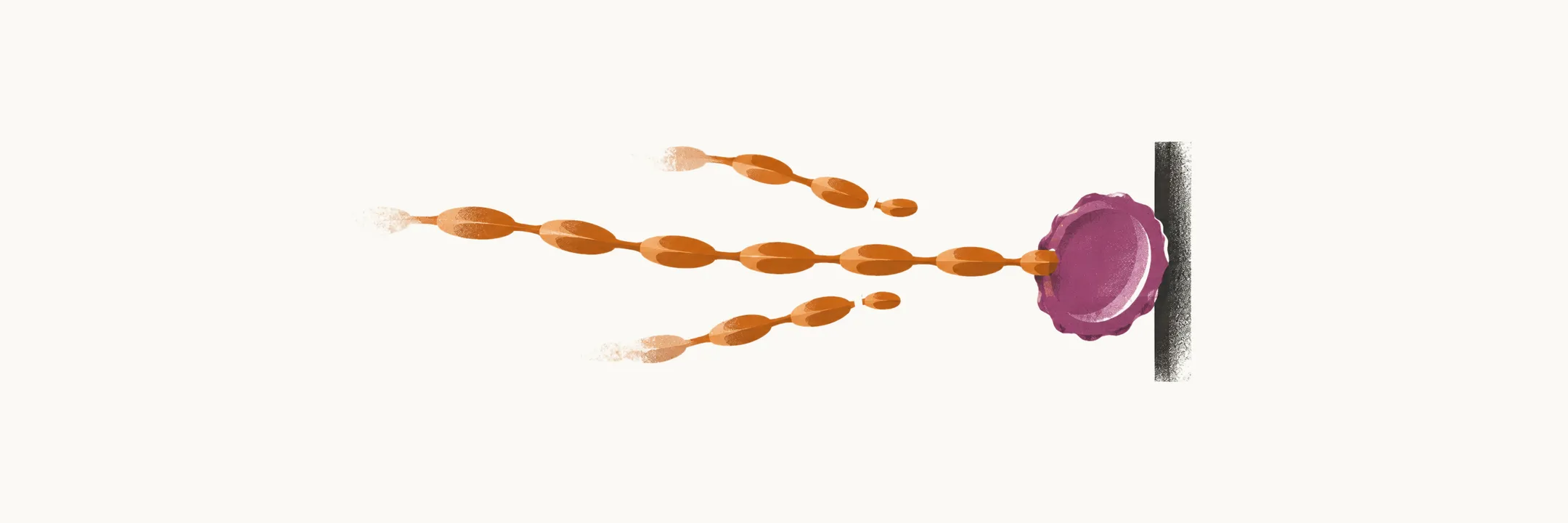
Von Willebrand disease (VWD) is the most common inherited bleeding disorder, and it is caused by defects in the protein that tethers platelets to the exposed vessel wall, von Willebrand factor (VWF). Its prevalence of symptomatic disease is about 1 in 1000 to 1 in 10,000.
What von Willebrand factor does
VWF serves two main functions. It is the major adhesion molecule that tethers the platelet to the exposed sub-endothelium, and this adhesin function is critically dependent on the presence of large VWF multimers. It is also the binding protein for coagulation factor VIII (FVIII); unlike the adhesin function, this one is not dependent on the large VWF molecules.
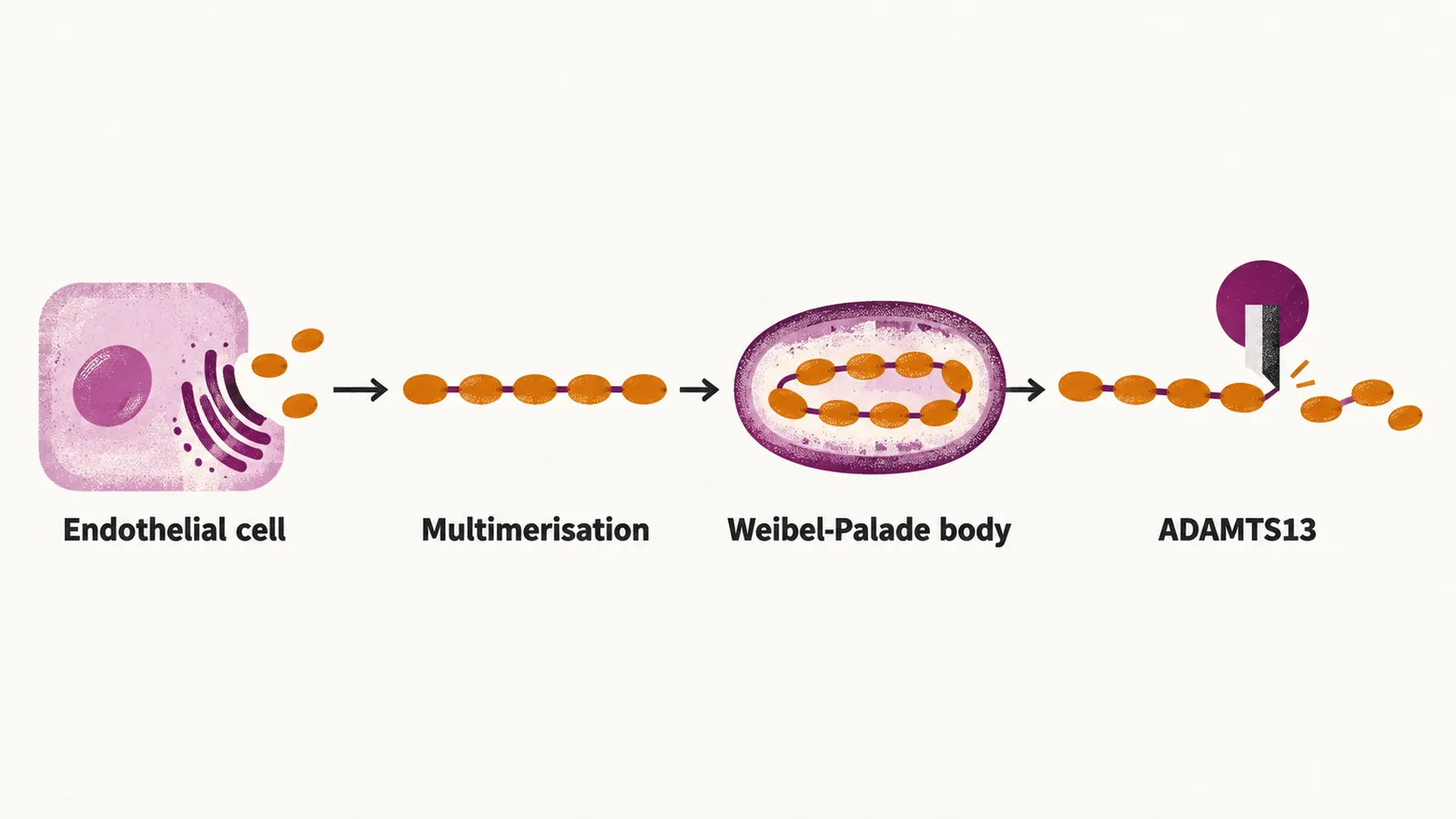
VWF is made by the endothelial cells, and it can also be found in platelets.
In the plasma and in the sub-endothelium, VWF is mostly present in its multimeric form, a chain of repeated VWF units. The process of multimerisation is due to the presence of two sites of disulphide bonds that are attached to one another in the endoplasmic reticulum (ER) and the Golgi apparatus of the cells, and the multimers are finally stored in the cells in multimeric form before release, inside the storage organelles called Weibel-Palade bodies.
The VWF multimers are cleaved into smaller molecules by the ADAMTS13 enzyme, which acts on the newly secreted multimers at the endothelial surface.
The difference between small and large multimers matters. The small multimers do not activate platelets, and the large ones do. The reason is that, if the small ones were able to activate platelets, platelet activation would always occur even when it is not needed, whereas activation by the large multimers happens only when the endothelial cells are damaged and release their large multimers into the plasma.
The inherited disease
VWD is mostly inherited, with mutations in its gene, which is located on chromosome 12; most cases of VWD are autosomal dominant. Most of the symptoms related to VWD are platelet-like, except in the very severe form of VWD, where the reservoir of FVIII diminishes so much that the bleeding symptoms are like haemophilia A.
There are 3 types of VWD, with 4 subtypes of type 2. Not all patients with VWD have bleeding; the bleeding in VWD is highly dependent on the overall balance of haemostasis.
The types of inherited von Willebrand disease
| Type | Defect | Features |
|---|---|---|
| type 1 VWD | a parallel decrease in VWF level, its function, and FVIII level | the most common form, about 70 to 80% of cases; the most common sign is mucosal bleeding; it is mostly not symptomatic in infancy, and in late childhood the first signs are mostly excessive bruising and epistaxis; it may first manifest after dental extraction, especially of the wisdom tooth, and after tonsillectomy |
| type 2 VWD | functional (qualitative) defects, so the level of VWF is high, but the VWF is functionally not efficient | divided into four subtypes by the specific functional defect |
| type 3 VWD | no VWF production and FVIII <10% of normal level | also called severe VWD; the main signs are mucosal and joint bleeding |
The four subtypes of type 2 VWD separate by which function is lost:
| Subtype | Functional defect |
|---|---|
| 2A VWD | platelet binding and/or collagen binding activity of VWF is decreased, due to either increased susceptibility to ADAMTS13 cleavage, which leads to loss of the intermediate and large multimers of VWF, or decreased production of intermediate and large multimers of VWF by the cells |
| 2B VWD | a gain-of-function mutation in the VWF A1 domain raises its affinity for platelet glycoprotein Ibα (GpIbα), so platelets bind VWF spontaneously and large VWF–platelet complexes form; these are cleared from the circulation, which consumes the large multimers and produces thrombocytopenia |
| 2M VWD | platelet binding and/or collagen binding activity of VWF is decreased |
| 2N VWD | variants of VWF that have less capability to attach to FVIII, which leads to a very short half-life of FVIII; it is also called autosomal haemophilia |
Acquired von Willebrand syndrome
Beside the inherited form of VWD, there are some acquired forms, called von Willebrand syndrome, which are due to:
- underlying lymphoproliferative disorders, most commonly monoclonal gammopathy of undetermined significance (MGUS), multiple myeloma, and Waldenström’s macroglobulinaemia
- Heyde’s syndrome, characterised by aortic stenosis with gastrointestinal (GIT) bleeding, in which shear stress at the level of the stenotic valve makes the VWF prone to proteolysis
In the lymphoproliferative forms the abnormal immunoglobulin binds VWF and accelerates its clearance from the plasma, so the factor is removed faster than it is replaced.
Laboratory testing and treatment
VWD is either quantitative (too little VWF, as in type 1) or qualitative (VWF that does not work, as in type 2). For the quantitative forms of VWD, that is type 1, there are antigenic tests; for qualitative VWD, such as type 2, there are tests that measure the function of VWF. Therefore, different tests have to be used for the different forms of VWD, based on whether the defect is quantitative or qualitative.
The main treatment for VWD is the use of DDAVP, or desmopressin, which results in increased release of VWF and FVIII from the endothelial cells.
Because VWF carries FVIII, the most severe forms of VWD can resemble haemophilia A, the deficiency of FVIII itself, which belongs to the wider group of coagulation factor deficiencies.