Differentiation is the process by which a hematopoietic stem cell (HSC), the blood-forming stem cell of the bone marrow, becomes a functional mature blood cell. Along the way the cell gives up options and, usually, its ability to divide.
What drives differentiation
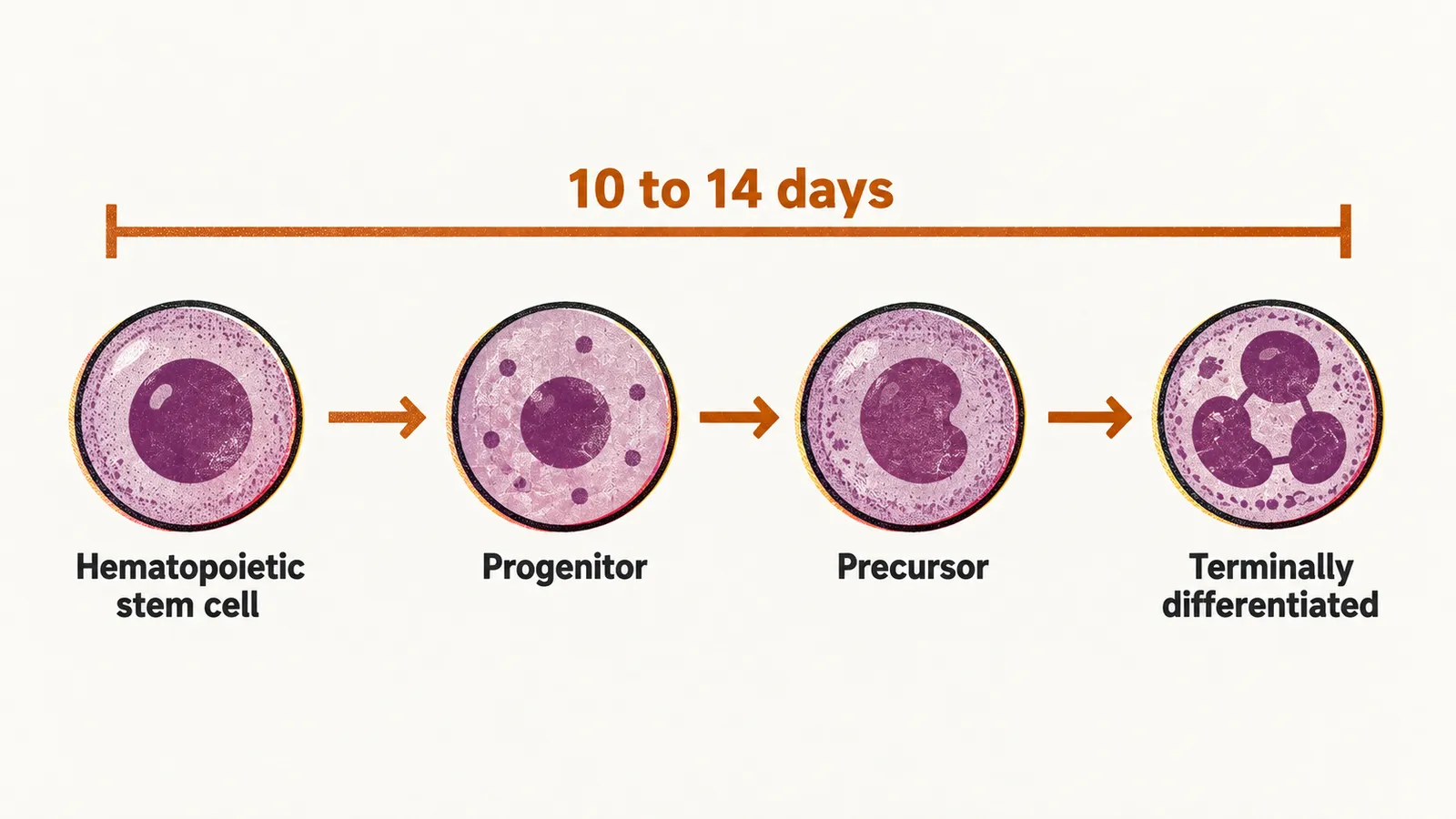
Terminally differentiated blood cells, the fully mature end products that do not change further, arise from HSCs under three broad influences: intrinsic changes in the genes of the cell, the effect of the niche, the supporting microenvironment around the stem cell, and the effect of cytokines, the signalling proteins that act on blood cells. These act together along a fixed sequence, from HSC to progenitor, from progenitor to precursor, and from precursor to the terminally differentiated, functional blood cell. The whole path from HSC to a terminally differentiated blood cell takes about 10 to 14 days.
Loss of plasticity
As a cell travels from HSC to terminal cell, its plasticity, the range of cell types it can still become, falls. A committed progenitor loses the option of other lineages: the progenitor of the myeloid line can no longer produce cells of the lymphoid lineage. Commitment is therefore a narrowing of choices, not only a gain of new features.
Loss of proliferation
Differentiation also usually costs the cell its ability to divide. Most blood cells cannot proliferate once terminally differentiated, except:
- stem cells, by definition;
- memory B and T cells;
- tissue-resident macrophages;
- some myeloid committed progenitor cells.
Because most blood cells cannot divide once they are mature, and they are short-lived, new cells have to come from the cells that can still divide, above all the stem cells.