A multipotent stem cell does not survive anywhere in the body on its own. It occupies a defined tissue microenvironment, the stem-cell niche, which keeps it alive and decides when it stays quiet and when it divides.
The stem-cell niche
Multipotent stem cells are found in one particular part of a tissue, called the stem-cell niche. The niche is more than a location: it is a special microenvironment that lets the stem cell renew itself and differentiate according to the needs of the body. In bone marrow, its main location is in the perivascular regions of the trabecular bones, that is, the tissue around the blood vessels in the spongy inner part of bone, and its content is what makes it special.
Cells and matrix that control the stem cells
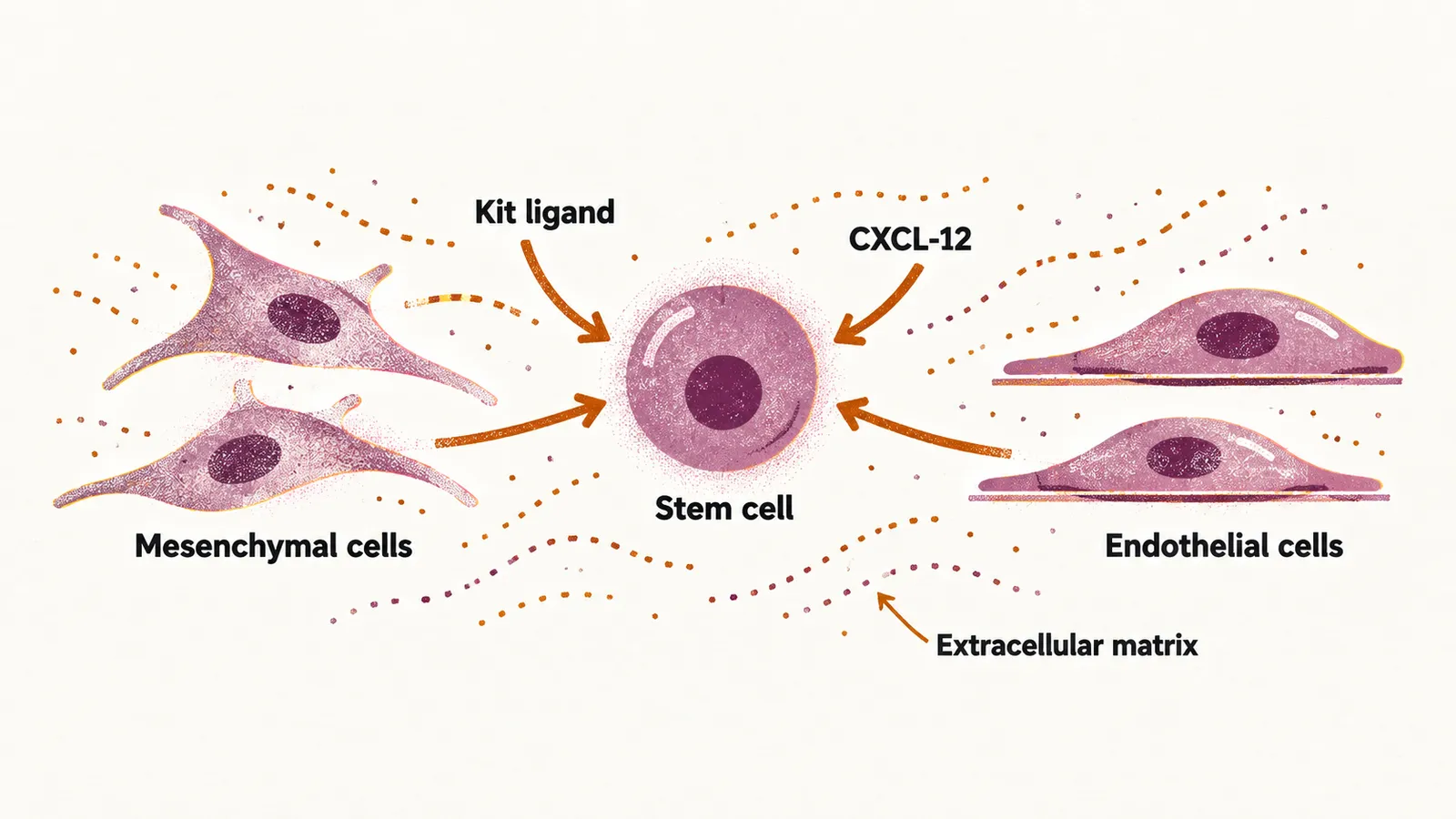
The niche controls the stem cells through signals from its cells and its matrix. Mesenchymal and endothelial cells of the niche produce two signalling molecules, Kit ligand and CXCL-12, which are important for the survival and localisation of hematopoietic stem cells. Other cells control the stem cells too, directly or indirectly: sympathetic neurons, unmyelinated Schwann cells, macrophages, megakaryocytes, and osteoblasts and osteoclasts. Beyond the cells, the extracellular matrix, the material that fills the space between cells, also acts on the stem cells, through molecules such as osteopontin and heparan sulfate.
The niche is therefore a community of supporting cells together with matrix, and the signals it gives shape the fate of the stem cell at its centre.
Quiescence of the multipotent stem cell
Multipotent stem cells in the niche receive particular factors that control their differentiation. A stem cell may remain quiescent, silent, or in a non-dividing state, until it receives a signal of high demand, tissue injury or disease. Quiescence is not a passive default: it is actively maintained by soluble factors and by signals from the other cells of the niche. This matters because dividing less protects the pool from exhaustion and from accumulating damage.
Why mutations in the niche matter
Because it is the cells of the niche, rather than the hematopoietic stem cells themselves, that control the stem cells, a mutation in a niche cell can itself cause disease. For instance, a mutation in niche cells can lead to the formation of a myeloid malignancy.