
Heavy chain diseases are a small group of clonal B-cell and lymphoplasmacytic disorders in which the abnormal clone secretes an incomplete immunoglobulin heavy chain — alpha, gamma or mu — without its matching light chain. Normally the heavy chain is made together with a light chain, so the missing partner is what makes these disorders distinctive.
The three heavy chain diseases
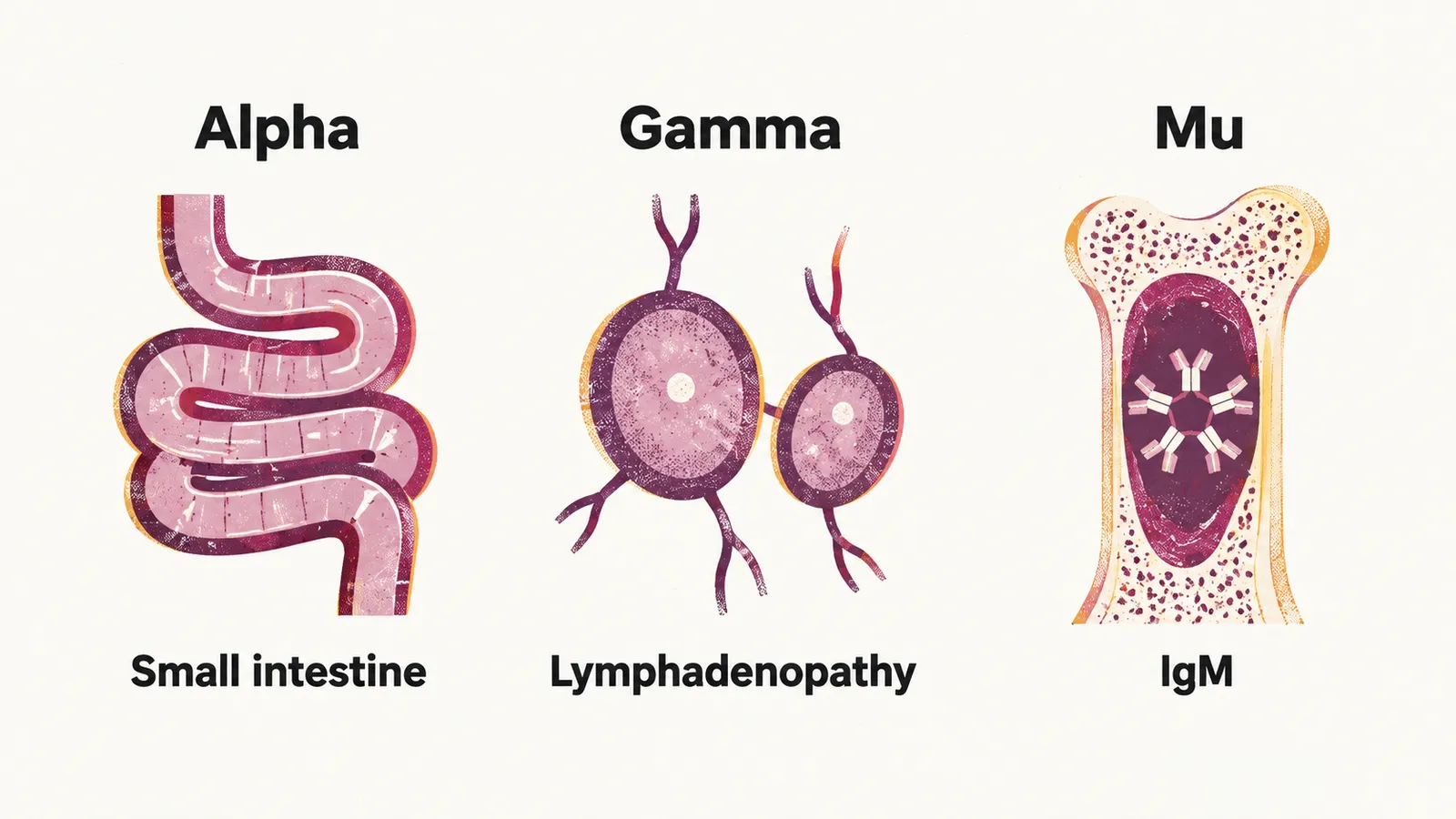
The three forms are named by the heavy-chain class they produce, and each has a different typical site of disease.
Alpha heavy chain disease
Alpha heavy chain disease produces an abnormal IgA heavy chain and usually involves the small intestine, particularly the duodenum and jejunum, a picture called immunoproliferative small intestinal disease (IPSID). It tends to affect younger adults from the Mediterranean and Middle East. The infiltrate thickens the bowel wall, so patients present with chronic diarrhoea, abdominal pain, weight loss and malabsorption, and advanced disease can obstruct or perforate the bowel. Part of the early disease is driven by chronic intestinal bacterial or parasitic infection, which is why the earliest stage can improve with antibiotics.
Gamma heavy chain disease
Gamma heavy chain disease, also called Franklin disease, produces an abnormal IgG heavy chain and is the most variable in its behaviour. It may be entirely asymptomatic, or it may present with lymphadenopathy, splenomegaly, fever, fatigue, weight loss or cytopenias (low blood cell counts), and it is often found alongside an autoimmune disorder or another lymphoproliferative disease.
Mu heavy chain disease
Mu heavy chain disease produces an abnormal IgM heavy chain and is the rarest form. It can look like chronic lymphocytic leukemia or another small B-cell disorder, with hepatosplenomegaly, lymphadenopathy or lymphocytosis, and vacuolated plasma cells in the marrow are a useful clue on the film.
How heavy chain disease is recognised
The defining finding is a monoclonal heavy chain that lacks its light chain. Serum and urine protein electrophoresis and immunofixation are the first tests, but electrophoresis alone can be normal or show only an inconspicuous band, so a negative result does not exclude the diagnosis; immunofixation that specifically checks the heavy-chain class and confirms that no kappa or lambda chain is attached is what makes it. The diagnosis is then completed by sampling the involved tissue — a small-bowel biopsy in the alpha form, a lymph node, marrow or other lesion in the others — where the lymphoplasmacytic infiltrate is seen.
Treatment
Treatment follows the clinical disease rather than the abnormal protein by itself. In early alpha heavy chain disease, treating the underlying intestinal infection — often with a prolonged course of antibiotics even when no organism is identified — can bring about remission, while advanced or antibiotic-refractory disease is treated like a lymphoma. In gamma and mu heavy chain disease, asymptomatic patients may simply be observed, and symptomatic or progressive disease is treated according to the associated lymphoma or clonal disorder. Because these diseases are rare, no single regimen is standard for all patients.