
Dermatomyositis involves skin and muscle together. Weakness follows a proximal symmetric pattern, affecting the muscles nearest the trunk on both sides, that evolves over days to weeks. That subacute tempo sits between the insidious years-long course of muscular dystrophy and the hours-long collapse of rhabdomyolysis, the acute breakdown of muscle. Recognising it early matters because treatment only rescues fibres that have not yet atrophied.
Who develops it
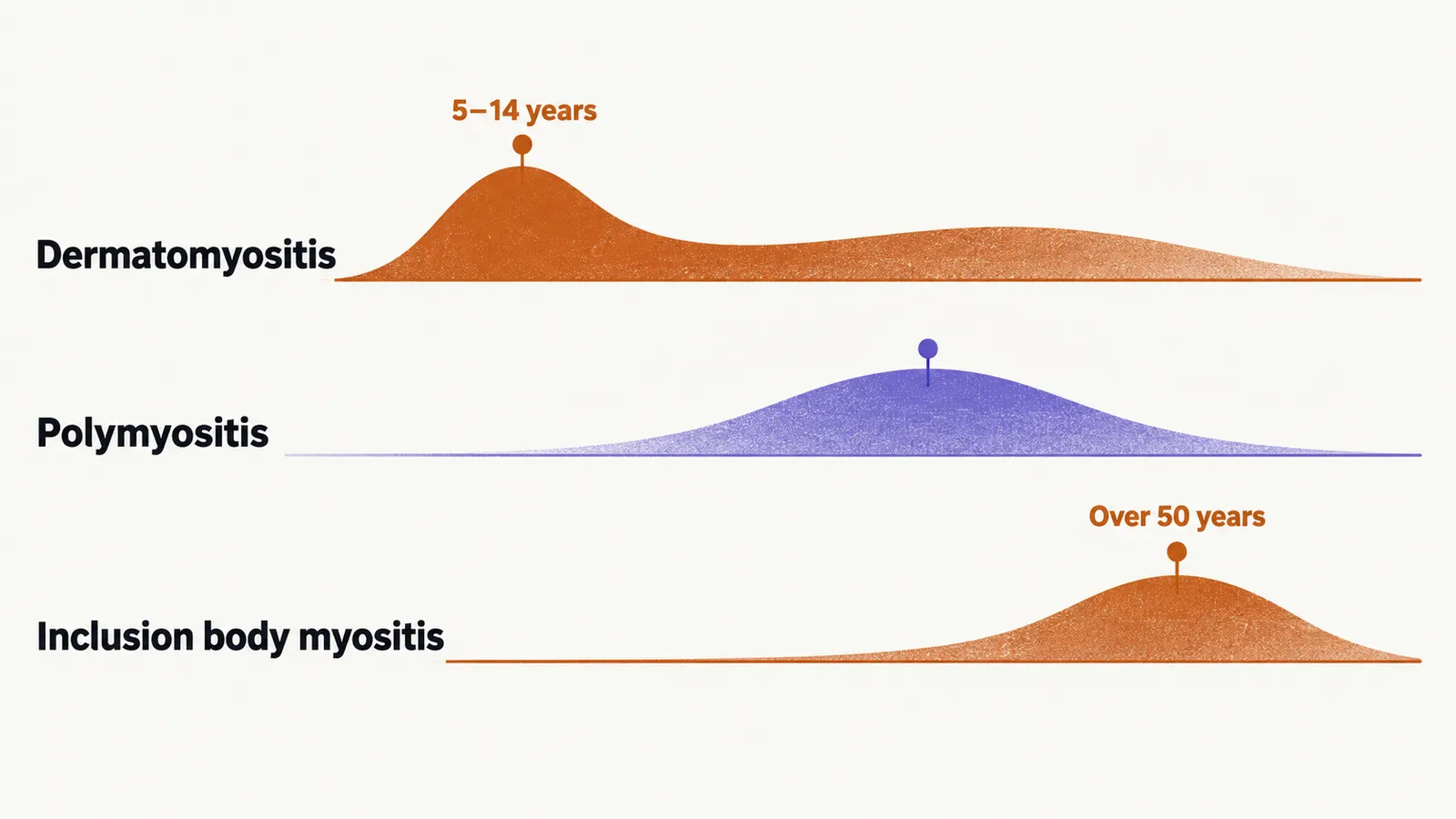
Women are affected roughly 3 times more often than men, and disease can appear at any age with a notable childhood peak between about 5 and 14 years. This breadth contrasts with polymyositis, which is rare in children and centres on middle adulthood, and with inclusion body myositis, which begins after 50. Juvenile disease shares the adult mechanism but calcifies far more often.
Muscle weakness
Weakness concentrates proximally and symmetrically, worse in the legs than the arms. Stairs, low chairs, and car seats expose hip-flexor and quadriceps failure; reaching overhead and hair-combing expose shoulder-girdle failure; neck-flexor weakness can drop the head. Distal strength holds until disease is advanced. About half of patients report muscle pain or tenderness, though weakness dominates rather than pain, which helps separate inflammatory disease from painless endocrine weakness and from the strictly exercise-triggered pain of metabolic myopathy.
Swallowing and speech
Roughly a third develop dysphagia (difficulty swallowing) or dysarthria (impaired speech) from pharyngeal and laryngeal involvement, that is, weakness of the throat and voice-box muscles. Swallowing difficulty deserves formal assessment because aspiration, the entry of food or fluid into the airway, follows it, and its frequency resembles polymyositis more than inclusion body myositis, where severe dysphagia is even more characteristic. The rash, not the swallowing pattern, is what separates dermatomyositis from polymyositis.
Cancer association
Adult-onset disease carries a well-established excess malignancy risk, stronger than in polymyositis and concentrated in older patients. The tumour may surface before, with, or after the muscle disease, sometimes by months or years, and successful cancer treatment can settle paraneoplastic disease, meaning disease driven by the remote effects of the cancer. Age-appropriate screening is therefore part of the initial workup and is repeated if disease resists therapy or recurs after improvement.