Dermatomyositis treatment is not disease-specific, yet it works for most patients when started before irreversible atrophy. The goals are to extinguish inflammation, preserve fibres that are still salvageable, restore strength and daily function, and then hold remission on the smallest durable drug burden. The protocol below is shared with polymyositis, with extra attention to lung disease in anti-synthetase and anti-MDA5 disease, and it does not apply to inclusion body myositis, which resists immunotherapy.
Anti-MDA5 disease with rapidly progressive interstitial lung disease is the exception to stepwise escalation: combination immunosuppression is started early, because there the lung disease, not the weakness, threatens life.
Induction with corticosteroids
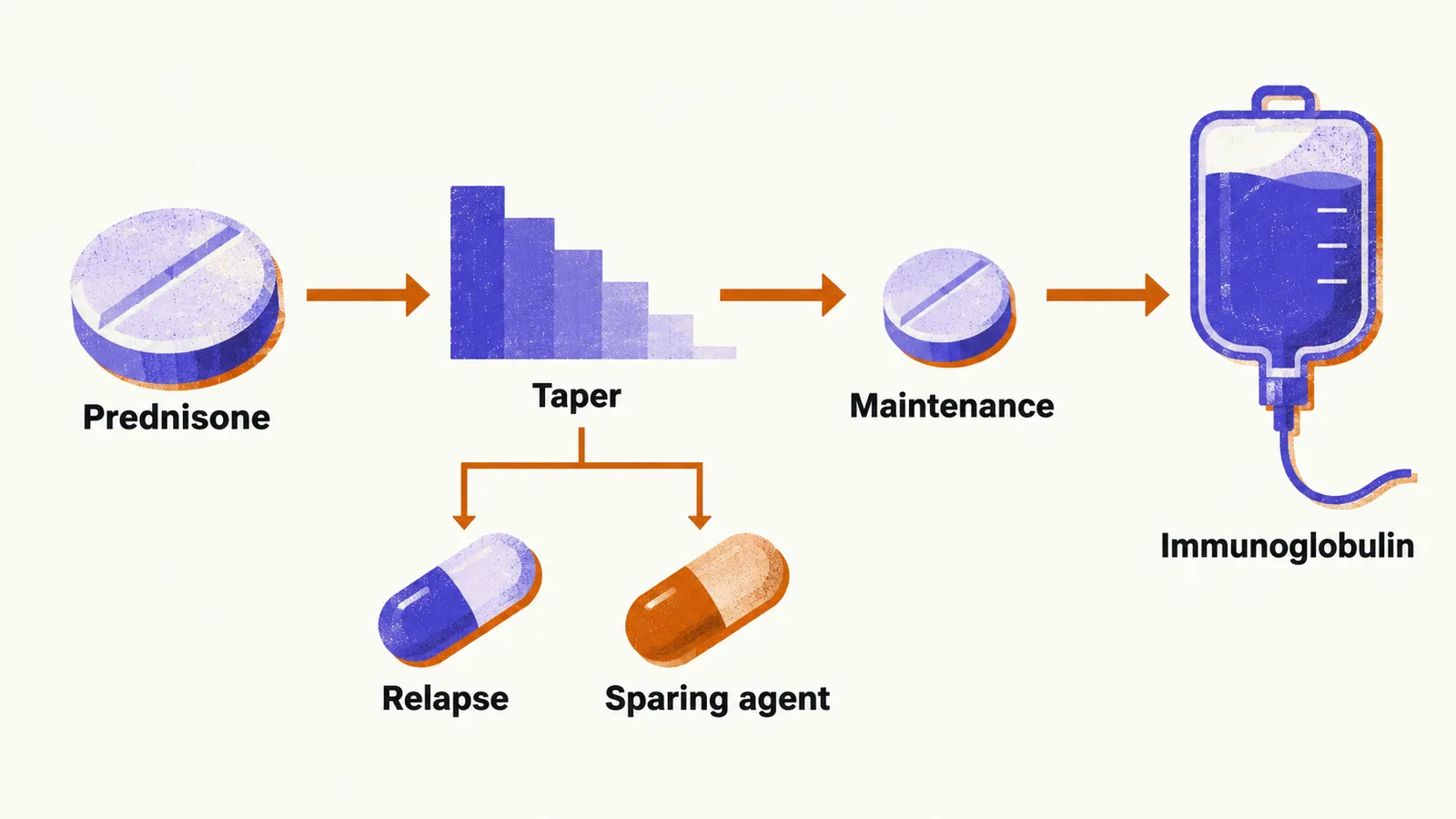
Active disease opens with weight-based oral prednisone, a corticosteroid, classically in the range of 0.8 to 1.5 mg per kg daily, with or without azathioprine from the outset. Steroids suppress the complement-mediated capillary injury and cytokine cascade that drive the disease. Strength and creatine kinase (CK, a muscle enzyme that rises with fibre injury) are reassessed over roughly 4 to 8 weeks, alongside monitoring for weight gain, hyperglycaemia, bone loss, cataract, and infection. Doses are individualised to severity, comorbidity, and current guidance rather than fixed by tradition.
Taper, relapse, and steroid-sparing agents
Once improvement is sustained, prednisone tapers slowly enough to avoid relapse but fast enough to limit toxicity. Relapse during taper, meaning returning weakness, rising CK, or rash, triggers a steroid-sparing agent, a drug that allows the steroid dose to come down: azathioprine, methotrexate, or ciclosporin, chosen by comorbidity and side-effect profile. Azathioprine needs thiopurine-methyltransferase assessment and acts slowly over months; methotrexate acts faster but brings hepatic and teratogenic concerns; ciclosporin brings renal, blood pressure, and interaction burden. Maintenance then settles on low alternate-day prednisone combined with azathioprine or on methotrexate, held long term in many patients because withdrawal invites return.
Rescue and refractory disease
Intravenous immunoglobulin, pooled antibodies given by infusion, rescues refractory disease and steroid-intolerant patients through immunomodulation, including autoantibody neutralisation and complement effects, without adding immunosuppression. A randomised placebo-controlled trial in active dermatomyositis confirmed meaningful improvement with immunoglobulin over placebo, supporting its rescue role. For the small group failing steroids, a sparing agent, and immunoglobulin, historical escalation runs to total lymphoid irradiation or haematopoietic transplantation. Modern practice also weighs B-cell depletion and other biologics for refractory cases; these postdate older teaching protocols, so agent choice should follow current guidelines rather than this note alone.
Malignancy co-management
Paraneoplastic disease, disease driven by the remote effects of a tumour, is treated on two fronts at once. The tumour is managed by its own standards while immunosuppression continues, successful cancer therapy can settle the muscle disease with it, and steroids may need adjustment around cancer immunotherapy. Disease that persists despite adequate immunosuppression, or returns after remission, reopens the malignancy search rather than simply escalating drugs.
The algorithm at a glance
Induction with weight-based prednisone leads to taper on improvement. A smooth taper continues to low maintenance dosing with a sparing agent. Relapse diverts to adding azathioprine, methotrexate, or ciclosporin before returning to maintenance. Refractory disease moves to immunoglobulin rescue and then to exceptional measures, with cancer management running in parallel whenever adult-onset disease or resistance raises the paraneoplastic question.