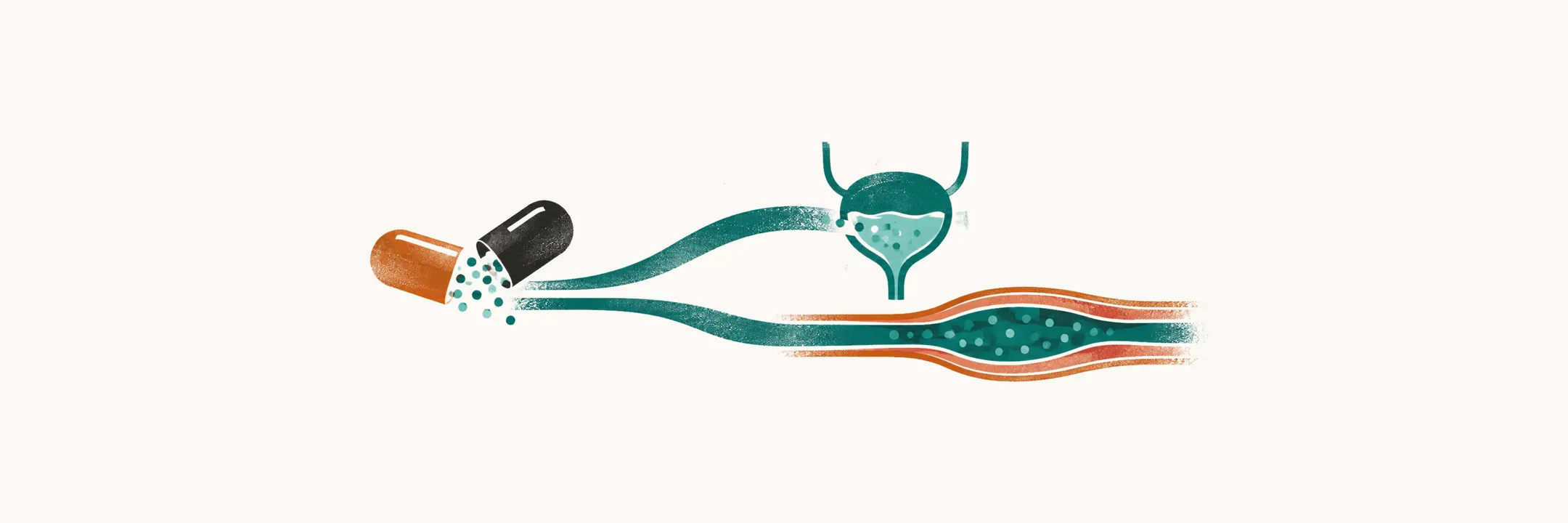
Antibiotic choice in a childhood urinary tract infection (UTI) becomes much easier once the infection is assigned to a compartment. Cystitis, infection limited to the bladder, is a urine compartment problem: the bacteria are in the bladder, and a drug that concentrates in urine can reach them. Pyelonephritis, infection of the kidney, and urosepsis, sepsis arising from the urinary tract, are urine plus blood compartment problems: bacteria have reached the renal parenchyma (the functioning kidney tissue) and may be in the bloodstream, so the drug must achieve adequate concentrations in tissue and blood, not only in urine. Most avoidable treatment errors come from choosing a drug that only satisfies the first compartment.
Drugs that stay in the urine
Fosfomycin is the clearest example. Oral bioavailability — the fraction of a swallowed dose that reaches the bloodstream — is around 40%, and serum concentrations remain low relative to the minimum inhibitory concentrations (the lowest concentrations that stop growth) of the organisms being treated, while urinary concentrations are high. So much so that fosfomycin is licensed for uncomplicated lower urinary tract infection and explicitly not indicated for pyelonephritis or perinephric abscess, a collection of pus around the kidney. It is an excellent urinary tract drug and an inadequate renal parenchymal one. In many countries the oral formulation is licensed for adults and older adolescents rather than young children, so local licensing ages should be checked before prescribing.
Nitrofurantoin works the same way: it concentrates in urine and does not produce useful serum or tissue levels, so it treats cystitis and not pyelonephritis. This makes both drugs useful in the right compartment and dangerous in the wrong one, because a child whose bladder-limited infection is actually an early pyelonephritis will be undertreated.
Oral or intravenous
Route is a separate question from compartment. A drug that reaches tissue and blood can be given by mouth, so pyelonephritis does not by itself demand intravenous treatment. Most children with a UTI who are drinking and not septic can be treated with oral antibiotics, and oral is the preferred route in current guidance for children over 3 months who are not vomiting or severely ill. Intravenous treatment with fluids is reserved for children who cannot tolerate oral medication, who are dehydrated or vomiting, who look septic, or who are under 3 months of age. The route decision is therefore about absorption and severity rather than about the diagnosis itself.
The drug options
With compartment and route settled, the remaining question is which organism the drug has to cover and how likely that organism is to resist it. Treatment usually starts empirically, before the culture result is known, so the choice follows the local antibiogram: the laboratory’s summary of how often the common urinary organisms in that area are susceptible to each antibiotic.
| Drug | Typical role | What to keep in mind |
|---|---|---|
| Amoxicillin alone | Not recommended empirically | Urinary E. coli resistance to ampicillin and amoxicillin is common enough that plain amoxicillin is unreliable without a susceptible isolate |
| Amoxicillin–clavulanate | First-line oral for febrile UTI in Italian and some European guidance; in UK guidance it is used only when the isolate is confirmed susceptible | Resistance varies by region: roughly 10–30% of urinary E. coli in European pediatric series, but about 40% in children with congenital anomalies of the kidney and urinary tract (CAKUT) or a neurogenic bladder (one whose nerve supply is impaired), so local antibiograms matter |
| Cephalosporins (oral cefixime or ceftibuten; IV ceftriaxone or cefotaxime) | Effective and widely used for pyelonephritis; UK guidance uses cefalexin as first-line oral | Very effective but a strong driver of resistance, so they are often described as second-line; third-generation resistance is rising by roughly 1–2% per year in some series |
| Aminoglycosides (gentamicin, amikacin) | IV, particularly in infants with pyelonephritis | Nephrotoxic and ototoxic (toxic to the kidney and to hearing): dose by weight and monitor serum levels, especially with any fall in kidney function |
| Trimethoprim–sulfamethoxazole | Lower urinary tract infection where resistance risk is low | Not a first choice for renal parenchymal infection in most guidance |
| Nitrofurantoin | Lower urinary tract infection when renal function is adequate | No useful tissue levels — cystitis only |
| Fosfomycin | Uncomplicated cystitis | Cystitis only, and licensing varies by age |
| Ciprofloxacin | Reserved, for resistant organisms when alternatives are exhausted | Historically avoided in children because of joint and cartilage effects in juvenile animals; modern pediatric use is more accepted for specific indications but it remains a reserve agent |
Even with the antibiogram as a guide, inadequacy of initial therapy is not rare — a quarter of children in one hospital series needed their antibiotic changed once susceptibilities were available.
How long to treat
Duration follows the compartment too:
- Cystitis is short: UK guidance for children uses 3 days of an oral agent such as trimethoprim or nitrofurantoin.
- Febrile UTI / pyelonephritis is longer: 7–10 days of oral treatment, or 2–4 days of intravenous treatment followed by oral therapy to a total of about 10 days.
- The AAP guideline for febrile infants aged 2–24 months allows 7–14 days of antimicrobial therapy.
Local protocols vary, and where the child sits within those ranges depends on the clinical response and the organism.
The order of operations
Drug, route and duration sit inside a fixed sequence that starts before the first dose:
- Collect the urine specimen before the first dose — antibiotics will suppress the culture.
- Start empiric treatment immediately afterwards, based on the local resistance pattern and the child’s clinical state.
- Review at 48 hours. If the child is not improving, reconsider the diagnosis, the compartment, and whether the organism is resistant or unusual.
- Adjust to the isolate’s susceptibility results when they return, narrowing where possible.
A non-E. coli organism is a signal in both directions: it predicts a higher chance of resistance, and it raises the probability of an underlying structural abnormality, which is a reason to complete imaging even if the infection settles quickly.
At a glance
- Cystitis is a urine problem; pyelonephritis is a urine and blood problem.
- Fosfomycin and nitrofurantoin concentrate in urine and should not be used for pyelonephritis.
- Oral treatment is appropriate for most children over 3 months who are drinking; IV plus fluids for those who are vomiting, dehydrated, septic-looking or under 3 months.
- Amoxicillin–clavulanate is first-line oral in Italian and some European guidance, while UK guidance prefers cefalexin and reserves amoxicillin–clavulanate for susceptible isolates — the local antibiogram decides.
- Cystitis: about 3 days. Pyelonephritis: 7–10 days, or about 10 days in total when treatment starts intravenously.
- Specimen first, antibiotic second, adjustment third.