
Once a child is toilet-trained, the explanation for repeated urinary tract infections often lies less in the kidney’s anatomy than in how the bladder and bowel behave between infections. Bladder and bowel dysfunction (BBD) is the combination of lower urinary tract symptoms with bowel disturbance, usually constipation, and it is one of the most common reasons for recurrence after a first UTI — and one of the few contributors that can be changed at home.
Control develops late
A newborn bladder empties reflexly as it fills, frequently and involuntarily. Voluntary control arrives gradually: daytime continence around age 3 and night-time continence around age 5. Two consequences follow. Bed-wetting before about age 5 is developmental rather than pathological, and a diagnosis of enuresis is not made before then. From age 5 onwards, the distinction between primary enuresis (the child has never been dry) and secondary enuresis (dry for a period, then wet again) becomes clinically useful, because secondary enuresis points towards an acquired problem such as inflammation, constipation or a dysfunctional voiding pattern.
Two opposite patterns
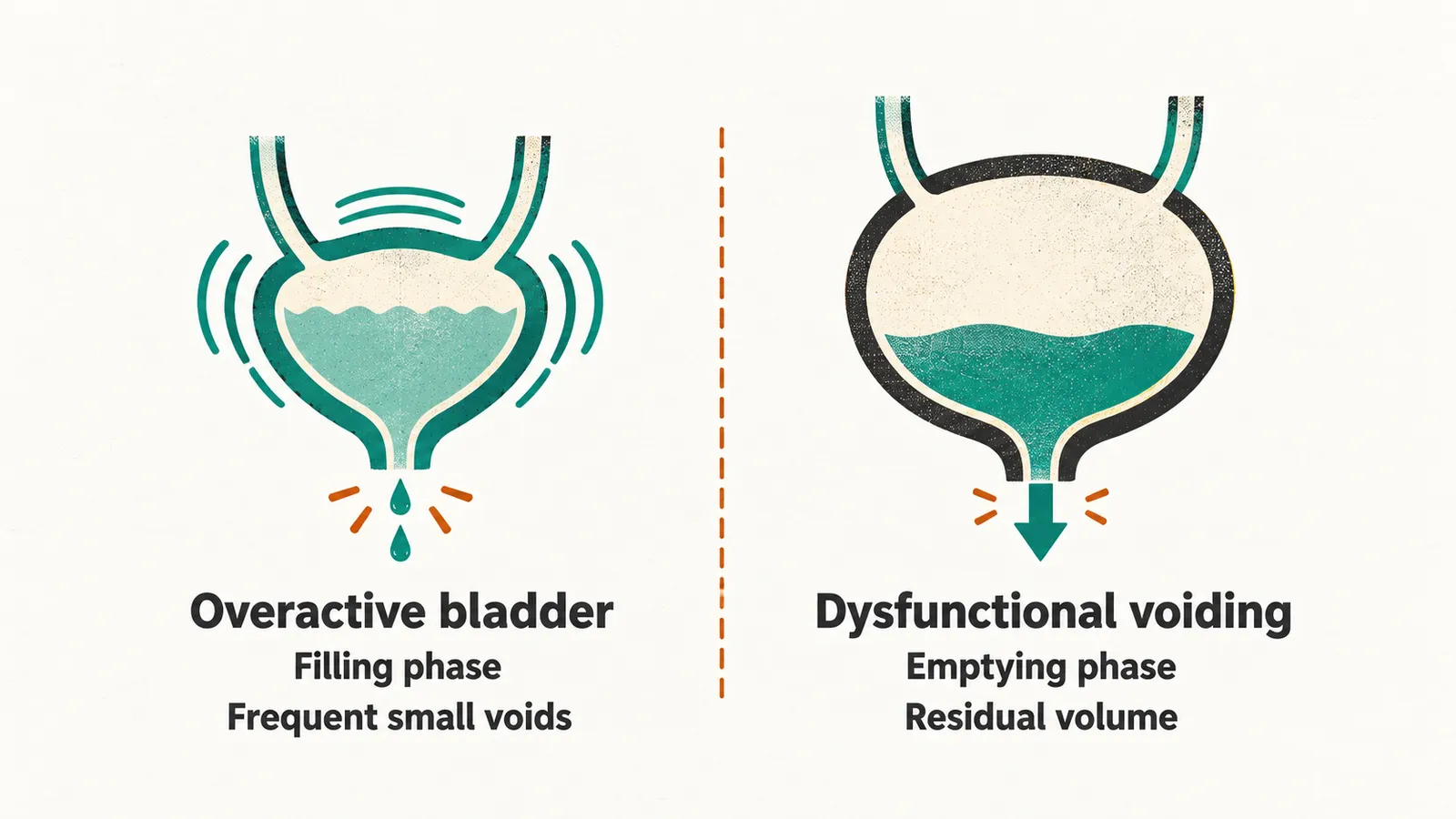
The bladder has two jobs: it stores urine while it fills, and it empties when the child chooses to void. Emptying depends on the detrusor, the muscle of the bladder wall, contracting while the sphincter at the bladder outlet relaxes. Dysfunction can arise in either phase, and the two failures look like opposites.
Overactive bladder is a filling-phase problem: the detrusor contracts before the bladder is full. The child voids often and urgently, in small volumes, and may leak before reaching a toilet. An overactive bladder raises the risk of ascending infection because each contraction can push urine, and bacteria, towards the ureters.
Dysfunctional voiding and the underactive bladder are emptying-phase problems: the detrusor contracts weakly or the sphincter fails to relax. The child voids infrequently and in large volumes, and a residual volume remains after each void. Residual warm urine is a favourable environment for bacterial growth, so this pattern produces cystitis and recurrent infection. It is easily missed because neither the family nor the child recognises infrequent voiding as a symptom.
The voiding history
Because the two patterns look so different, the history has to ask about both filling and emptying, and it is the most productive step in a toilet-trained child with recurrent infection. The items worth covering:
| Item | What it points to |
|---|---|
| Voiding frequency | Fewer than 4 or more than 7 voids a day suggests a storage or emptying disorder |
| Urgency | Sudden, hard-to-defer urge; the bladder contracts during filling rather than gradually |
| Incontinence | Involuntary daytime urine loss |
| Hesitation | Difficulty starting the stream |
| Straining or effort | Abdominal pressure needed to start or maintain voiding |
| Weak or intermittent stream | Reduced flow, stop-start voiding, sometimes spraying |
| Holding manoeuvres | Postponing micturition by crossing the legs, squatting, or sitting on the heel to compress the urethra against it (sometimes called Vincent’s curtsy sign) |
| Post-void dribbling | Loss of urine immediately after the main void |
| Constipation | Hard, infrequent stools or a palpable faecal mass |
Holding manoeuvres usually mean the child is fighting a detrusor contraction rather than being inattentive or lazy, so they are a diagnostic finding rather than a behavioural quirk.
Frequency thresholds
The International Children’s Continence Society treats 4–7 voids a day as normal daytime frequency for a child. Eight or more (after ruling out high fluid intake and diabetes insipidus) constitutes increased daytime frequency, and three or fewer constitutes decreased daytime frequency. Both extremes matter, because they represent opposite failure modes: the frequent small voids of an overactive bladder and the infrequent large voids of dysfunctional voiding.
Constipation, and why it causes urinary infection
The Paris Consensus on Childhood Constipation Terminology (PACCT) defines chronic constipation as at least 2 of the following over the preceding 8 weeks:
- Fewer than 3 bowel movements per week
- More than 1 episode of faecal incontinence per week
- A large faecal mass in the rectum, or one palpable on abdominal examination
- A stool large enough to obstruct the toilet
- Retentive posturing or stool withholding
- Painful defecation
The Rome IV criteria for functional constipation cover the same domains with age-specific wording and a shorter minimum duration of about 1 month, so the definition in use depends on the reference being applied.
The mechanism connecting the bowel to the bladder is mechanical. The rectum lies directly behind the bladder, and a loaded rectum compresses it, so the bladder cannot empty completely. The result is a high residual volume with stasis, functional obstruction and bacterial proliferation — the same conditions that predispose to ascending infection. Treating the constipation can therefore interrupt a recurrent infection cycle without any change to the kidney or ureter.
Why BBD matters as much as reflux
BBD and vesicoureteral reflux — the backflow of urine from the bladder up the ureter towards the kidney — are not competing explanations; they compound each other. Reflux gives urine a route upwards, and a bladder that contracts against a full rectum or empties incompletely supplies the pressure and the residual urine to use it. Children with both have a higher risk of recurrent infection and renal damage than children with either alone. In the RIVUR trial, which studied antibiotic prophylaxis in children with reflux, children with bladder and bowel dysfunction at baseline had more recurrent urinary tract infections, and the absolute benefit of prophylaxis was larger in that group.
The management order
The order follows from the mechanisms above: the bowel comes first because a loaded rectum keeps the bladder from emptying, and imaging comes last because its findings are not interpretable until the functional problem is treated.
- Take the voiding history in a structured way, ideally supported by a frequency–volume chart, a diary of the time and volume of each void.
- Diagnose and treat constipation first — adequate fluid and fibre, unhurried toilet time after meals, and an osmotic laxative such as polyethylene glycol where needed. It is treated as first-line in a toilet-trained child with recurrent infection, and it is the one step the family can carry out at home.
- Treat the bladder pattern. Overactive bladder responds to scheduled voiding, bladder training and sometimes anticholinergics; dysfunctional voiding responds to timed and double voiding (voiding a second time shortly after the first), relaxation techniques and, in resistant cases, pelvic floor physiotherapy.
- Re-image only if symptoms persist after the bowel and bladder are managed.
The reasoning error to avoid is repeating imaging in a child with recurrent cystitis and unrecognised constipation. A child who holds urine and stool does not need a second cystogram before the bowel has been dealt with; the imaging findings will not be interpretable until the functional problem is treated.
At a glance
- Voiding history first in every toilet-trained child with recurrent UTI.
- Normal frequency is 4–7 voids a day; 8 or more and 3 or fewer are both abnormal.
- Overactive bladder voiding is frequent, urgent and small-volume; dysfunctional voiding is infrequent, large-volume and leaves a residual.
- Constipation is defined by at least 2 of the PACCT items over 8 weeks, and a loaded rectum compresses the bladder, causing stasis and infection.
- BBD and reflux worsen each other, and children with both are at highest risk.
- Treat the bowel, then the bladder, then re-image if symptoms persist.